
Fill a gallon jug from the tap, wrap it in a hand towel, and slide it into an old backpack. That’s 8.3 pounds (3.8 kg): about 5% of a 165-lb (75 kg) adult, and close to where a careful first ruck should start. Most people who quit rucking don’t quit because it was too easy. They quit because week one hurt.
Quick answer: To start rucking after 35, walk 20–30 minutes on flat ground carrying 5–10 lb (2–4.5 kg), or about 5% of your body weight, in a snug backpack, twice a week. Keep a pace you can talk at (around 20 minutes per mile). Change only one thing per week: time, distance, or weight. Add weight in small steps (about 2 lb / 1 kg) only after your current load feels easy. Never run with the pack.
What rucking is, and why it suits midlife
Rucking is walking with weight on your back. The word comes from the military rucksack, but the civilian version is calmer: a backpack, a few pounds, and a route you already know. Cleveland Clinic sports medicine physician Matthew Kampert, DO, calls it “urban hiking” and describes three things you can adjust: the weight, the distance, and how long you walk.
Why it fits adults 35 and older:
- It counts twice. The Physical Activity Guidelines for Americans ask adults for 150–300 minutes of moderate aerobic activity a week plus muscle-strengthening work on 2 or more days. A loaded walk is aerobic, and it makes your legs, back, and trunk hold a load. It doesn’t replace strength training, but it makes walking time work harder.
- The dial is fine-grained. You can add 1 lb at a time. Few workouts let you progress that gently.
- It is still walking. No jumping, no gym, and no new skill to learn. If you can walk 30 minutes comfortably today, you have the base.
What rucking won’t do: it won’t “melt” anything, and nobody has run a trial showing it prevents a specific disease. The honest pitch is that it makes walking harder in a controllable way, and the evidence behind that is solid. Load-carriage research summarized by Army scientist Joseph Knapik and colleagues shows that energy cost rises with the weight carried, your body mass, walking speed, and grade.
Before your first ruck: a 5-minute readiness check
Answer these honestly before adding any weight:
- Can you walk 30 minutes at a steady pace without pain the next day?
- Do you have current back, neck, hip, knee, or foot pain? (If yes, get it checked first. Harvard Health says people with neck or back pain should avoid rucking.)
- Are you pregnant, or managing a heart, lung, or bone condition? Talk to your clinician before you load up.
If you can’t yet walk 30 minutes, spend 2–4 weeks building to it with no pack. Cleveland Clinic’s advice is the same: a light load can mean an empty pack while you find out how many minutes feel comfortable.
Gear: what you need and what can wait
You can start this week with things you already own. Spend money only after a month of rucks tells you what bothers you.
| Item | Start with | Upgrade when… |
|---|---|---|
| Pack | A sturdy backpack with wide, padded straps and a chest or waist strap | The load bounces, sags low, or digs into your shoulders |
| Weight | Water jugs, wrapped books, rice bags, or a dumbbell wrapped in a towel (weigh it) | You want a flat load that sits high and still; that’s what ruck plates are for |
| Shoes | Your current walking shoes, if they’re supportive and not worn out | You get hot spots, or the shoes are past their mileage |
| Socks | Synthetic or wool, not cotton | You blister anyway; then try a thin liner sock underneath |
| Tracking | Your phone’s walking app, plus a note of the weight you carried | Rarely necessary |
Two packing rules come straight from military load research. First, keep the weight high and tight against your back. Loads close to your own center of mass cost the least energy and keep you more upright, and high placement works best on even ground (Knapik et al., 2004). Second, use a hip belt if your pack has one. The U.S. Army’s injury-prevention fact sheet notes that a properly adjusted hip strap can take about 30% of the load off your back.
We haven’t reviewed rucking packs or plates yet. When we do, every pick will be carried on logged miles first; the method is at How We Test, and reviews will live in Gear Lab.
How much weight to start with
Medical sources cluster in a narrow band. Cleveland Clinic suggests a first ruck might start with 5 pounds, even if you lift weights. Physicians quoted by UCLA Health suggest about 5% of body weight for weighted walking. Harvard Health puts the ceiling for starters at about 10% of body weight.
Our rule for beginners over 35: start at 5% of body weight or 5–10 lb, whichever feels easier, and treat 10% as the target for the end of month one or two, not the starting point. No trial has established an “optimal” beginner load, so that rule is a conservative reading of the guidance, not a proven number. For a personal number and a 6-week progression, use our ruck weight calculator.
| Body weight | Week 1 (≈5%) | Month 1–2 target (≈10%) |
|---|---|---|
| 130 lb (59 kg) | 6–7 lb (3 kg) | 13 lb (6 kg) |
| 160 lb (73 kg) | 8 lb (3.5 kg) | 16 lb (7 kg) |
| 190 lb (86 kg) | 9–10 lb (4.5 kg) | 19 lb (8.5 kg) |
| 220 lb (100 kg) | 10–11 lb (5 kg) | 22 lb (10 kg) |
Why not start heavier? Lifting and carrying aren’t the same stress. In Dr. Kampert’s words, “Lifting weights at the gym isn’t the same as carrying 20 pounds on your back for several miles.” The tissues that complain first (feet, shins, the front of the knee, the tops of the shoulders) adapt more slowly than your heart and lungs.
Form: how to ruck without a sore back
- Stand tall. Ribs stacked over hips, shoulders back and down. A slight forward lean is normal as weight goes up; a hunch is a sign the load is too heavy or riding too low.
- Snug every strap. Shoulder straps first, then the chest strap, then the hip belt. The pack shouldn’t sway when you twist.
- Keep your normal stride. Shorter, choppier steps or a waddle mean you should drop weight.
- Walk, don’t run. The Army advises against loaded speeds above 4 mph. For beginners, about 3 mph (a 20-minute mile, or 12.5 min/km) is plenty.
- Go easy on hills at first. Uphill raises the effort; downhill loads your knees and quads. Add them in week 3 or later.
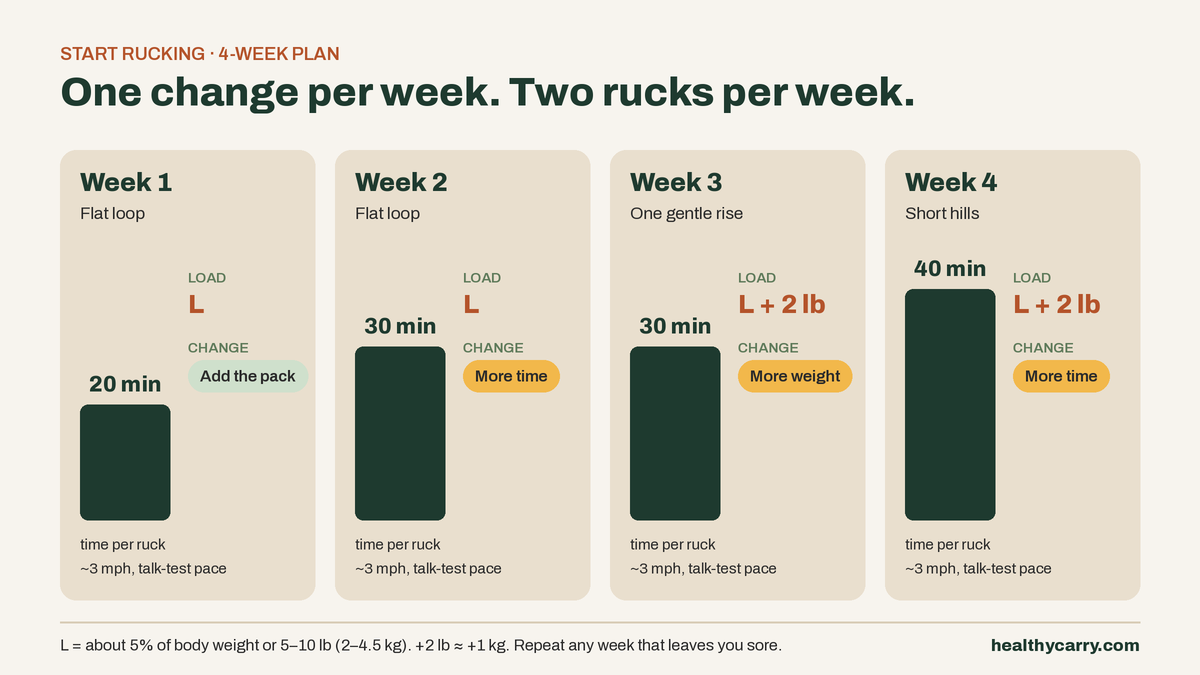
Your 4-week Start Rucking plan
This plan follows one rule borrowed from both civilian and military guidance: change one variable at a time. Cleveland Clinic suggests raising one component by about 10% a week. The Army fact sheet advises raising distance and load on separate days, by about 10% each time.
Use your week-1 load from the table above (call it “L”). Ruck on non-consecutive days, and keep your other walks unloaded.
| Week | Rucks | Load | Time per ruck | Route | The one change |
|---|---|---|---|---|---|
| 1 | 2 | L (≈5% BW or 5–10 lb) | 20 min | Flat loop | Add the pack |
| 2 | 2 | L | 30 min | Flat loop | More time |
| 3 | 2 | L + 2 lb (1 kg) | 30 min | Flat, one gentle rise | More weight |
| 4 | 2–3 | L + 2 lb (1 kg) | 40 min | Mixed, short hills | More time |
On two other days each week, do 20 minutes of simple strength work: sit-to-stands, step-ups, glute bridges, wall push-ups, and a light farmer’s carry. That covers the strength days in the federal guidelines, and older adults should add balance work too (HHS, 2018). The pairing matters: a systematic review of military training found that load-carriage speed improved most with programs of about 3 sessions a week that mixed resistance and aerobic work with a once-weekly progressive loaded march.
How to know you’re ready for the next week: you finished every ruck at a pace you could talk at, nothing hurt the next morning beyond normal muscle tiredness, and your feet came home without blisters. If any of those failed, repeat the week. Repeating a week is part of the plan.
Why slow progression actually works
This isn’t just caution for its own sake. When U.S. Marine Corps recruit training switched to a periodized, progressive load-carriage program, the share of recruits injured fell from 58% to 39%, even though they did more loaded hikes (relative risk 0.68). Recruits aren’t 45-year-olds, but the principle carries over: the same work, built up gradually, breaks fewer people.
Rucking vs. walking vs. a weighted vest
| Plain walking | Rucking (backpack) | Weighted vest | |
|---|---|---|---|
| Where the load sits | None | On your back; shifts your center of gravity backward | Spread around your torso |
| Best for | Building a base, recovery days | Longer outdoor walks, carrying water and layers | Shorter walks, treadmill, chores; people who feel less steady |
| Cost to start | $0 | $0 (backpack you own) | A vest, often $30 and up |
| Watch-outs | Can plateau | Shoulder pressure, blisters on longer routes | Fit across the bust and short torsos; heat |
UCLA sports medicine surgeon Sharon Hame, MD, notes that a vest may be the better choice if you’re concerned about stability or your back, because a backpack moves your center of gravity. If that’s you, read our guide to weighted vest walking before buying anything.
Safety first. Stop and drop weight if you feel joint pain (not just tired muscles), numbness or tingling in your arms or hands, a new limp, dizziness, or chest discomfort. Numbness can come from straps pressing on nerves, which the Army calls “rucksack palsy”. Loosen or adjust the straps right away. Foot pain that sharpens over days, rather than fading, needs a clinician; heavy loads too soon can lead to stress fractures. If you have a heart, bone, joint, or spine condition, or you’re pregnant, get medical clearance first. This guide is general education, not medical advice.
Common beginner mistakes
- Starting at 20 lb because it “felt fine” in the kitchen. Weight feels light for five minutes. Judge a load by how you feel the next morning.
- Adding weight and distance in the same week. Pick one.
- Rucking every day. Military guidance spaces loaded marches about a week apart and suggests more than four a month may be excessive for soldiers (U.S. Army Public Health Center). Two or three short rucks a week is plenty for civilians starting out.
- Letting the load ride low. Pad the bottom of the pack with a towel or foam so the weight sits between your shoulder blades.
- Cotton socks. Foot blisters top the list of common load-carriage injuries in military research (Knapik et al., 2004). Synthetic socks and a liner help.
Where to go after week 4
Keep adding about 2 lb (1 kg) every two weeks, alternating with time increases, until you reach roughly 10% of your body weight for 45–60 minutes. Some people stop there for good, and that’s a complete, useful habit. Others move on to hills, longer weekend rucks, or loaded carries; we cover those in Train. If you’re rucking for bone or joint reasons in midlife, our Carry for Life section looks at what the research does and doesn’t show. And if you’re pairing rucking with a protein or creatine plan, see Fuel.
FAQ
How much weight should a beginner ruck with?
Start with about 5% of your body weight or 5–10 lb (2–4.5 kg), whichever feels easier. Work toward roughly 10% over the first one to two months. If you’re new to exercise, walk with an empty pack for a week or two first.
How often should I ruck as a beginner?
Two times a week on non-consecutive days is a solid start, with unloaded walks and two short strength sessions on other days. Move to three rucks a week only after a month without aches.
Is rucking bad for your knees or back?
For most healthy adults who start light, it’s a low-impact activity. Problems usually come from too much weight too soon, a load riding low, or downhill walking before you’re ready. If you already have back, neck, or knee pain, see a clinician or physical therapist before adding weight.
Can I use a regular backpack for rucking?
Yes. Choose a sturdy one with wide shoulder straps and a chest or waist strap. Pack the weight high and tight, and fill gaps with a towel so nothing shifts. A dedicated rucking pack becomes worth it when you carry more than about 15–20 lb or the load bounces.
How fast should I walk when rucking?
About 3 mph (a 20-minute mile, or 12.5 min/km) is a good beginner pace: you should be able to talk in full sentences. Don’t run with a loaded pack; Army guidance discourages loaded speeds above 4 mph.
Is rucking good for women over 40?
It can be a practical way to add load to walking without a gym. The same start-light rules apply. If balance or back comfort is a concern, a weighted vest may suit you better than a backpack. Claims about bone density should be read carefully; the evidence for loaded walking alone is still thin.
Get the free 4-week Start Carrying plan: a printable version of this plan with a weekly log, sent to your inbox.
Sources
- Cleveland Clinic. “Should You Add Rucking to Your Workout?” (2024). health.clevelandclinic.org/what-is-rucking
- U.S. Department of Health and Human Services. Physical Activity Guidelines for Americans, 2nd edition (2018). odphp.health.gov (PDF)
- Knapik JJ, Reynolds KL, Harman E. “Soldier load carriage: historical, physiological, biomechanical, and medical aspects.” Military Medicine (2004). PubMed 14964502
- U.S. Army Public Health Center. “Foot Marching and Load-Carriage Injuries,” Fact Sheet 12-008-0522 (2022). ph.health.mil (PDF)
- Knapik JJ, et al. “A systematic review of the effects of physical training on load carriage performance.” Journal of Strength and Conditioning Research (2012). journals.lww.com
- “Profiling injuries sustained following implementation of a progressive load carriage program in United States Marine Corps recruit training.” Work (2024). PubMed 38552130
- UCLA Health. “Should you walk with a weighted vest?” (2025). uclahealth.org
- Harvard Health Publishing. “What are the benefits of walking with a weighted vest?” (2025). health.harvard.edu
