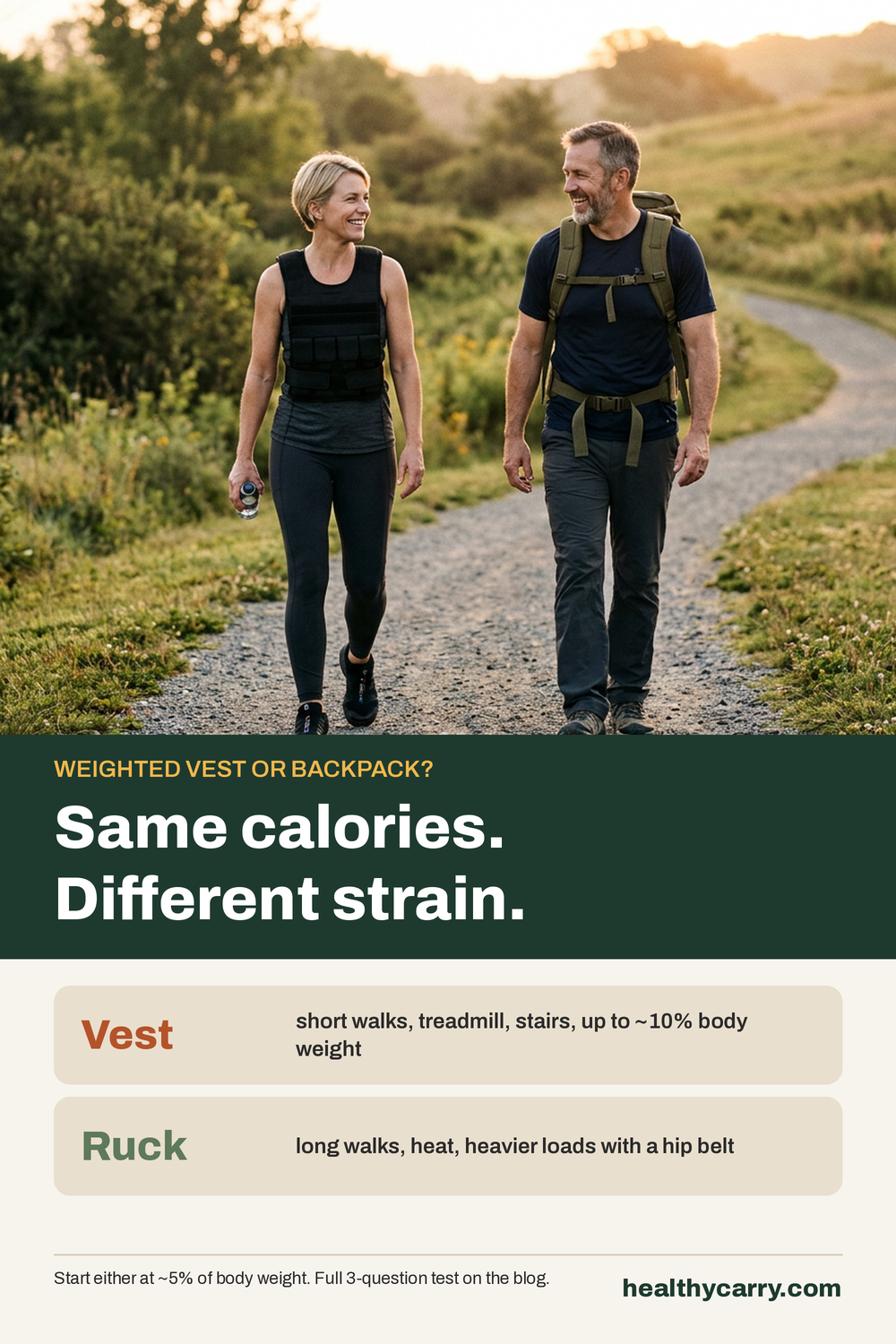
Here’s a result most “vest vs ruck” posts skip: when researchers had experienced load carriers walk 3 miles at 4 mph carrying 45 lb, once in a weighted vest and once in a backpack, the average oxygen cost came out 1,625.9 vs 1,625.6 mL per minute. Practically identical. So the calorie argument is a wash. The real differences are where the weight sits, how your body reacts to it, and which one you’ll still be using in March.
Quick answer: Weighted vest vs rucking: at the same load, they burn about the same energy. Pick a weighted vest for short walks, treadmills, stairs and loads up to about 10% of body weight. Pick a rucking backpack with a hip belt for longer outdoor walks, heavier loads, hot weather and carrying water. Both should start at about 5% of body weight.
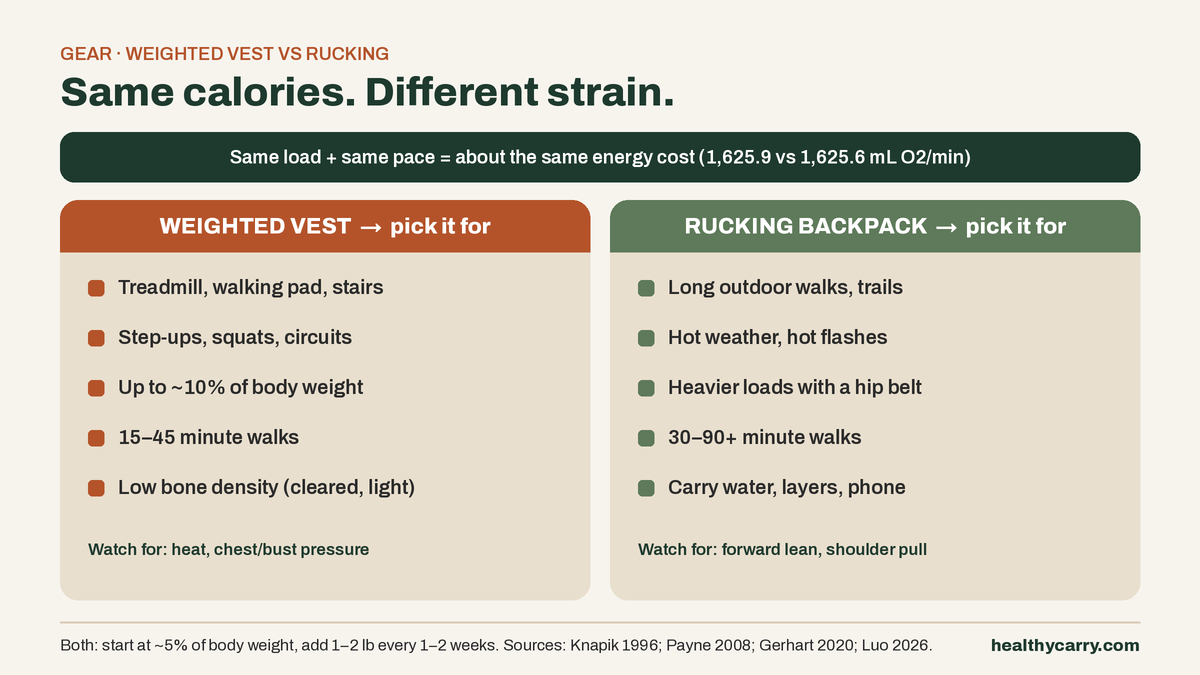
Weighted vest vs rucking: what’s actually different?
Both tools add load to a walk. The difference is placement.
- A weighted vest splits the load front and back, tight to your torso. That keeps the combined center of mass close to where it already is, so your walking pattern changes less.
- A rucking backpack puts the load behind you. To stay balanced, you lean forward slightly, and the heavier the pack, the more you lean. A good pack moves some of the weight to your hips with a belt.
A classic US Army review of load carriage found exactly this pattern: front-and-back “double packs” (the closest thing to a vest) had a lower energy cost and fewer deviations from normal walking than backpacks, but backpacks were more versatile. Heavier backpacks increased forward trunk lean, knee bend and ground forces. Framed packs with hip belts reduced shoulder-muscle activity.
In practice, at the light loads most of us use for fitness walking (5 to 20 lb), the energy difference shrinks to almost nothing. The 45-lb comparison above found no meaningful gap. It’s comfort, posture and convenience that separate them.
Is a weighted vest or a rucking backpack better for women over 40?
Neither wins outright, but a few things matter more for women in midlife:
- Chest and bust fit. Vests sit on the chest. Many are cut for flat torsos, and a poor fit means pressure, rubbing or a vest that rides up. A backpack leaves the chest open, though a sternum strap still needs to sit above or below the bust, not across it.
- Heat and hot flashes. A vest covers most of your torso. If you run hot, a backpack with a breathable back panel is usually the cooler choice.
- Endurance. In a small study of nine recreationally fit women doing a treadmill test to exhaustion, they lasted significantly longer in an evenly distributed vest than with a rucksack at the same load, even though oxygen use and heart rate peaked at similar levels.
- Bones and posture. If you have low bone density, a load that pulls you into a forward lean is worth thinking about. A vest keeps the trunk more upright. Either way, keep the load light and ask your clinician or a physical therapist first.
One more thing the research is clear on: how you use the load matters more than which tool carries it. A 2026 review of weighted-vest trials in adults 60+ found that low loads worn during daily life (3–5% of body weight, 2 hours a day) generally didn’t improve muscle or bone. The benefits showed up in structured, progressively loaded sessions: walking, step-ups, stairs and squats at 5–10% of body weight.
The side-by-side comparison
| Factor | Weighted vest | Rucking backpack |
|---|---|---|
| Energy cost at the same load | About equal | About equal |
| Where the load sits | Front + back, tight to torso | Behind you, high on the back |
| Posture effect | Stays more upright | Slight forward lean, more with weight |
| Comfortable load range | About 5–10% of body weight for walking | 5% to start; 15–20%+ with training and a hip belt |
| Session length sweet spot | 15–45 minutes | 30–90+ minutes |
| Treadmill, stairs, step-ups, squats | Better: no swing, arms free | Works, but can shift on squats |
| Heat | Hotter: covers the torso | Cooler front; sweaty back |
| Carries water, layers, phone | Little or none | Yes |
| Chest/bust fit issues | Common | Rare (check sternum strap) |
| Cheapest way to try it | Need a vest | Any snug backpack you own |
| Small weight steps | Easy if it has small pockets | Easy with water bottles or small plates |
HealthyCarry summary of the load-carriage studies listed in Sources plus practical fit factors. Load ranges are starting guidance for healthy adults, not limits proven in trials.
Which should you choose? A 3-question test
Answer these honestly, and the choice usually makes itself.
1. Where will you do most of your walking?
Treadmill, walking pad, stairs or a mix of walking and bodyweight moves: vest. Sidewalks, parks and trails for 30 minutes or more: backpack.
2. How heavy do you want to go eventually?
If 10% of your body weight (15 lb at 150 lb) is plenty, a vest covers you. If you want to work toward 20–30 lb for hikes or ruck events, a backpack with a hip belt handles heavier loads more comfortably over time.
3. What’s going to make you quit?
If it’s heat, chest pressure or a vest that doesn’t fit your shape, go backpack. If it’s a pack bouncing on your back or pulling your shoulders, go vest. The best tool is the one you’ll put on three times a week.
| Your situation | Our pick | Why |
|---|---|---|
| Total beginner, unsure you’ll stick with it | Backpack you own | Free to test with 5–8 lb of water bottles or books |
| Walking pad at your desk | Vest | Doesn’t press into a chair back, arms stay free |
| Hot climate or hot flashes | Backpack | Chest and belly stay uncovered |
| Hikes or a ruck event on the calendar | Backpack + hip belt | Trains the exact load you’ll carry |
| Walk + step-ups/squats circuit | Vest | Load doesn’t swing or shift |
| Low bone density, cleared to exercise | Vest, light | More upright trunk; start at 5% or less |
| Neck, shoulder or back pain | Neither yet | Get checked first; both load the spine |
How much weight should you start with in each?
The same starting rule works for both: about 5% of your body weight, then add 1–2 lb every week or two only while your posture and stride stay normal.
| Body weight | Start (5%) | Typical vest ceiling for walks (10%) | Backpack after 2–3 months (15%) |
|---|---|---|---|
| 130 lb (59 kg) | 6–7 lb | 13 lb | about 20 lb |
| 150 lb (68 kg) | 7–8 lb | 15 lb | about 22 lb |
| 170 lb (77 kg) | 8–9 lb | 17 lb | about 25 lb |
| 190 lb (86 kg) | 9–10 lb | 19 lb | about 28 lb |
| 210 lb (95 kg) | 10–11 lb | 21 lb | about 31 lb |
HealthyCarry starting points, rounded. If you’re new to exercise or over 65, start nearer 3%. For a personal number and a 6-week progression, use the ruck weight calculator.
Why does the vest column stop at 10%? Most medical guidance for walking vests caps them around there, and the trials in older adults rarely went higher for walking. Backpacks spread heavier loads better once a hip belt takes some of the weight, which is why rucking programs progress further. That’s a comfort and tolerance difference, not proof that heavier is better.
How to wear each one so it doesn’t hurt
Weighted vest
- Snug enough that it doesn’t bounce when you walk fast, loose enough to take a full breath.
- Load the weights evenly, front and back. Lopsided pockets twist your torso.
- Shoulder pads matter. If your traps ache after 20 minutes, the vest is too heavy or too loose.
- Start with shorter walks than usual: 15–20 minutes, or less than half your normal distance.
Rucking backpack
- Keep the weight high and tight against your back. Loads that sag low increase forward lean.
- Use a sternum strap and, above about 15 lb, a hip belt.
- Stand tall from the ankles. A small lean is normal; a hunch means the pack is too heavy.
- Pad hard plates with a towel or foam so nothing digs into your spine.
When to skip both (or ask first): neck or back problems, spinal stenosis, a recent fracture, hip or knee arthritis that flares with load, uncontrolled heart or lung disease, balance problems or pregnancy. Stop for sharp pain, numbness or tingling in your arms, dizziness or a change in how you walk. Never run with either.
Can you use a weighted vest for rucking?
Yes. Rucking just means walking with load, and a vest does the job for walks up to about 45 minutes. Where vests struggle is long distances and heavier loads: shoulders and traps take most of the weight because there’s no hip belt. If you’re walking past an hour or carrying more than about 20 lb, a pack usually feels better.
Do you burn more calories with a vest or a backpack?
About the same at the same weight and pace. Energy cost depends mostly on total mass moved, speed, slope and terrain. The 45-lb study found no difference in average oxygen use, though it noted women used slightly more with the vest and men with the backpack. A 2024 military study built a separate equation for vest loads because they behave a little differently, but the differences are small next to speed and hills. For your own estimate, plug load, pace and grade into the rucking calorie calculator.
If you’re walking for your bones, pace may matter more than gear. A 2026 analysis of 124 trials linked about 140 minutes a week of brisk walking to meaningful bone-density benefits. We broke down how much walking for bone density that really means.
The bottom line
Don’t buy anything yet. Load 5–8 lb into a backpack you already own and walk 20 minutes, three times this week. If it bounces, rubs or makes you hot, you’ve learned what to look for in a vest. If it feels fine, you may never need one. Either way, the walk is doing the work. New to all of this? Start with how to start rucking or weighted vest walking, and browse the rest of Gear.
FAQ
Is a weighted vest safer than a rucking backpack?
Neither is automatically safer. A vest keeps the trunk more upright and changes your gait less, while a backpack with a hip belt handles heavier loads with less shoulder strain. Safety comes mostly from a light start (about 5% of body weight) and slow progression.
Is rucking or a weighted vest better for weight loss?
At the same load and pace, they burn about the same calories. Adding 5–15% of body weight raises the cost of a walk modestly. Walking more often, faster or uphill makes a bigger difference than which tool you choose.
Which is better for osteoporosis: rucking or a weighted vest?
There’s no head-to-head trial. Vest programs have the most research in older women, mainly as part of structured exercise. With osteoporosis, get a plan from your clinician or a physical therapist before adding any load.
Can I wear a weighted vest all day?
You can, but trials in older adults found low-load daily wear (3–5% of body weight) generally didn’t improve muscle or bone. Structured walks and exercises with the vest were where benefits appeared.
How heavy should a weighted vest be for a woman?
Start at about 5% of your body weight: 7–8 lb if you weigh 150 lb. Most guidance caps walking vests around 10% of body weight.
Get the free 4-week Start Carrying plan: a printable plan that works with a vest or a backpack, plus one evidence-checked carrying tip each week in Load Notes.
Sources
- Knapik J, Harman E, Reynolds K. “Load carriage using packs: a review of physiological, biomechanical and medical aspects.” Applied Ergonomics 1996;27(3):207-16. PubMed 15677062
- Payne WR, McNicol A, Harvey JT. “Energy Expenditure When Walking While Wearing Either a Weighted Vest or a Loaded Backpack.” Conference abstract, Medicine & Science in Sports & Exercise 2008;40(5):S354. doi:10.1249/01.mss.0000323418.39156.af
- Gerhart HD, Pressl R, Storti KL, Bayles MP, Seo Y. “The effects of a loaded rucksack and weighted vest on metabolic cost and stride frequency in female adults.” Ergonomics 2020;63(2):145-151. doi:10.1080/00140139.2019.1710266
- “Metabolic Costs of Walking with Weighted Vests.” Medicine & Science in Sports & Exercise 2024. doi:10.1249/mss.0000000000003400
- Luo H, Zhang X, Li H, Yin M, Li Z. “Weighted vest interventions in older adults: a mini-review of implementation, benefits, and limitations.” Frontiers in Public Health 2026;14:1811712. frontiersin.org
- Puthoff ML, et al. “The effect of weighted vest walking on metabolic responses and ground reaction forces.” Medicine & Science in Sports & Exercise 2006;38:746-52. PubMed 16679992
- UCLA Health. “Should you walk with a weighted vest?” uclahealth.org
- Lu C, et al. “Effect of exercise on bone health in middle aged and older adults: hierarchical network meta-analysis of randomised trials.” BMJ 2026;394:e100561. bmj.com