
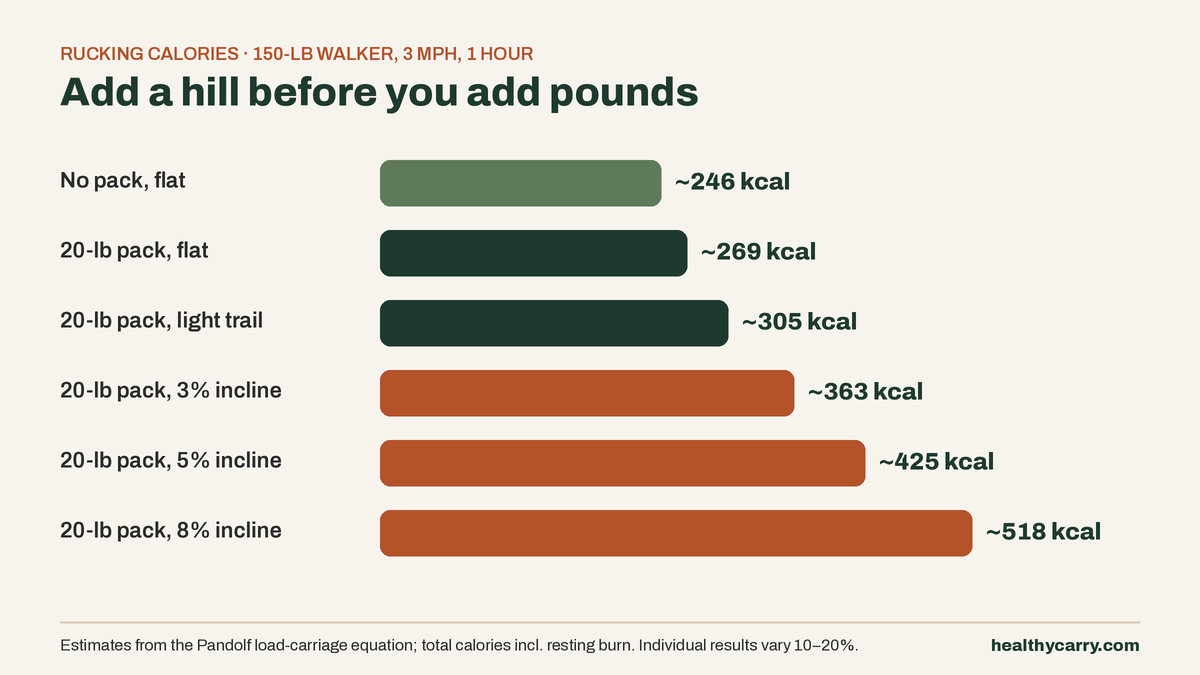
Here’s the number that surprises most new ruckers: for a 150-lb walker at 3 mph, strapping on 20 lb (9 kg) raises the calorie burn by only about 9%. Walk the same pace up a gentle 5% grade with that pack, and the burn jumps 58%, to about 425 calories an hour. Load matters. Hills and pace matter more.
Quick answer: A 150-lb (68 kg) person rucking 20 lb (9 kg) at 3 mph on flat pavement burns roughly 270 calories an hour, versus about 245 walking without a pack. On a 5% incline the same ruck burns about 425 an hour. Use the calculator below for your weight, load, pace, grade and terrain.
Rucking calorie calculator
How many calories does rucking burn compared with walking?
Less extra than most rucking marketing suggests, at least on flat ground at an easy pace. The table below uses the same equation as the calculator for a 150-lb (68 kg) and a 180-lb (82 kg) person walking on pavement for one hour.
| Body weight | Pack | 3.0 mph | 3.5 mph |
|---|---|---|---|
| 150 lb | None | ~245 | ~305 |
| 150 lb | 10 lb | ~255 | ~320 |
| 150 lb | 20 lb | ~270 | ~335 |
| 150 lb | 30 lb | ~285 | ~350 |
| 180 lb | None | ~295 | ~365 |
| 180 lb | 20 lb | ~320 | ~395 |
| 180 lb | 30 lb | ~330 | ~410 |
Notice the pattern: speeding up by half a mile per hour adds more than a 20-lb pack does. That’s useful news if your joints don’t love heavy loads.
What raises the burn the most: weight, pace or hills?
Hills, by a wide margin. Here’s the same 150-lb person carrying 20 lb at 3 mph for an hour, changing only the grade:
| Incline | Calories per hour | Versus flat |
|---|---|---|
| 0% (flat) | ~270 | — |
| 3% | ~365 | +35% |
| 5% | ~425 | +58% |
| 8% | ~520 | +93% |
Terrain counts too. The same ruck on a grassy or light trail burns about 13% more than on pavement, because soft ground makes every step work harder.
The practical takeaway: keep the pack light and add a hill before you add pounds. A treadmill at 3–5% incline is an easy way to do this on bad-weather days.
How the calculator works
We use the Pandolf equation, published by U.S. Army researchers in 1977 and still the standard starting point for load-carriage energy cost. It estimates metabolic power (in watts) from body weight, load, walking speed, grade and a terrain factor. We convert watts to calories per hour (1 W ≈ 0.86 kcal/h).
Two honest limits:
- It’s an estimate. Studies comparing predicted and measured energy cost show the equation can miss for any one person, often by 10–20%. Fitness, walking style and pack fit all shift the number.
- Slow walking is underestimated. Later studies found Pandolf under-predicts at slow speeds; the newer Ludlow and Weyand model corrects for this. If you walk under about 2.5 mph, treat the result as a floor, not a ceiling.
Downhill walking isn’t modeled here (we treat negative grades as flat), and the numbers include your resting metabolism, so they’re total calories, not “extra” calories.
Safety first: burning more calories is not a reason to carry more than your body is ready for. Start with about 5% of your body weight and build slowly. Our ruck weight calculator gives you a conservative starting load and a 6-week progression.
Is rucking good for weight loss?
It can help, mainly because it’s an activity many people can do for 45–60 minutes several times a week without pounding their joints. A 45-minute ruck burns roughly 200–320 calories for most adults. Over a week of three rucks, that’s the energy in about one to two meals, not a dramatic number on its own. Weight loss still depends mostly on what and how much you eat.
Where rucking shines for adults over 35 is everything around the scale: steady cardio, stronger legs, back and core, and a load that may support bone health. Read how to start rucking after 35 for a 4-week beginner plan, or weighted vest walking if you’d rather wear the weight.
FAQ
How many calories does rucking burn per mile?
At 3 mph on flat ground, a 150-lb person carrying 20 lb burns about 90 calories per mile (including resting burn), versus about 80 without a pack. Hills raise this sharply.
Does rucking burn more than walking?
Yes, but on flat ground at the same pace, a pack of 10–20% body weight adds only about 5–15% more calories. Speed and incline add more.
Is 30 minutes of rucking enough?
For health, yes. Thirty minutes at a brisk pace counts toward the 150 weekly minutes of moderate activity in the U.S. Physical Activity Guidelines, and two or three short rucks a week is a solid start.
Are fitness tracker calories accurate for rucking?
Usually not very. Most wrist trackers don’t know you’re carrying a load and estimate from heart rate and movement, so they can miss in either direction. Use any number, ours included, as a rough guide.
Does a weighted vest burn more calories than a backpack?
At the same weight, pace and grade, the difference is small. Vests spread the load more evenly, which some people find more comfortable for longer walks.
Keep going
Want a simple plan instead of numbers? Get the free 4-week Start Carrying plan, or browse all our free tools.
Sources
- Pandolf KB, Givoni B, Goldman RF. Predicting energy expenditure with loads while standing or walking very slowly. J Appl Physiol, 1977.
- Ludlow LW, Weyand PG. Energy expenditure during level human walking: seeking a simple and accurate predictive solution. J Appl Physiol, 2016.
- Looney DP, et al. Metabolic costs of standing and walking in healthy military-age adults: a meta-regression. Med Sci Sports Exerc, 2019.
- Herrmann SD, et al. 2024 Adult Compendium of Physical Activities.
- U.S. Department of Health and Human Services. Physical Activity Guidelines for Americans, 2nd edition.
Educational estimate only, not medical advice.
