
Ask ten rucking websites how much weight a beginner should carry and you’ll hear anything from 5 lb to 30 lb (2–14 kg). Ask medical centers and the range shrinks to 3–10% of your body weight. This calculator uses that narrower, more cautious band and turns it into a number for you, plus six weeks of small steps.
Quick answer: Most beginners should start rucking with about 5% of their body weight (roughly 5–10 lb / 2–4.5 kg), or 3% if they’re new to exercise or over 65. Add about 1–4 lb (0.5–2 kg) every two weeks, changing only one thing per week, and work toward about 10% of body weight over the first two months. Enter your details below for a personal starting load and a 6-week progression.
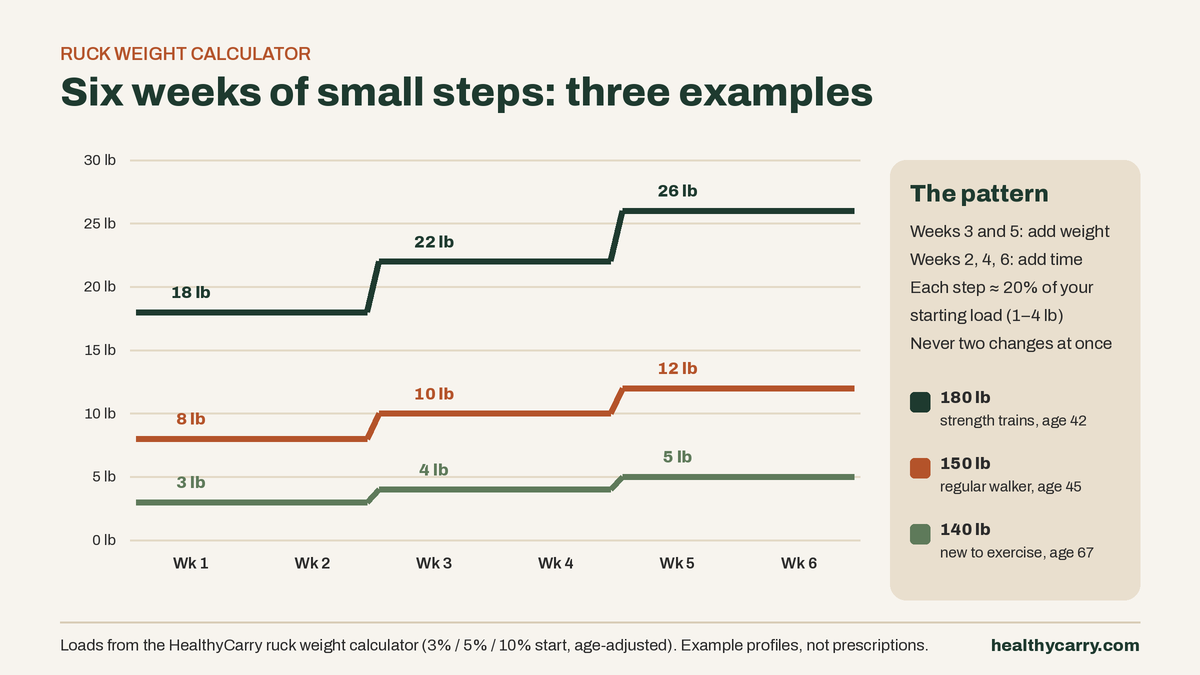
Ruck weight calculator
How the calculator works
We kept the math simple and transparent, so you can check it with a pencil.
1. A starting percentage based on your experience
| Experience | Starting load | Why |
|---|---|---|
| New to exercise or returning | 3% of body weight | Henry Ford Health suggests no more than 3% to start weighted walking |
| Walk regularly | 5% of body weight | UCLA Health and Mass General Brigham both suggest about 5% |
| Strength train or have rucked before | 10% of body weight | Harvard Health’s “about 10%… at least for starters” |
Even the 10% tier is modest on purpose. Cleveland Clinic’s Matthew Kampert, DO, points out that lifting at the gym isn’t the same as carrying 20 pounds for miles, and suggests a first ruck might use just 5 lb.
2. An age adjustment (our judgment, stated plainly)
We multiply the starting percentage by 1.0 for ages 35–49, 0.85 for 50–64, and 0.7 for 65+, and we cap the 65+ start at 5%. No study tells us these exact multipliers. They’re our conservative choice, anchored to a 2026 review of weighted-vest studies in adults 60 and older. That review recommends starting at 1–5% of body mass, toward 1–3% for frail or first-time users, and progressing only while gait stays stable. Feet, tendons, and bones adapt more slowly than heart and lungs at any age, and recovery tends to take longer with age.
3. Small steps, one change at a time
The 6-week plan alternates: one week adds time, the next adds weight. Each weight step is about 20% of your starting load, rounded to the nearest pound (or 0.5 kg) and kept between 1 and 4 lb (0.5–2 kg). Averaged over two weeks, that’s close to the 10%-per-week pace Cleveland Clinic suggests for one component at a time. It also mirrors the U.S. Army’s guidance to raise distance and load on separate days, by about 10% each time.
4. A hard ceiling
The plan never exceeds 8% of body weight for new exercisers, 10% for regular walkers, or 15% for trained users (10% for anyone 65+) within the six weeks. For comparison, U.S. Army training loads typically run 40 to more than 100 pounds. That’s a job requirement, not a health target.
Starting loads at a glance (ages 35–49)
| Body weight | New to exercise (3%) | Regular walker (5%) | Trained (10%) |
|---|---|---|---|
| 120 lb (54 kg) | 4 lb (1.5 kg) | 6 lb (2.5 kg) | 12 lb (5.5 kg) |
| 150 lb (68 kg) | 5 lb (2 kg) | 8 lb (3.5 kg) | 15 lb (7 kg) |
| 180 lb (82 kg) | 5 lb (2.5 kg) | 9 lb (4 kg) | 18 lb (8 kg) |
| 210 lb (95 kg) | 6 lb (3 kg) | 11 lb (5 kg) | 21 lb (9.5 kg) |
| 240 lb (109 kg) | 7 lb (3.5 kg) | 12 lb (5.5 kg) | 24 lb (11 kg) |
For ages 50–64, multiply by 0.85. For 65+, multiply by 0.7 and keep the start at or below 5% of body weight.
Why progression matters more than the starting number
The most convincing data on loaded walking come from the military, and they’re about pacing, not peak load. When Marine Corps recruit training adopted a periodized, progressive load-carriage program, injuries fell from 58% to 39% of recruits (relative risk 0.68), even as recruits did more loaded hikes. The Army recommends allowing 2 to 6 months to build to maximum distances and loads.
Weight is also only one lever. Energy cost rises with load, body mass, speed, and grade (Knapik et al., 2004). That means a gentle hill can do what another 5 lb would, often with less strain on your shoulders. For walking with a vest instead of a pack, see our guide to weighted vest walking.
Safety note. A calculator can’t see your knees. Treat the result as a ceiling for week 1, not a target. Stop and lighten the load if you feel joint pain, numbness or tingling in your arms or hands, dizziness, or chest discomfort, or if your stride changes. Harvard Health advises people with neck or back pain, and anyone pregnant, to avoid weighted vests and rucking. If you have a heart, lung, bone, joint, or spine condition, get medical clearance first. General education, not medical advice.
What to do with your number
- Weigh your load. Use a bathroom scale: weigh yourself with and without the pack. Water is handy at 8.3 lb (3.8 kg) per gallon.
- Pack it high and tight against your back, padded with a towel so it can’t shift.
- Follow the plan in our beginner’s guide to rucking, and add two short strength sessions a week from Train.
- Hold off on gear. A sturdy backpack is enough for the first six weeks. We’ll review packs and plates in Gear Lab only after logged testing, following our How We Test method.
- For midlife bone, joint, and menopause questions, see Carry for Life; for protein around training, see Fuel.
FAQ
How much weight should I ruck with as a beginner?
About 5% of your body weight if you already walk regularly, or 3% if you’re new to exercise or over 65. For a 150-lb (68 kg) walker, that’s about 8 lb (3.5 kg).
Is 20 lb too heavy to start rucking?
For most beginners, yes. Twenty pounds is 10% of a 200-lb person and 15% of a 135-lb person. Unless you already strength train and are on the heavier side, start lighter and build up over a few months.
How fast should I increase ruck weight?
Add about 1–4 lb (0.5–2 kg) every two weeks, and never add weight in the same week you add time or distance. Repeat a week whenever something aches the next morning.
What’s the maximum weight I should ruck with?
For general health, most adults never need more than about 10–15% of their body weight; many medical sources cap vests at 10%. Heavier loads are for specific goals like events or occupational training, built up over months.
Does this calculator work for a weighted vest?
Roughly, yes. Vest guidance uses the same 3–10% range. If balance is a concern, use the “new to exercise” setting, and read our weighted vest guide for vest-specific fit and timing.
Get the free 4-week Start Carrying plan: printable progression and log, built around your starting load.
Sources
- Cleveland Clinic. “Should You Add Rucking to Your Workout?” (2024). health.clevelandclinic.org
- UCLA Health. “Should you walk with a weighted vest?” (2025). uclahealth.org
- Mass General Brigham. “Do Weighted Vests Work?” (2025). massgeneralbrigham.org
- Henry Ford Health. “Should You Wear A Weighted Vest While Working Out?” (2025). henryford.com
- Harvard Health Publishing. “What are the benefits of walking with a weighted vest?” (2025). health.harvard.edu
- Luo H, et al. “Weighted vest interventions in older adults: a mini-review.” Frontiers in Public Health (2026). PMC13056602
- U.S. Army Public Health Center. “Foot Marching and Load-Carriage Injuries,” Fact Sheet 12-008-0522 (2022). ph.health.mil (PDF)
- Progressive load carriage program and injuries in USMC recruit training. Work (2024). PubMed 38552130
- Knapik JJ, Reynolds KL, Harman E. “Soldier load carriage: historical, physiological, biomechanical, and medical aspects.” Military Medicine (2004). PubMed 14964502
