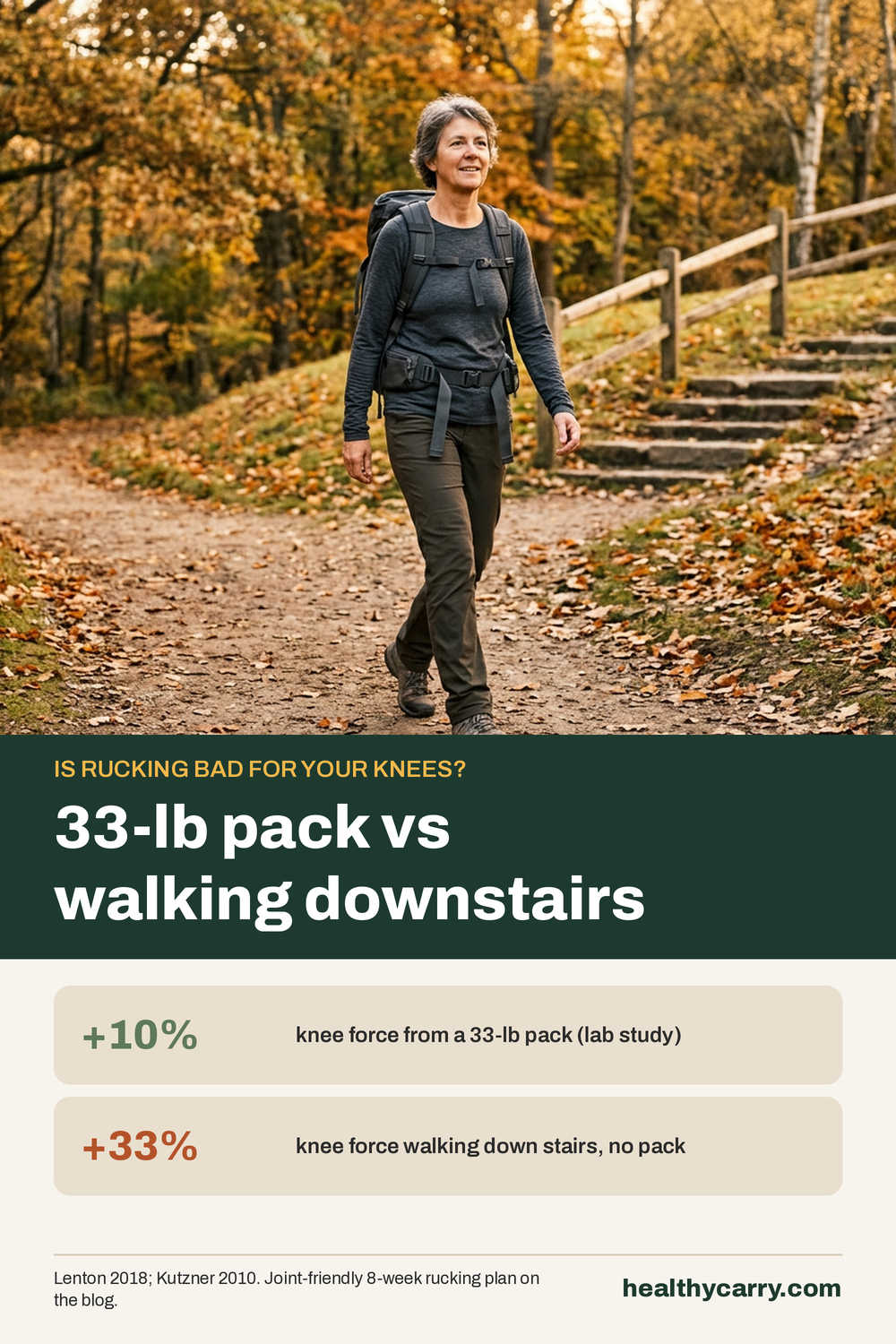
Here’s a number most rucking articles never give you. In a lab study of soldiers, strapping on 33 pounds raised peak knee force by about 10%. Walking down a flight of stairs, with no pack at all, puts roughly 33% more force through the knee than walking on the flat. So if you’re worried a backpack will wreck your knees, the weight is only part of the story. How fast you go, how steep you descend and how quickly you ramp up matter just as much.
Quick answer: Is rucking bad for your knees? Not for most people, if you start light. A 33-lb (15 kg) pack raised peak knee force about 10% in one lab study, and walking for exercise is linked to less new knee pain in adults 50+ with arthritis. Risk climbs with heavy loads, fast pace, downhills and sudden jumps in mileage.
Is rucking bad for your knees? What the numbers show
Every step loads your knee with a multiple of your body weight. Muscles pulling across the joint add most of that force, not just gravity. Researchers have measured this two ways: with sensor-equipped knee implants in real people, and with detailed computer models fed by motion capture and muscle data.
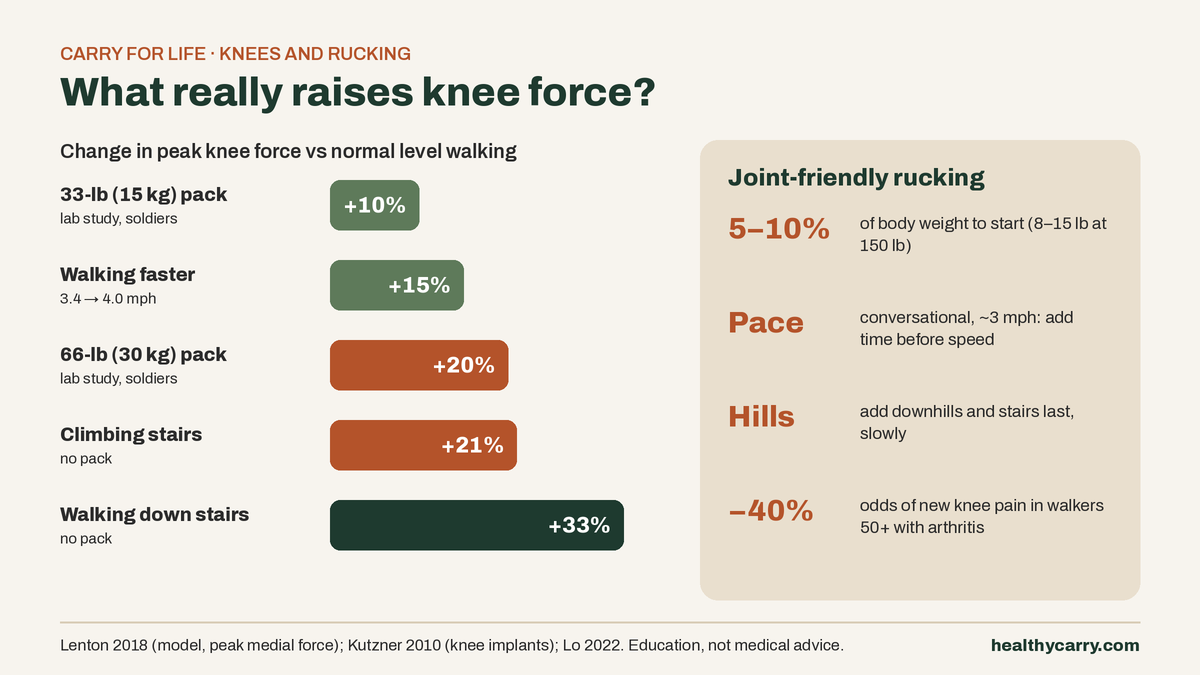
We pulled the key figures into one table. The first four rows come from instrumented knee implants. The rest come from a modeling study of 21 soldiers walking with 15 kg and 30 kg loads.
| Activity | Peak knee force | Change vs. normal walking | Source |
|---|---|---|---|
| Standing on two legs | 1.1 × body weight | about −60% | Kutzner 2010 |
| Level walking, no pack | 2.6 × body weight | baseline | Kutzner 2010 |
| Climbing stairs | 3.2 × body weight | +21% | Kutzner 2010 |
| Walking down stairs | 3.5 × body weight | +33% | Kutzner 2010 |
| Walking with 33 lb (15 kg) | — | +10% | Lenton 2018 |
| Walking with 66 lb (30 kg) | — | +20% | Lenton 2018 |
| Walking faster (3.4 → 4.0 mph) | — | +15% | Lenton 2018 |
| 66 lb at a fast 4.0 mph | about 5 × body weight | roughly running territory (~6×) | Lenton 2018 |
Kutzner data: 5 adults with instrumented knee implants (average peak resultant force). Lenton data: model estimates in 21 male Army reservists, average 183 lb; percent changes are for peak medial (inner) knee force. The two methods differ, so compare the percentages, not the absolute values across rows.
Three things jump out:
- Moderate load is a modest bump. 33 lb was about 18% of the soldiers’ body weight, and it added roughly 10%. Most beginners start with 5–10% of body weight.
- Speed matters as much as weight. Walking about 0.6 mph faster raised knee force more than adding 33 lb did.
- Heavy and fast stacks up. 66 lb at a near-march pace pushed knee force toward what running produces. That’s military rucking, not what most people over 40 need.
What about downhills?
Going down is where packs bite. A 2025 study in Gait & Posture found a backpack increased the knee’s extension moment (how hard the thigh muscles must brake) throughout the stance phase when walking downhill, while on level and uphill ground the change was smaller. Combine that with the stair-descent numbers above and the practical rule is clear: add hills and stairs last, and take them slowly.
Does walking with weight cause knee arthritis?
There’s no good evidence that light rucking causes arthritis. The research on walking itself points the other way.
In the Osteoarthritis Initiative, 1,212 adults 50 and older who already had knee arthritis were followed for four years. Among those without frequent knee pain at the start, 26% of people who walked for exercise developed frequent pain, compared with 37% of non-walkers. That’s about 40% lower odds. Walkers also showed less narrowing of the inner knee joint space on X-rays.
It’s an observational study, so it can’t prove walking protected the knees. People with healthier knees may simply walk more. But it’s hard to square with the idea that regular walking wears knees out.
Body weight is the other piece. In a trial of older adults with knee arthritis, every pound of body weight lost was linked to about 4 pounds less force on the knee with each step. Pack weight isn’t the same as body weight. Still, it’s a reminder that load counts at every step, so the number in your pack deserves respect.
Where heavy carrying does cause trouble is in the military, where soldiers’ loads can exceed 45 kg (about 100 lb). Reviews there find the lower limbs and the back are the most common injury sites, and they recommend building up with speed, grade and terrain rather than weight alone. Those loads are several times what we suggest for beginners.
Is rucking bad for your back?
Light rucking isn’t likely to hurt a healthy back, and walking may help one that’s been sore before.
The strongest recent evidence is the WalkBack trial, published in The Lancet in 2024. It enrolled 701 adults (average age 54, 81% women) who had just recovered from an episode of low back pain. Half got a personalized, progressive walking program with six physiotherapist sessions. Half got no treatment.
The walkers went a median of 208 days before their next activity-limiting back pain episode. The control group made it 112 days. That’s a 28% lower risk of recurrence. The program didn’t use a pack. But it does show that steady, gradually increasing walking is something backs tend to like.
Load is where you need care. Modeling studies show compression and shear forces in the lower spine rise as backpack weight goes up, and walking on slopes raises them further. Heavy packs also make people lean forward to keep balance, which shifts work onto the low back muscles.
Do hip belts protect your knees or back?
Less than you’d think. In the soldier study above, armor with a hip belt didn’t change knee forces at all. A separate modeling study of Marines carrying 84 lb found lower-spine and hip joint forces were similar with a hip-belt pack and a shoulder-only pack. Hip belts mainly take pressure off your shoulders, which still matters for comfort. For your joints, the total weight and how you walk matter more than the strap.
A knee- and back-friendly rucking plan
Here’s how we’d set up the first two months, built around the variables the research flags: weight, speed, slope and how fast you ramp.
| Variable | Weeks 1–4 | Weeks 5–8 | Why |
|---|---|---|---|
| Pack weight | 5–10% of body weight (8–15 lb at 150 lb) | Up to 10–15%, adding 2–5 lb at a time | 33 lb (~18% BW) added ~10% knee force |
| Pace | Conversational, about 2.8–3.2 mph | Same; add time before speed | Faster pace raised knee force ~15% |
| Terrain | Flat paths or treadmill with gentle incline | Add gentle uphills; short, slow downhills | Descents load knees most |
| Time | 20–30 min, 2–3 times a week | 30–45 min, 3 times a week | Gradual ramps cut overuse injuries |
| Change per week | One dial only | One dial only | Easy to see what caused a flare |
Not sure where to start? Our ruck weight calculator gives a starting load for your body weight and experience, and the treadmill rucking guide shows how to use incline instead of extra pounds (and skip downhills entirely). For the full beginner walk-through, see how to start rucking.
Form tips that take load off your knees
- Shorten your stride. Overstriding lands your heel far ahead of your body and increases braking force. Quick, short steps feel smoother under load.
- Pack it high and tight. Heavy items close to your spine, between the shoulder blades. A swinging load makes your legs and back work harder to steady it.
- Stay tall. A slight lean from the ankles is fine. Folding at the waist puts the work on your low back.
- Go slow downhill. Small steps, slightly bent knees, and poles if you have them. Or take the pack off for steep descents.
- Vest or backpack? A vest spreads weight front and back, which some people with back issues prefer. See weighted vest vs. rucking backpack to compare.
When to stop and get checked: knee swelling, locking, catching or giving way; pain that’s worse the next morning or makes you limp; back pain that spreads below the knee, or comes with numbness, tingling or weakness in the leg; or any pain that changes how you walk. If you have diagnosed knee arthritis, a recent injury or surgery, talk with a physical therapist or doctor before adding load.
What we don’t know yet
- Women and older adults are underrepresented. The best load-carriage studies are in young men. One study found men and women use similar walking mechanics under load, but direct knee-force data in women 40+ is thin.
- No long-term rucking trials. No study has followed recreational ruckers for years to track knee or back outcomes. Our plan is built from short-term biomechanics plus walking studies.
- Models aren’t measurements. Most backpack knee-force numbers come from computer models, which are good but not perfect. The implant data are real but come from just five people with knee replacements.
More on joints, bones and training after 40 lives in Carry for Life.
FAQ
Is rucking bad for your knees?
For most healthy adults, no, as long as the load starts light and builds slowly. In one lab study a 33-lb pack raised peak knee force about 10%, less than walking down stairs adds. Heavy loads, fast pace and long downhills raise the risk.
Is rucking bad for your back?
Light, gradual rucking isn’t likely to harm a healthy back. Walking programs actually cut back-pain recurrence in a 2024 Lancet trial. Spinal loads rise with pack weight and slopes, so start light, pack weight high and close, and stay upright.
Is rucking better for your knees than running?
Generally yes at typical beginner loads. Running loads the knee around 6 times body weight per step. Walking is closer to 2.5–3 times, and a moderate pack adds about 10%. Only heavy loads at a fast pace push knee forces toward running levels.
Can I ruck with knee arthritis?
Many people can, with a physical therapist’s guidance. Walking for exercise is linked to less new knee pain in adults with arthritis. Start with an empty or very light pack on flat ground, keep pain under about 3 out of 10, and stop if swelling appears.
Why do my knees hurt after rucking?
Usually too much, too soon: a jump in weight, distance or downhill work. Overstriding and a bouncing pack also add load. Drop the weight back, shorten your stride, avoid descents for a week or two, and get checked if pain persists or swelling shows up.
How much weight should I ruck with to protect my knees?
Start with about 5–10% of your body weight, roughly 8–15 lb for a 150-lb person, and add 2–5 lb at a time every week or two. Keep the pace conversational. Our ruck weight calculator gives a personal starting point.
Get the free 4-week Start Carrying plan: a printable walking-and-carry plan with a weekly log, plus one evidence-checked tip each week in Load Notes.
Sources
- Lenton GK, Bishop PJ, Saxby DJ, et al. “Tibiofemoral joint contact forces increase with load magnitude and walking speed but remain almost unchanged with different types of carried load.” PLOS One 2018;13(11):e0206859. journals.plos.org
- Kutzner I, Heinlein B, Graichen F, et al. “Loading of the knee joint during activities of daily living measured in vivo in five subjects.” J Biomech 2010;43(11):2164-73. PubMed 20537336
- Lo GH, Vinod S, Richard MJ, et al. “Association between walking for exercise and symptomatic and structural progression in individuals with knee osteoarthritis: data from the Osteoarthritis Initiative cohort.” Arthritis Rheumatol 2022;74(10):1660-7. PMC9529782
- Messier SP, Gutekunst DJ, Davis C, DeVita P. “Weight loss reduces knee-joint loads in overweight and obese older adults with knee osteoarthritis.” Arthritis Rheum 2005;52(7):2026-32. PubMed 15986358
- Pocovi NC, Lin CC, French SD, et al. “Effectiveness and cost-effectiveness of an individualised, progressive walking and education intervention for the prevention of low back pain recurrence in Australia (WalkBack): a randomised controlled trial.” Lancet 2024;404(10448):134-44. thelancet.com
- “Joint moments and muscle excitations increase with body-mass normalized backpacks across walking slopes.” Gait & Posture 2025. sciencedirect.com
- “A backpack load sharing model to evaluate lumbar and hip joint contact forces during shoulder borne and hip belt assisted load carriage.” Applied Ergonomics 2020. doi.org
- “Walking slope and heavy backpacks affect peak and impulsive lumbar joint contact forces.” J Biomech Eng 2024. doi.org
- Orr RM, Pope R, Lopes TJA, et al. “Soldier load carriage, injuries, rehabilitation and physical conditioning: an international approach.” Int J Environ Res Public Health 2021. PMC8069713
- Silder A, Delp SL, Besier T. “Men and women adopt similar walking mechanics and muscle activation patterns during load carriage.” J Biomech 2013;46(14):2522-8. doi.org