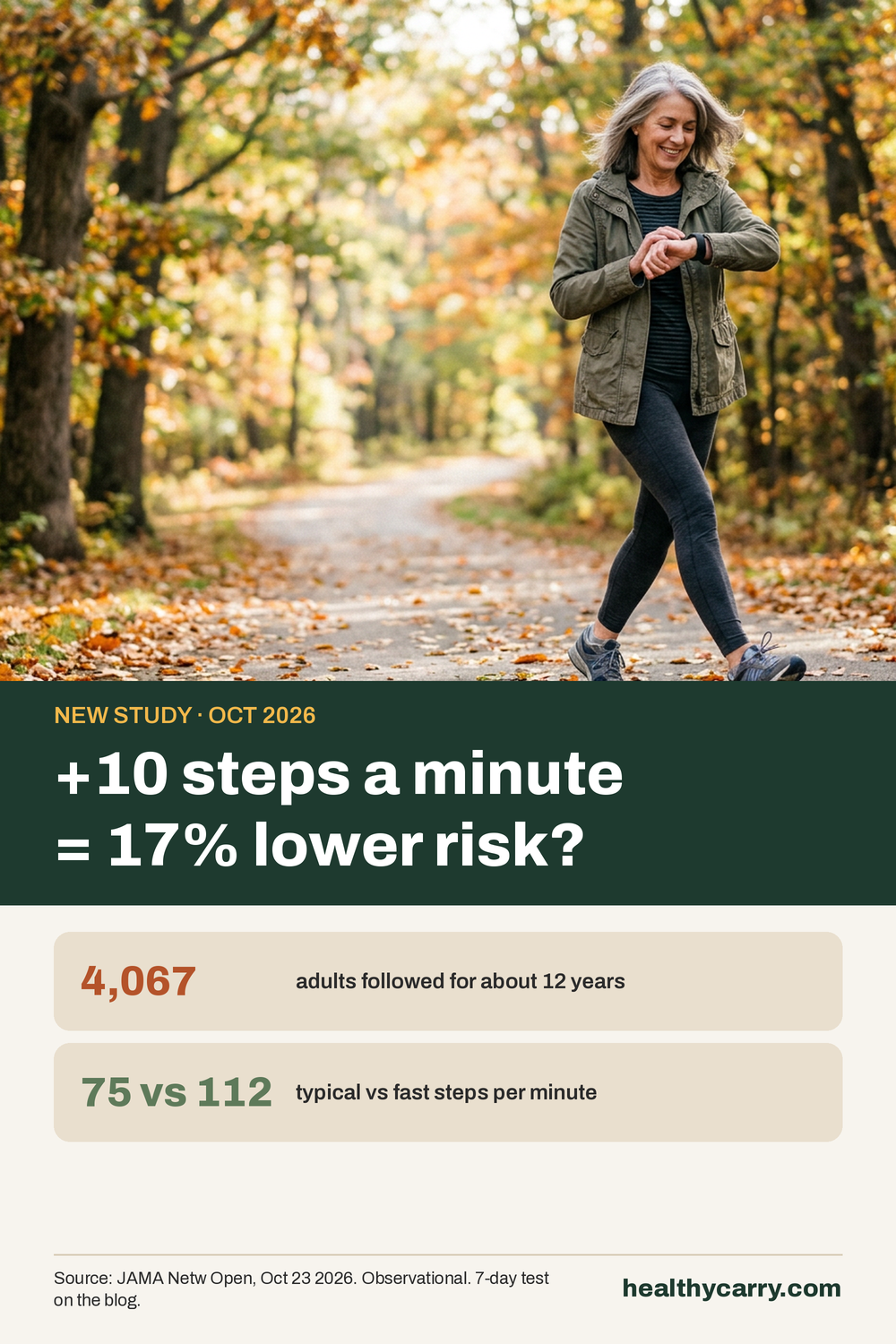
Most of us count steps. A new JAMA Network Open study asked a different question: how fast are your steps? Over nearly 12 years, people who walked at a quicker cadence, 10 more steps per minute, had a 17% lower risk of dying than people who strolled, even after the researchers accounted for age, smoking, weight, blood pressure and more.
Quick answer: A study of 4,067 UK adults (average age 69) published October 23, 2026 found that each 10 extra steps per minute of everyday walking cadence went with a 17% lower all-cause mortality risk (HR 0.83, 95% CI 0.76–0.90) over about 12 years. It’s observational, so it shows an association, not proof. Practical takeaway: keep your daily steps, then make some of them brisker.
What did the walking cadence study find?
The paper, “Clinical Walking Speed, Free-Living Walking Cadence, and All-Cause Mortality”, used the Whitehall II cohort in England. Participants wore a wrist accelerometer for about 9 days in 2012–2013. The researchers then followed them through August 2024 using national death records. Cadence means steps per minute while you are actually walking, not your daily total.
| Measure | Result in the study |
|---|---|
| People | 4,067 (average age 69.3; 26% women, 74% men) |
| Follow-up | Median 11.8 years; 739 deaths (18.2%) |
| Typical (median) cadence | 75.3 steps/min |
| Fast (95th percentile) cadence | 112.2 steps/min |
| Average daily steps | 9,524 |
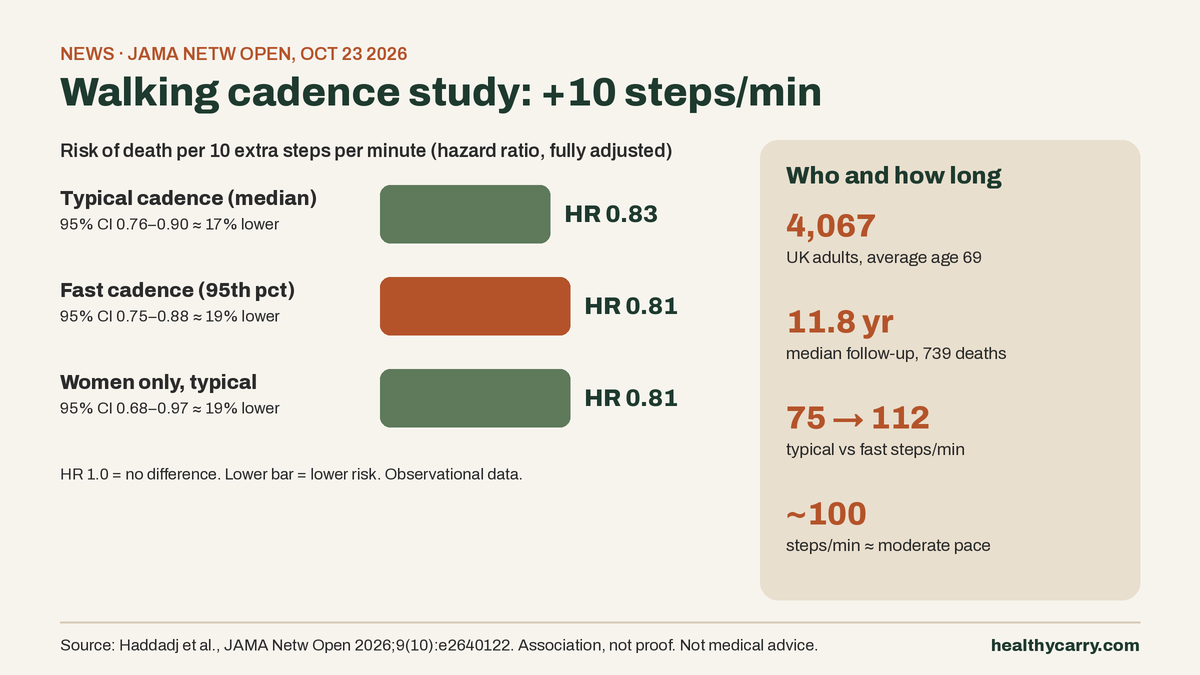
| Risk per +10 steps/min, typical cadence | HR 0.83 (95% CI 0.76–0.90) |
| Risk per +10 steps/min, fast cadence | HR 0.81 (95% CI 0.75–0.88) |
| Women only, typical cadence per +10 steps/min | HR 0.81 (95% CI 0.68–0.97) |
| Clinical walking speed, per +0.1 m/s | HR 0.90 (95% CI 0.87–0.93) |
An HR of 0.83 means a 17% lower rate of death in the follow-up period for each 10-step-a-minute difference, in models that adjusted for sociodemographic, behavioral and health factors. The link stayed after adjusting for daily step count, so it wasn’t only people who walk more.
What does 10 more steps per minute look like in real life?
It’s smaller than it sounds. Going from 100 to 110 steps per minute is a slightly longer, quicker stride. A review the authors cite (Tudor-Locke and colleagues, 2018) treats about 100 steps per minute as a rough marker of moderate-intensity walking for adults. These are ballpark figures, not prescriptions.
| Your walk | Cadence | Try this |
|---|---|---|
| Window shopping | About 75–85 | Pick one block a walk to speed up |
| Purposeful walk | About 100 | Aim for this on part of every walk |
| Brisk push | About 110+ | 1–3 minutes at a time, then ease off |
Count steps for 30 seconds and double it. If you wear a tracker, many show cadence, or you can use a free metronome app set to 100–110 beats per minute.
What does it mean for you if you walk or ruck?
Three takeaways, with the honest limits attached.
- Pace may matter on top of volume. Both measures lined up with lower risk. You don’t have to choose between steps and speed.
- Add short fast stretches. Try 3 minutes brisk, 3 minutes easy, a few rounds. That’s the idea behind interval-style walking with a weighted vest, though that exact combination hasn’t been studied.
- Don’t add weight to chase cadence. A heavier load usually lowers your stride rate. If you ruck, check your pace with the rucking pace calculator and build load slowly, as in how to start rucking.
What can’t this study tell us?
- It can’t prove cause. Fitter, healthier people naturally walk faster. The authors adjusted for many factors, but illness you can’t see could still drive both slow walking and earlier death.
- One group, one country. Whitehall II began with British civil servants. The sample was 74% male and 92.5% White, and healthier than the original cohort.
- Women’s numbers are less precise. 1,043 women gave a wider confidence interval (0.68–0.97), though the direction matched the men’s.
- Cadence isn’t pace. It was measured from a wrist device, and the authors say it shouldn’t be treated as interchangeable with walking speed. Only clinical walking speed improved the prediction model once health factors were included.
- No training trial. Nobody was told to speed up. We don’t know whether raising your cadence changes your risk.
Safety first: If you have heart disease, joint problems or dizziness, or you haven’t been active lately, check with your clinician before adding speed or weight. Stop if you feel chest pain, unusual shortness of breath or sharp joint pain. This article is general information, not medical advice.
Your 7-day cadence experiment
- Day 1: take a normal walk and count steps in 30 seconds. Double it for your baseline.
- Days 2–7: on three walks, add 1–2 minutes at a cadence about 10 steps per minute above your baseline. Keep the rest easy.
- Next week: lengthen the fast stretches by a minute if your breathing, joints and energy feel fine.
For another walking result worth knowing, see our write-up of the walking and bone density study.
Frequently asked questions
What is walking cadence?
Cadence is the number of steps you take per minute while walking. In this study it was calculated from a wrist accelerometer, using only the 10-second windows classified as walking.
What is a good walking cadence for adults over 40?
About 100 steps per minute is often used as a rough marker of moderate-intensity walking. The study’s participants averaged 75 steps per minute overall and about 112 at their fastest. Your own best pace depends on height, fitness and any joint issues.
Does walking faster really lower death risk?
In this study, faster cadence and faster clinical walking speed both went with lower risk. It’s an observational association, so it can’t show that speeding up causes the lower risk.
Is cadence more important than daily steps?
The study didn’t rank them. Cadence stayed linked to lower mortality after adjusting for daily step count, which suggests both carry information.
Does a weighted vest change my cadence?
It can. Added load often shortens your stride and slows your pace. If you walk with a vest, keep it light enough that you can still hold a brisk, comfortable cadence.
Get the free 4-week Start Carrying plan: a printable plan with a weekly log, so your next few weeks of walking are easy to track.
Sources
- Haddadj R, Danilevicz IM, Rowlands AV, et al. “Clinical Walking Speed, Free-Living Walking Cadence, and All-Cause Mortality.” JAMA Netw Open 2026;9(10):e2640122. Published October 23, 2026. jamanetwork.com
- Vetrano DL. “Measuring Mobility Function in Everyday Life—Beyond the Stopwatch” (invited commentary), JAMA Netw Open, October 23, 2026. jamanetwork.com
- Tudor-Locke C, Han H, Aguiar EJ, et al. “How fast is fast enough? Walking cadence (steps/min) as a practical estimate of intensity in adults: a narrative review.” Br J Sports Med 2018;52(12):776-788. PubMed 29858465
- Paluch AE, Bajpai S, Bassett DR, et al. “Daily steps and all-cause mortality: a meta-analysis of 15 international cohorts.” Lancet Public Health 2022;7(3):e219-e228. PubMed 35247352
- Study code and data statement: github.com/rayanehaddadj/walk-speed-walk-cad-mortality-WHII