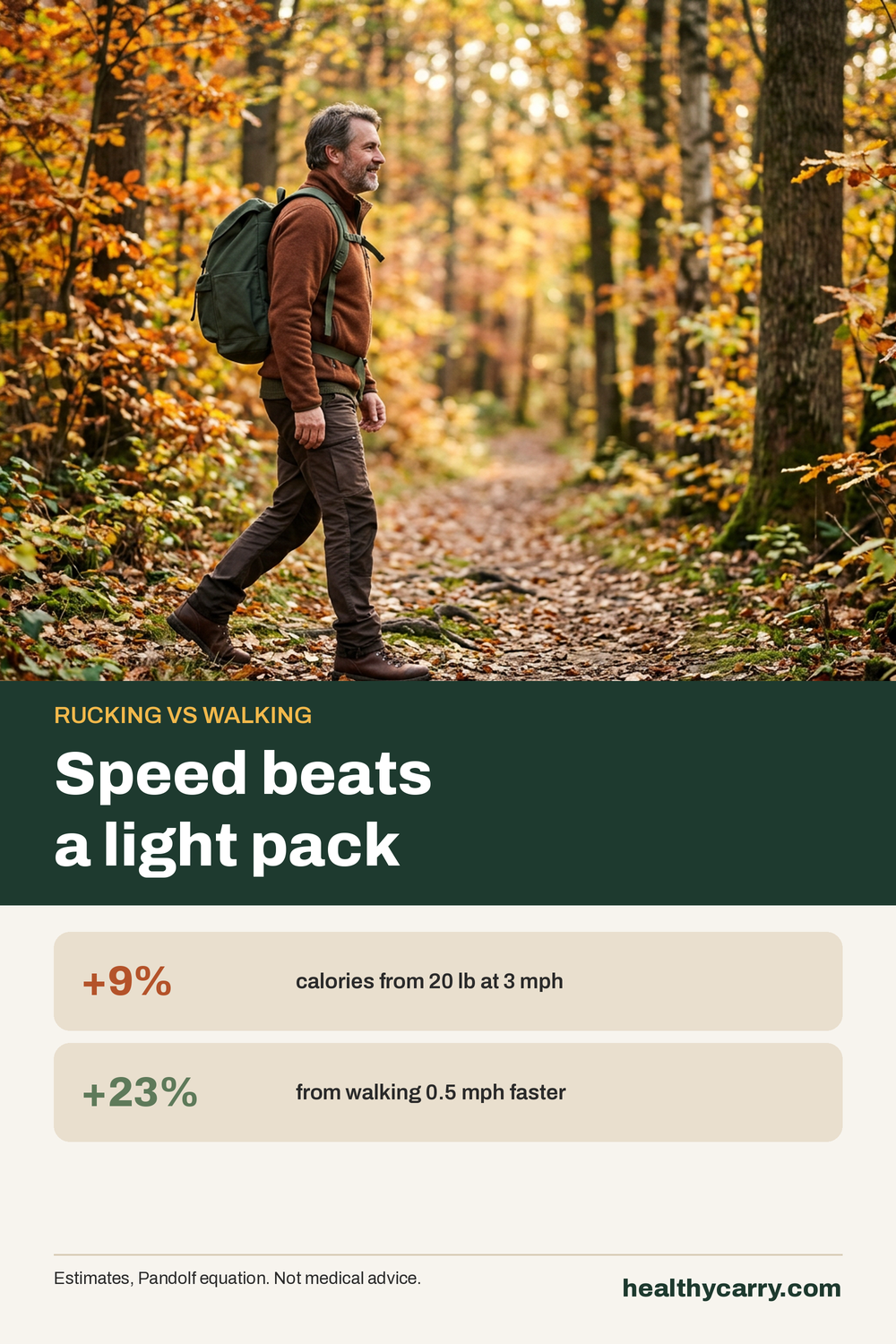
Here’s a number that surprises most people: for a 160-lb person walking 3 mph, adding a 20-lb pack raises calorie burn by roughly 9%. Walking just half a mile an hour faster raises it by about 23%. If you’ve been wondering whether rucking beats walking, the answer depends on which dial you turn.
Quick answer: Rucking vs walking: rucking is walking with a loaded pack. At the same speed, a light pack (10-20 lb) adds about 4-9% to calorie burn for a 160-lb person. Speed adds more than light weight does. Rucking pays off when you want more leg and trunk work, or you can’t walk faster.
Rucking vs walking: how many more calories does it burn?
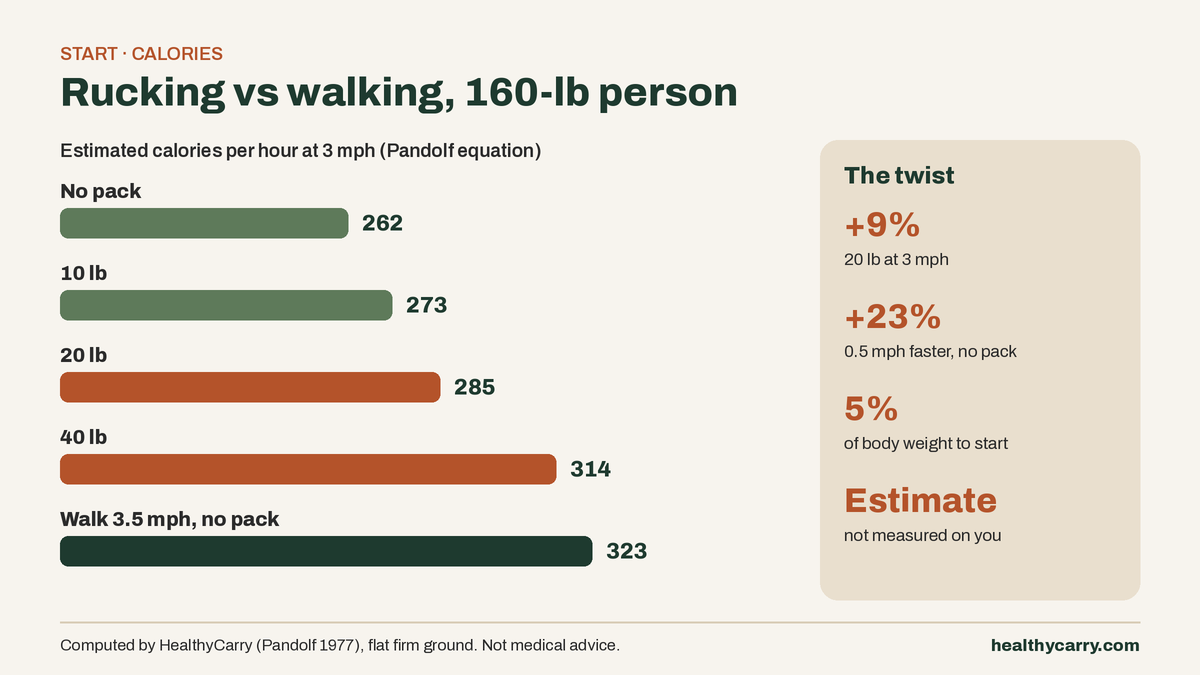
These are model estimates from the Pandolf load-carriage equation, the same one in our rucking calorie calculator. They assume a 160-lb person on flat, firm ground. They are total calories per hour, including what you’d burn anyway. Real numbers vary person to person.
| Speed | No load | 10 lb | 20 lb | 30 lb | 40 lb |
|---|---|---|---|---|---|
| 2.5 mph | 211 | 219 | 228 | 238 | 250 |
| 3.0 mph | 262 | 273 | 285 | 299 | 314 |
| 3.5 mph | 323 | 338 | 354 | 371 | 390 |
| 4.0 mph | 393 | 412 | 433 | 455 | 478 |
Read across a row to see what weight adds. Read down a column to see what speed adds. At 3 mph, 20 lb adds about 23 calories an hour. Going from 3.0 to 3.5 mph without a pack adds about 61. Speed wins at light loads.
Is rucking better than walking?
It depends on your goal.
- If your goal is calories, walking faster or longer is the cheaper lever. Rucking helps when you’ve hit a pace ceiling, or you’re short on time and want a harder 30 minutes.
- If your goal is strength, a pack gives your legs, glutes and trunk more to do on every step, which plain walking doesn’t. Research on loaded walking is thin, though, and no trial shows that casual rucking builds bone, so treat that as a reasonable bet, not a promise.
- If your goal is joint comfort or you’re just starting, plain walking comes first. Build 30 minutes of easy walking before adding load.
Rucking vs walking with a weighted vest: what’s the difference?
At the same load, the energy cost is about the same. We cover that in weighted vest vs rucking. What changes is fit, heat and comfort, not calories.
How much weight should I add?
Start at about 5% of body weight, which is 8 lb for a 160-lb person, and hold it for two weeks. Use the ruck weight calculator for your number. Past about 10% of body weight, calories rise faster, but so does the strain on feet, knees and back. Read is rucking bad for your knees and does rucking hurt your back before going heavier.
A simple way to choose
| Your situation | Start with |
|---|---|
| New to exercise, or under 30 min of walking a day | Plain walking, 30 min |
| Walking 30+ min and want more challenge | Light pack, 5% of body weight |
| Short on time | Brisk walk first, then light pack |
| Bone or joint concerns | Ask your clinician first |
Not sure how fast you walk? Check the rucking pace calculator. New to all this? How to start rucking has a gentle plan.
What these numbers can’t tell you
- They are equation-based estimates, not measurements of you.
- The equation tends to under-predict at very slow speeds, so slow walkers should treat figures as a floor.
- Hills, trails and sand raise the cost a lot. This table is flat, firm ground.
Safety: Check with your doctor before adding load if you have heart, bone, joint or balance concerns. Stop for chest pain, dizziness or sharp pain. This is general information, not medical advice.
FAQ
Does rucking burn more calories than walking?
Yes, at the same speed, but with light loads the difference is small. For a 160-lb person at 3 mph, a 20-lb pack adds about 9% by the Pandolf equation.
Is rucking good for weight loss?
It can help by increasing calories burned and by being easier on the joints than running for many people. Weight loss depends mostly on total energy balance, so consistency and food matter more than the pack.
Is rucking better than running?
They suit different goals. Running burns more per minute at most speeds, but rucking is lower impact for many people. Pick the one you will keep doing.
Is rucking vs walking better for women over 50?
Both can be good. Start with walking, add a light pack slowly, and talk to your clinician about bone health. See rucking for women over 50.
How fast should I ruck?
Most beginners ruck at 2.5 to 3.5 mph. Heavier packs slow people down, so judge effort, not just pace.
Want the easy version?
Get the free 4-week Start Carrying plan – one short email a week, no hype.
Sources
- Pandolf KB, Givoni B, Goldman RF. Predicting energy expenditure with loads while standing or walking very slowly. J Appl Physiol, 1977.
- Calories per hour computed by HealthyCarry from the Pandolf equation (160 lb, level ground, terrain factor 1).
- Physical Activity Guidelines for Americans, 2nd edition. health.gov
- Compendium of Physical Activities. pacompendium.com