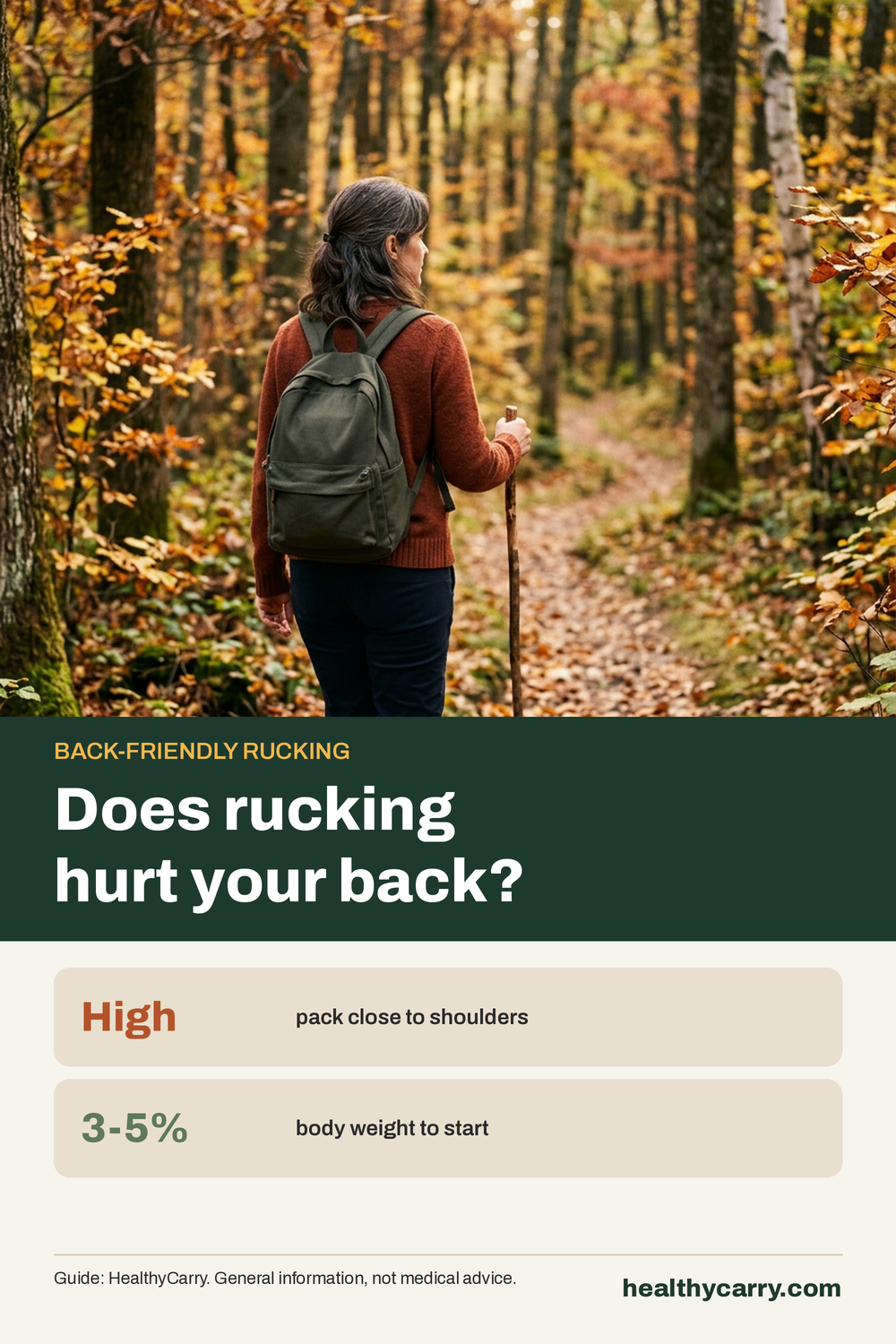
Strap on a pack and your lower back is the first to complain, right? Or the last? Both can be true. Searches like “does rucking hurt your back” come up all the time, and the honest answer is: it depends on the load, the fit and your starting point.
Quick answer: Rucking can aggravate back pain when the pack is too heavy, hangs low or bounces, and a review of load-carriage studies says carrying loads may provoke low back pain. Yet walking and exercise are recommended for chronic low back pain. Start light, carry high and snug, stay under about 5% of body weight at first, and stop for sharp or radiating pain.
Does rucking hurt your back?
A systematic review of 47 load-carriage studies concluded that the evidence is conflicting and could not be pooled, but that carrying loads may provoke low back pain, plus neck, upper back and shoulder pain. Backpack weight can influence perceived pain, and design and placement matter too. A separate scoping review found no consistent support that more load raises the risk of developing non-specific low back pain. Put together: load is a trigger for some people, not a proven cause of back problems.
Can walking and rucking help back pain?
For chronic low back pain, the World Health Organization conditionally recommends structured exercise as part of care, and a Cochrane review found exercise probably reduces pain compared with no treatment or usual care. A 2026 meta-analysis of 13 trials found walking programs reduced pain and disability, and a Lancet trial of an individualized walking and education program lowered recurrence of activity-limiting back pain (hazard ratio 0.72). None of those tested a loaded pack. So the fair summary is: walking is supported, adding a pack is untested, so add load cautiously.
| Question | What the evidence says | Certainty |
|---|---|---|
| Can carrying loads provoke back pain? | Possibly, conflicting evidence | Low |
| Does more load cause low back pain? | No consistent support in a scoping review | Low |
| Does exercise reduce chronic low back pain? | Probably, versus no treatment | Moderate |
| Does walking help? | Pain and disability fell in 13 trials | Low to moderate |
| Does rucking itself help? | Not tested | None |
How do I set up a pack so it spares my back?
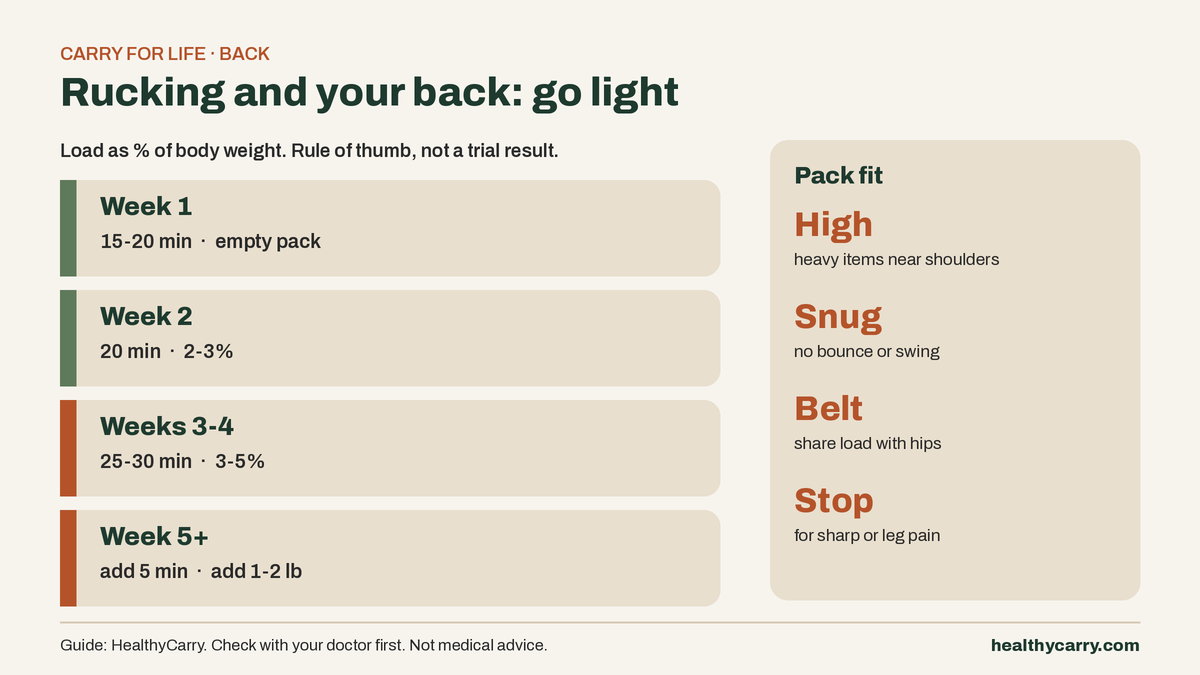
- Carry high. Heaviest items against your shoulder blades, not at the bottom of the bag.
- Snug, no swing. Compress the straps so the pack does not bounce when you walk.
- Use the hip belt and sternum strap to share the load between hips and shoulders.
- Keep your head up and ribs stacked. If you lean forward to balance, the load is too heavy.
- Shorten your stride on hills and downhill.
A back-friendly progression
| Week | Load | Time | Check |
|---|---|---|---|
| 1 | Empty pack | 15-20 min | Straps and posture |
| 2 | 2-3% body weight | 20 min | No new pain that evening |
| 3-4 | 3-5% | 25-30 min | Pain no worse next morning |
| 5+ | Add 1-2 lb | Add 5 min | Change one thing at a time |
If the pack makes you feel worse the next morning, drop back one step. Use the ruck weight calculator for your numbers, and see the 8-week plan for women over 50, rucking and your knees and weighted vest walking.
What strength work helps your back carry a load?
Two short sessions a week of hip hinges with a light weight, planks, rows and a farmer’s carry. These are general conditioning ideas, not a back pain treatment, and a physical therapist can tailor them.
Safety: See a doctor first if you have current back pain, a disc or spine condition, osteoporosis or past fractures. Stop and get checked for pain down a leg, numbness, weakness or night pain. This is general information, not medical advice.
FAQ
Does rucking hurt your lower back?
It can if the load is too heavy, sits low or swings. Many people ruck without back pain once the pack is light, snug and high. Persistent or sharp pain is a reason to stop and get checked.
Is rucking good for back pain?
There is no rucking-specific trial. Walking and general exercise have decent evidence for chronic low back pain, so a light, well-fitted ruck may suit some people, but it is not a treatment.
How heavy should a pack be with a sensitive back?
Start with an empty pack and add a few pounds at a time. A common rule of thumb is 3-5% of body weight for beginners. That is a practical guideline, not a trial result.
Is a weighted vest easier on the back than a backpack?
Some people find a snug vest feels more stable because the load sits close to the torso. Fit matters more than the type, and trial evidence comparing them for back pain is lacking.
Why does my upper back or shoulders hurt after rucking?
Usually a loose pack, thin straps or a heavy load pulling you backward. Tighten the straps, raise the pack, lighten it and check your posture.
When should I see a doctor?
See a doctor for pain that goes down a leg, numbness, weakness, pain at night or after a fall, or anything that does not settle in a few days.
Want the easy version?
Get the free 4-week Start Carrying plan – one short email a week, no hype.
Sources
- Can load carriage system weight, design and placement affect pain and discomfort? A systematic review. Work. PubMed
- Insufficient evidence for load as the primary cause of nonspecific (chronic) low back pain: a scoping review. JOSPT 2024. doi.org
- Nunez-Cortes R, et al. How much walking is enough for chronic low back pain? PM&R 2026. doi.org
- Effectiveness of an individualised, progressive walking and education intervention for low back pain recurrence (WalkBack) randomised controlled trial. The Lancet 2024. thelancet.com
- World Health Organization. Guideline for non-surgical management of chronic primary low back pain in adults, 2023. iris.who.int
- Cochrane. Exercise for treatment of chronic low back pain. cochrane.org