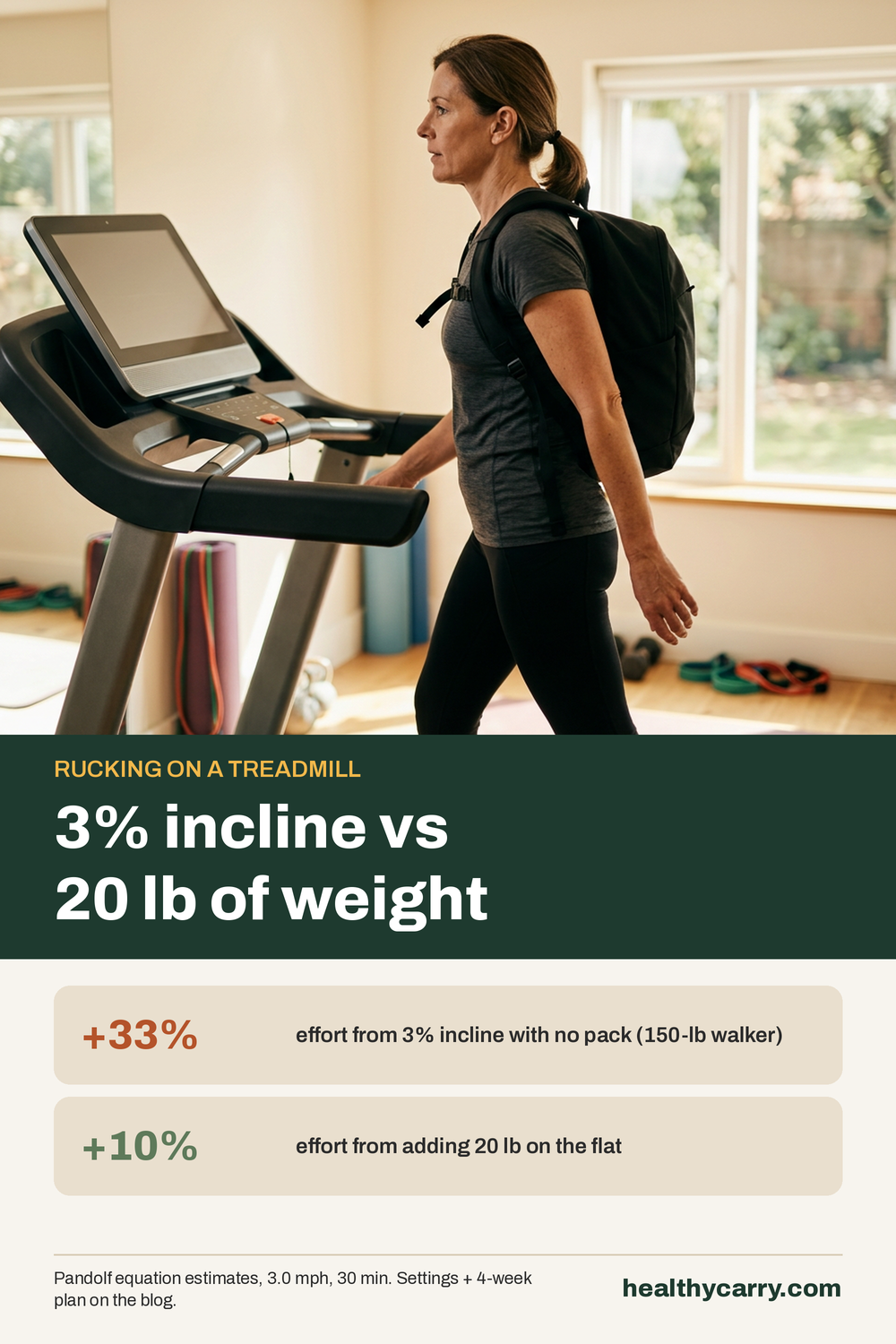
Most people start rucking on a treadmill by adding weight to the pack. It’s the wrong dial to turn first. Run the numbers on a standard load-carriage equation and a 150-lb walker gets about 10% more work from adding 20 lb to the pack at 3 mph, but about 33% more from a 3% incline with no extra weight at all. On a treadmill, the incline button is your cheapest, gentlest load.
Quick answer: Yes, rucking on a treadmill works. Start at 2.5–3.0 mph, 0–1% incline, with about 5–10% of your body weight in a backpack, for 20–30 minutes. Progress incline before weight: by our calculations, 3% grade adds roughly 3–4 times more effort than 20 extra pounds. Keep your hands off the rails, wear the load high and tight, and keep the pace conversational.
Is rucking on a treadmill effective?
Yes. Your legs, heart and lungs don’t know whether the ground is moving or you are. The energy cost of walking with a load depends on four things: your body weight, the load, your speed and the grade. A treadmill lets you control the last two exactly, which makes it one of the easiest places to learn rucking safely.
What you give up is terrain. Outdoors, gravel, curbs, camber and wind make your ankles, hips and core work in ways a flat belt doesn’t. So the treadmill is a great base, not a full replacement. Most people do best with treadmill sessions on busy or bad-weather days and at least one outdoor walk a week.
Two treadmill-specific upsides matter for adults 40+:
- You can stop instantly. If a hip, knee or back complains, hit the stop key and take the pack off. No long walk home under load.
- Hills without the downhill. Outdoor hills come with descents, and walking downhill with weight is hard on knees. A treadmill gives you the uphill only.
Incline vs weight: which dial should you turn?
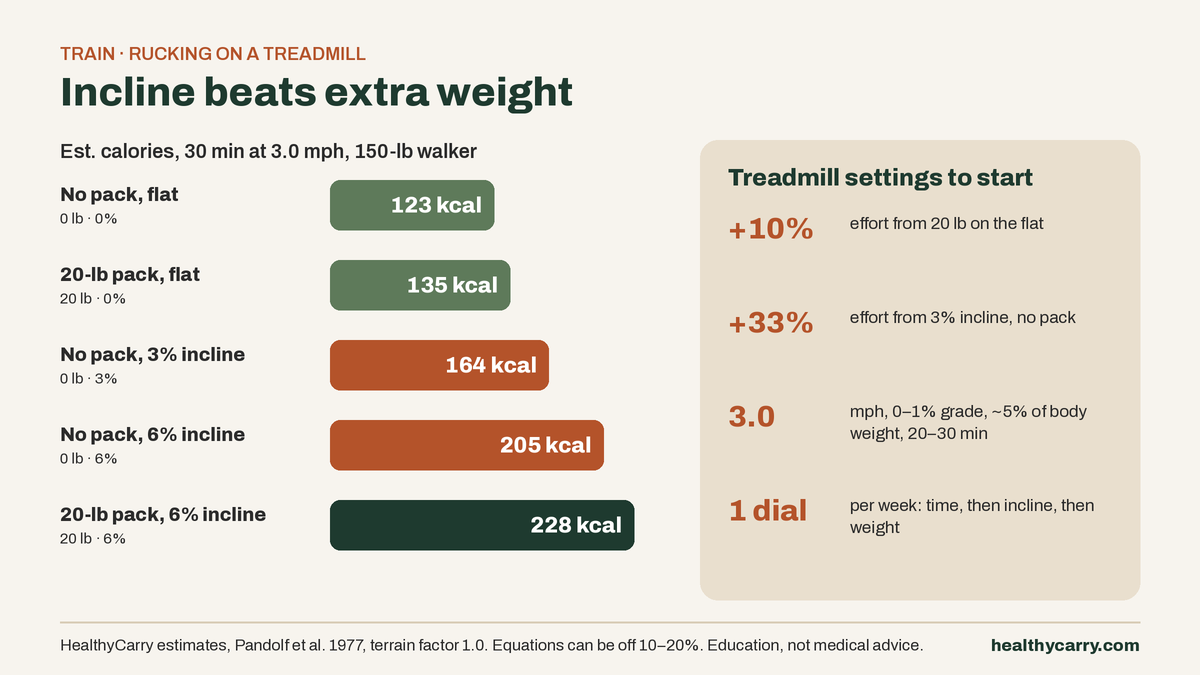
We ran the Pandolf load-carriage equation, a widely used military formula for the energy cost of walking with a pack, for two body weights. Numbers are estimated total calories for 30 minutes on a treadmill. Treat them as estimates: equations can be off by 10–20% for any one person, and newer models (Looney 2019) refine the slow-speed and hill math.
| 30 min on a treadmill | 3.0 mph, 0% | 3.0 mph, 3% | 3.0 mph, 6% | 3.5 mph, 0% | 3.5 mph, 3% |
|---|---|---|---|---|---|
| 150-lb walker, no pack | 123 | 164 | 205 | 151 | 199 |
| 150 lb + 10-lb pack | 128 | 172 | 216 | 159 | 210 |
| 150 lb + 20-lb pack | 135 | 181 | 228 | 167 | 221 |
| 180-lb walker, no pack | 147 | 197 | 246 | 182 | 239 |
| 180 lb + 10-lb pack | 153 | 205 | 257 | 189 | 250 |
| 180 lb + 20-lb pack | 159 | 214 | 269 | 197 | 261 |
HealthyCarry calculation with the Pandolf equation (1977), terrain factor 1.0 for a treadmill; total kcal including resting cost. Estimates, not measurements.
What the table shows:
- Weight alone is a small step. For the 150-lb walker at 3.0 mph on the flat, 20 lb adds about 12 calories per 30 minutes (+10%).
- Incline is a big step. The same walker with no pack at 3% gets about 41 extra calories (+33%), and at 6% about 82 (+67%).
- Load still matters for your frame. Calories aren’t the only reason to ruck. A pack loads your upper back, core and hips and gives your bones a heavier daily load. That’s why we suggest a light pack plus incline, not one or the other.
Want your own numbers? Plug your weight, load, pace and grade into our rucking calorie calculator.
What speed and incline should you use?
A good treadmill ruck feels like a purposeful walk: you can talk in full sentences, but you wouldn’t want to sing. Use this as a starting point and adjust by feel.
| Level | Speed | Incline | Pack | Time |
|---|---|---|---|---|
| First 2 weeks | 2.5–3.0 mph (20–24 min/mile) | 0–1% | ~5% of body weight | 20–30 min |
| Building | 3.0–3.3 mph | 2–4% | 5–10% of body weight | 30–40 min |
| Comfortable | 3.0–3.5 mph | 3–6% steady, or short 8% climbs | 10–15% of body weight | 40–60 min |
Not sure how heavy to start? Our ruck weight calculator gives a starting load from your body weight and experience. For pace conversions, use the rucking pace calculator.
Do you need the “1% incline” rule?
The popular advice to set 1% to “match outdoors” comes from running research: at running speeds, air resistance outdoors adds about what a 1% grade adds indoors. At walking speeds air resistance is tiny, so for rucking 0–1% is fine either way. Pick a grade for your goal, not to copy the outdoors.
How to ruck on a treadmill, step by step
- Pack it high and tight. Put the weight (a plate, sandbag or water bottles wrapped in a towel) high in the pack, close to your spine. Tighten the shoulder straps so nothing bounces, then clip the chest strap.
- Warm up unloaded or light. 5 minutes at an easy pace, 0%.
- Clip the safety key to your clothing before you add load.
- Set your working pace, then raise the incline 1% at a time.
- Hands off the rails. Holding on takes weight off your legs and changes your posture. A light touch for balance is fine while you learn; then let your arms swing.
- Stand tall. A slight forward lean from the ankles is normal on an incline. Bending at the waist or rounding your shoulders means the load is too heavy or the grade too steep.
- Cool down 3–5 minutes at 0%, then take the pack off seated or with it resting on a bench, not by twisting it off your shoulders.
A 4-week treadmill rucking plan for beginners over 40
Three sessions a week, with a rest or strength day between. If a week feels hard, repeat it. Change only one thing per week: time, incline or weight.
| Week | Session 1 (steady) | Session 2 (incline) | Session 3 (longer) |
|---|---|---|---|
| 1 | 20 min, 3.0 mph, 0–1%, ~5% body weight | 20 min, 3.0 mph, 2% | 25 min, 3.0 mph, 0–1% |
| 2 | 25 min, 3.0 mph, 1% | 4 x 3 min at 4% with 2 min at 1% | 30 min, 3.0 mph, 1% |
| 3 | 30 min, 3.0–3.2 mph, 2% | 5 x 3 min at 5% with 2 min at 1% | 35 min, 3.0 mph, 2% |
| 4 | 30 min, 3.2 mph, 2–3%, add 2–5 lb if weeks 1–3 felt easy | 4 x 4 min at 6% with 2 min at 1% | 40 min, 3.0 mph, 2% |
After week 4, keep progressing one dial at a time: add 5 minutes, then 1–2% incline, then 2–5 lb. Want a printable version with a log? It’s in the free plan linked at the end of this post. Ready to take it outside? Start with our beginner’s guide to rucking after 35.
Vest or backpack on the treadmill?
Both work. A vest spreads load over your chest and back and is handy for short sessions and step-ups. A backpack is easier to load heavier and cooler on your chest, which many women in menopause appreciate. At the same load and speed, the energy cost is about the same. See weighted vest vs rucking for a side-by-side.
Treadmill rucking mistakes to avoid
- Going heavy before going uphill. Big jumps in load are the most common cause of sore shoulders, feet and lower backs. Use incline first.
- Max incline from day one. 10–15% grades with a pack load your calves and Achilles hard. Build up over weeks.
- Running with the pack. Rucking is walking. Running under load raises impact on knees and spine.
- Hanging on the rails. It makes the number on the screen look better than the work you’re doing.
- Trusting the calorie display. Most treadmills don’t know you’re carrying a pack. Use an equation-based estimate instead.
Safety first: Check with your clinician before adding load if you have osteoporosis or a recent fracture, heart or lung disease, pelvic floor symptoms, or back, hip or knee pain. Stop for chest pain, dizziness, unusual shortness of breath, or pain that changes how you walk. Mild muscle soreness is normal; sharp or joint pain isn’t.
FAQ
Can you ruck on a treadmill?
Yes. Walk with a weighted backpack at a conversational pace, start at 0–1% incline and 2.5–3.0 mph, and progress incline gradually. Keep your hands off the rails so your legs carry the load.
What incline should I ruck at on a treadmill?
Start at 0–2% for the first couple of weeks, then build to 3–6% for steady sessions. Short climbs at 6–8% work well once you’re comfortable. Raise the grade 1% at a time.
How fast should you ruck on a treadmill?
Most beginners do well at 2.5–3.0 mph (about 20–24 minutes per mile). Experienced ruckers often walk 3.3–3.75 mph. If you can’t talk in full sentences, slow down or lower the incline.
Is rucking on a treadmill as good as outside?
For heart, lungs and leg strength, it’s very close at the same speed, grade and load. Outdoors adds uneven terrain, downhills and weather, which train balance and joints differently. Mixing both is ideal.
How many calories does rucking on a treadmill burn?
By the Pandolf equation, a 150-lb person carrying 20 lb at 3.0 mph burns about 135 calories in 30 minutes on the flat and about 181 at 3% incline. Use our calculator for your own numbers; treadmill displays usually ignore the pack.
Is treadmill rucking bad for your knees?
Uphill walking with light load is generally gentle on knees because there’s no downhill and no impact like running. Start light, avoid running with weight, and stop if knee pain changes your stride.
Get the free 4-week Start Carrying plan: a printable walking-and-carry plan with a weekly log, plus one evidence-checked tip each week in Load Notes.
Sources
- Pandolf KB, Givoni B, Goldman RF. “Predicting energy expenditure with loads while standing or walking very slowly.” Journal of Applied Physiology 1977;43(4):577-81. PubMed 908672
- Looney DP, Santee WR, Hansen EO, et al. “Estimating energy expenditure during level, uphill, and downhill walking.” Medicine & Science in Sports & Exercise 2019;51(9):1954-60. PubMed 30973477
- Jones AM, Doust JH. “A 1% treadmill grade most accurately reflects the energetic cost of outdoor running.” Journal of Sports Sciences 1996;14(4):321-7. PubMed 8887211
- Knapik J, Harman E, Reynolds K. “Load carriage using packs: a review of physiological, biomechanical and medical aspects.” Applied Ergonomics 1996;27(3):207-16. PubMed 15677062
- US Department of Health and Human Services. Physical Activity Guidelines for Americans, 2nd edition. health.gov