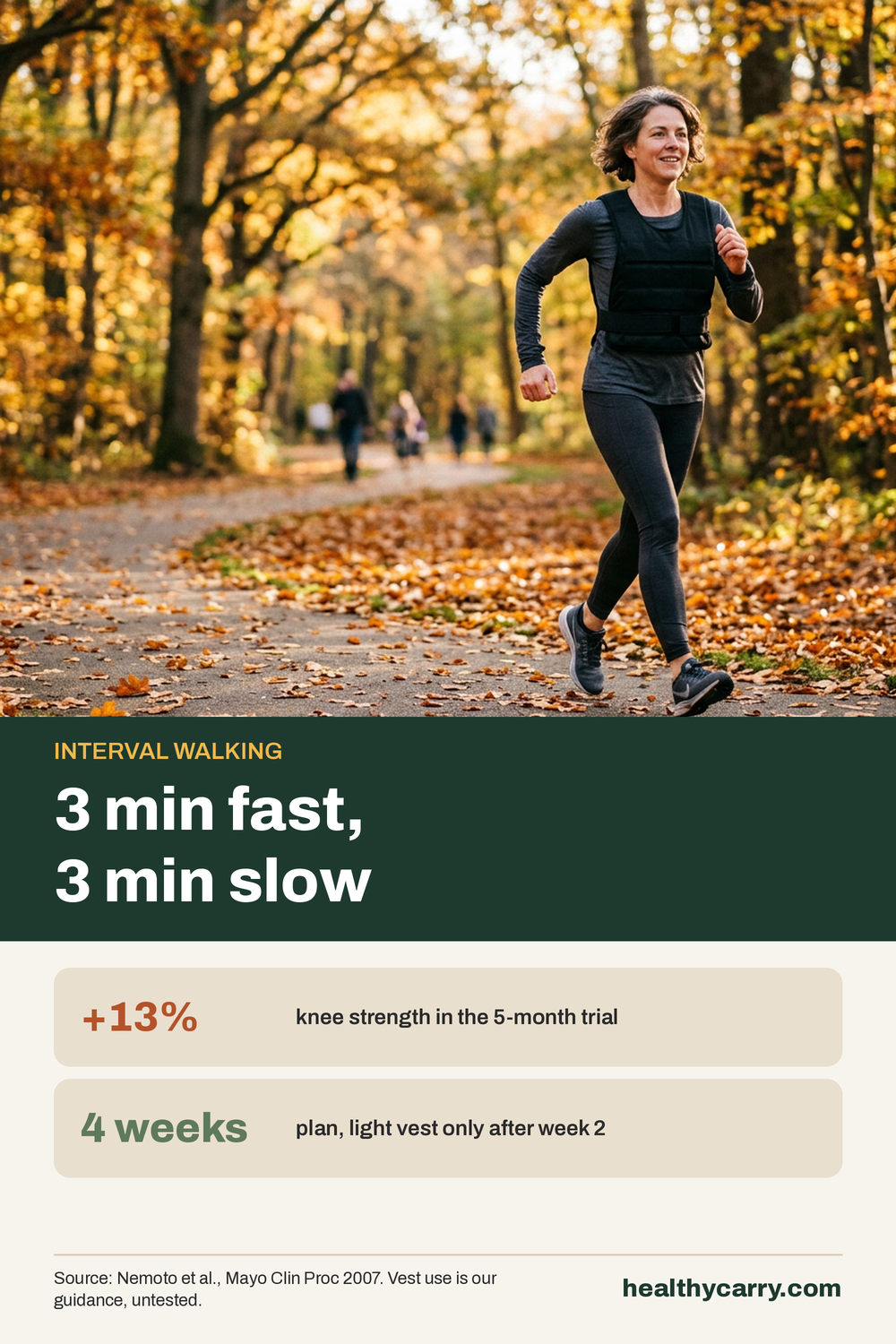
Three minutes fast, three minutes easy, repeat. That’s the whole idea behind “Japanese walking,” and in the original trial it beat plain moderate walking for thigh strength and blood pressure in people around age 63. The big question we keep getting: should you wear a weighted vest while you do it? Short answer: not at first, and here’s a plan that adds one carefully.
Quick answer: Japanese walking is interval walking training: 3 minutes of fast walking, then 3 minutes of slow walking, repeated 5 or more times, at least 4 days a week. In a 5-month randomized trial of 246 adults averaging age 63, it raised knee-extension strength 13%. Nobody tested it with a weighted vest, so learn the intervals first, then add a light vest (about 3–5% of body weight).
What is Japanese walking, and where did it come from?
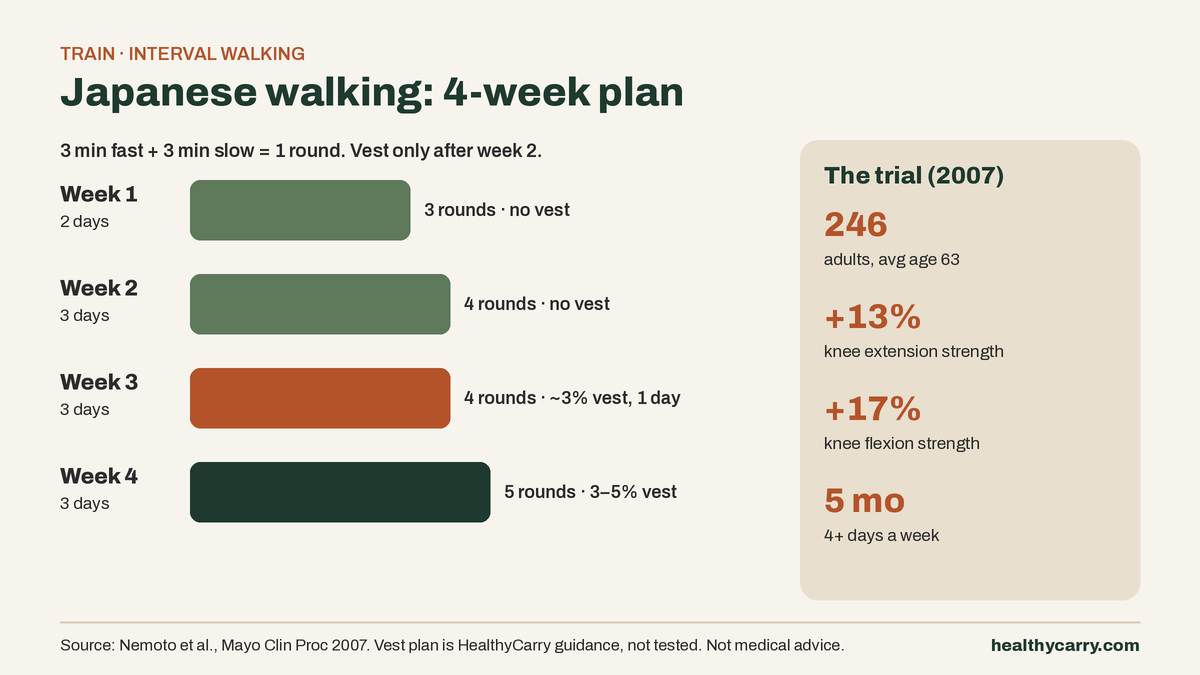
The method comes from researchers at Shinshu University in Japan, who called it interval walking training (IWT). It isn’t a martial art or a secret technique. It’s a simple pattern: alternate fast walking at roughly 70% or more of your peak walking capacity with slow walking at about 40%, three minutes each. The trial, Nemoto and colleagues, Mayo Clinic Proceedings, 2007, ran for 5 months.
| Detail | What the trial reported |
|---|---|
| People | 246 adults (60 men, 186 women), average age 63 ± 6 |
| Groups | No walking training, moderate continuous walking, interval walking |
| Interval group | 5 or more sets of 3 min fast (about 70% of peak) + 3 min slow (about 40%), 4+ days a week |
| Knee extension strength | +13% |
| Knee flexion strength | +17% |
| Peak aerobic capacity | +8% (cycling), +9% (walking) |
| Blood pressure | Larger drop in resting systolic pressure than the continuous group |
A later report on 679 people doing 5 months of the same method (Mayo Clinic Proceedings, 2019) found an average 14% rise in peak aerobic capacity, with results varying by how much fast walking people actually did.
How do you do Japanese walking step by step?
- Warm up with 3–5 minutes of easy walking.
- Fast 3 minutes: walk quickly enough that talking in full sentences is hard, but you can keep going. Think “late for a train,” not jogging.
- Slow 3 minutes: drop to an easy stroll where you can breathe comfortably.
- Repeat until you’ve done 5 rounds (30 minutes). Beginners can start with 2–3 rounds.
- Cool down with a few minutes of easy walking.
In the trial the target was 4 or more days a week, but most people don’t need to start there. Begin with 2 days and build up. Honestly, many participants struggled to hit the target: in the interval group, the prescribed targets were met by 31 of 68 women and 11 of 19 men. Starting small is normal.
Can you do Japanese walking with a weighted vest?
Maybe, but there’s no trial to say it’s better. The studies used no added weight. That matters for two reasons. A vest slows most people down, so your “fast” segments may feel harder without being faster. And extra load on knees and hips adds up over many weeks. For general background see our weighted vest walking guide.
Our suggestion, which is our own coaching guidance and not something the research tested: learn the intervals without a vest for 2 weeks, then try a snug vest weighing about 3–5% of your body weight. Only add more after several comfortable weeks, as in how to start rucking. Use the ruck weight calculator to find your number.
Japanese walking weighted vest plan: 4 weeks
| Week | Sessions | Rounds (3 fast + 3 slow) | Vest |
|---|---|---|---|
| 1 | 2 | 3 rounds (18 min) | None |
| 2 | 3 | 4 rounds (24 min) | None |
| 3 | 3 | 4 rounds (24 min) | About 3% of body weight, on 1 session only |
| 4 | 3 | 5 rounds (30 min) | About 3–5%, on 2 of 3 sessions |
Example: at 150 lb, 3% is 4.5 lb and 5% is 7.5 lb. If your knees, hips or back complain, drop the vest and keep the intervals. The intervals are the part with the evidence.
Stop and get help if you notice: chest pain or pressure, shortness of breath that doesn’t settle when you slow down, dizziness or fainting, or sharp joint pain that changes how you walk. If you have heart disease, high blood pressure, osteoporosis or a recent injury, check with your clinician before doing fast intervals or adding weight. This article is general information, not medical advice.
Japanese walking vs regular walking: which is better?
| Question | Regular steady walk | Japanese walking |
|---|---|---|
| Effort | Even, easy to moderate | Alternating hard and easy |
| Time for 30 minutes | One pace | 15 minutes fast, 15 minutes slow |
| Strength and fitness gains in the trial | Smaller | Larger (thigh strength, peak capacity) |
| Best for | Recovery days, long walks | 2–3 shorter, focused sessions a week |
They work together. Keep your easy daily walking, and use intervals on a few days. If a recent news item on pace interests you, see the new walking cadence study.
Frequently asked questions
What is the Japanese walking method?
It’s interval walking: 3 minutes of fast walking followed by 3 minutes of slow walking, repeated at least 5 times, on 4 or more days a week in the original research.
How long should I do Japanese walking?
A full session is about 30 minutes (5 rounds). Beginners can start with 2–3 rounds, 2 days a week, and build up.
Is Japanese walking good for weight loss?
The trials measured strength, aerobic capacity and blood pressure rather than weight loss as the main results, so we can’t promise fat loss. Walking more and eating well are what move body weight.
Is Japanese walking safe for women over 50?
The 2007 trial enrolled mostly women (186 of 246) with an average age of 63. Intensity was scaled to each person’s own capacity. Check with your clinician if you have a health condition.
Should I use a weighted vest for Japanese walking?
It’s optional and untested. Start without one, then try about 3–5% of body weight if your joints feel fine.
Get the free 4-week Start Carrying plan: a printable plan with a weekly log, to pair with your interval days.
Sources
- Nemoto K, Gen-no H, Masuki S, Okazaki K, Nose H. “Effects of high-intensity interval walking training on physical fitness and blood pressure in middle-aged and older people.” Mayo Clin Proc 2007;82(7):803-811. PubMed 17605959
- Masuki S, et al. “High-intensity walking time is a key determinant to increase physical fitness and improve health outcomes after interval walking training in middle-aged and older people.” Mayo Clin Proc 2019. mayoclinicproceedings.org
- “Health benefits of interval walking training.” Appl Physiol Nutr Metab 2024. doi.org/10.1139/apnm-2023-0595
- CNN Health. “‘Japanese walking’: Enhance your walks with interval training,” October 17, 2025. cnn.com
- “Beyond epidemiology: field studies and the physiology laboratory as the whole world” (IWT protocol description). PMC2805369