
“Ruck a 15-minute mile” is advice built for soldiers and events, not for a 52-year-old starting her first ruck with 8 lb on her back. For health, a good rucking pace is simply a brisk walk you could keep talking through, which for most adults lands somewhere between 17 and 22 minutes per mile.
Quick answer: A beginner rucking pace is about 20 minutes per mile (3 mph, 4.8 km/h, 12:26 per km). Brisk is 17–18 minutes per mile (3.3–3.5 mph). Use the converter below to switch between min/mile, mph, km/h and min/km, and to see how long your route will take.
Rucking pace converter
What is a good rucking pace for beginners?
Start at whatever pace lets you talk in full sentences while carrying the load, usually around 3 mph (20 minutes per mile). If you're breathing too hard to talk, slow down or lighten the pack. After two to four weeks, many people settle naturally into 17–18 minutes per mile.
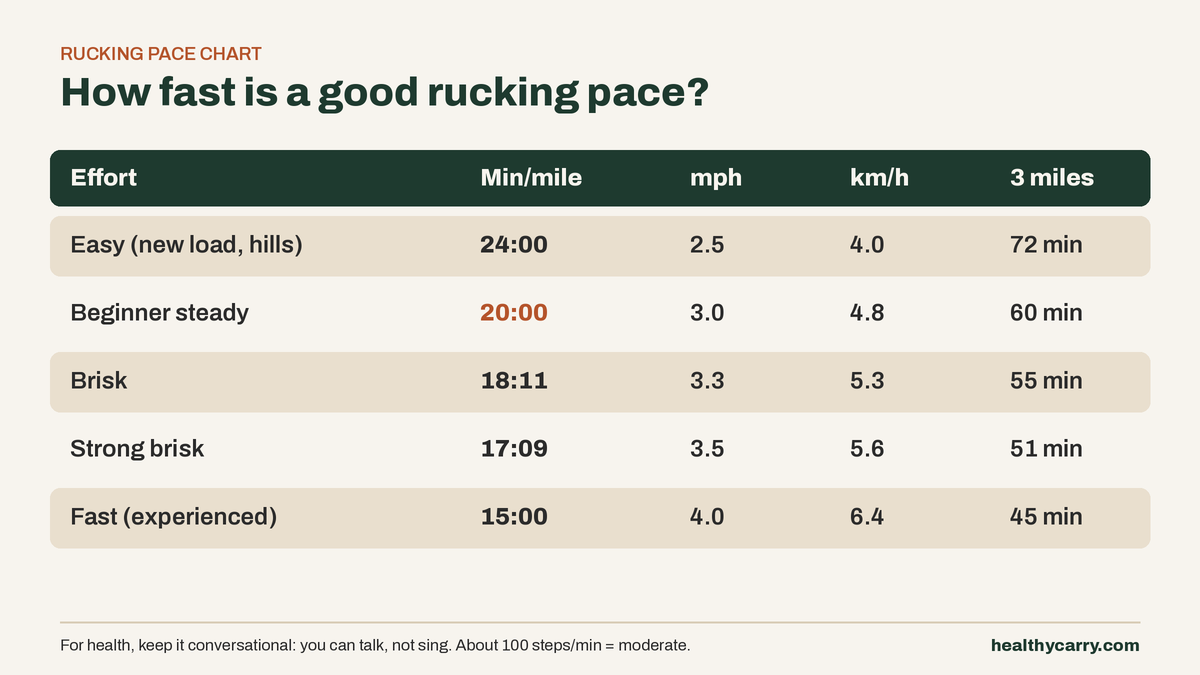
Rucking pace chart
| Effort | Min/mile | mph | km/h | Min/km | 3 miles takes |
|---|---|---|---|---|---|
| Easy (new load, hills) | 24:00 | 2.5 | 4.0 | 14:55 | 72 min |
| Beginner steady | 20:00 | 3.0 | 4.8 | 12:26 | 60 min |
| Brisk | 18:11 | 3.3 | 5.3 | 11:18 | 55 min |
| Strong brisk | 17:09 | 3.5 | 5.6 | 10:39 | 51 min |
| Fast (experienced) | 15:00 | 4.0 | 6.4 | 9:19 | 45 min |
Is a 15-minute mile a good rucking pace?
For events and military-style standards, it's a common benchmark. For general health after 35, it isn't necessary, and pushing for it with a load is where shins, knees and lower backs start to complain. Faster isn't the goal; consistent, comfortable rucks are. If you want more challenge, a hill or a slightly longer route is usually kinder to your joints than speed. Our rucking calorie calculator shows how much a gentle incline adds compared with speed or weight.
How do you know your pace is "moderate"?
Two simple checks:
- The talk test: you can talk but not sing. That's moderate intensity, the kind that counts toward the 150 weekly minutes in the U.S. Physical Activity Guidelines.
- Steps per minute: the CADENCE-Adults studies found that about 100 steps per minute marks moderate-intensity walking in adults, including those aged 61–85. Count your steps for 15 seconds and multiply by four.
Never run with a ruck. Running multiplies the impact of every extra pound on your feet, knees and spine. If your pace is creeping toward a jog, lighten the load instead. Not sure how much weight to carry? Use our ruck weight calculator.
Should you slow down when you add weight?
Yes. A good rule is to keep the same effort, not the same speed. When you add 2–4 lb, expect to be 30–60 seconds per mile slower for a week or two. Change only one thing at a time: weight, time or pace. That's the core of the plan in how to start rucking after 35.
FAQ
How long does it take to ruck 1 mile?
About 17–20 minutes for most beginners at a brisk, conversational pace, and up to 24 minutes on hills or with a new load.
How long does it take to ruck 5 miles?
About 1 hour 25 minutes to 1 hour 40 minutes at 17–20 minutes per mile.
Is rucking pace slower than walking pace?
Usually a little. Most people walk 30–60 seconds per mile slower with a pack, especially in the first weeks.
Does walking pace matter for weighted vest walking?
The same rules apply: keep it conversational and slow down when you add weight. See our weighted vest walking guide.
Keep going
Get the free 4-week Start Carrying plan, or browse all our free tools.
Sources
- Tudor-Locke C, et al. Walking cadence (steps/min) and intensity in 21–40 year olds: CADENCE-adults. Int J Behav Nutr Phys Act, 2019.
- Tudor-Locke C, et al. Walking cadence (steps/min) and intensity in 61–85-year-old adults: the CADENCE-Adults study. Int J Behav Nutr Phys Act, 2021.
- U.S. Department of Health and Human Services. Physical Activity Guidelines for Americans, 2nd edition.
- CDC. Measuring physical activity intensity (talk test).
Educational information only, not medical advice.
