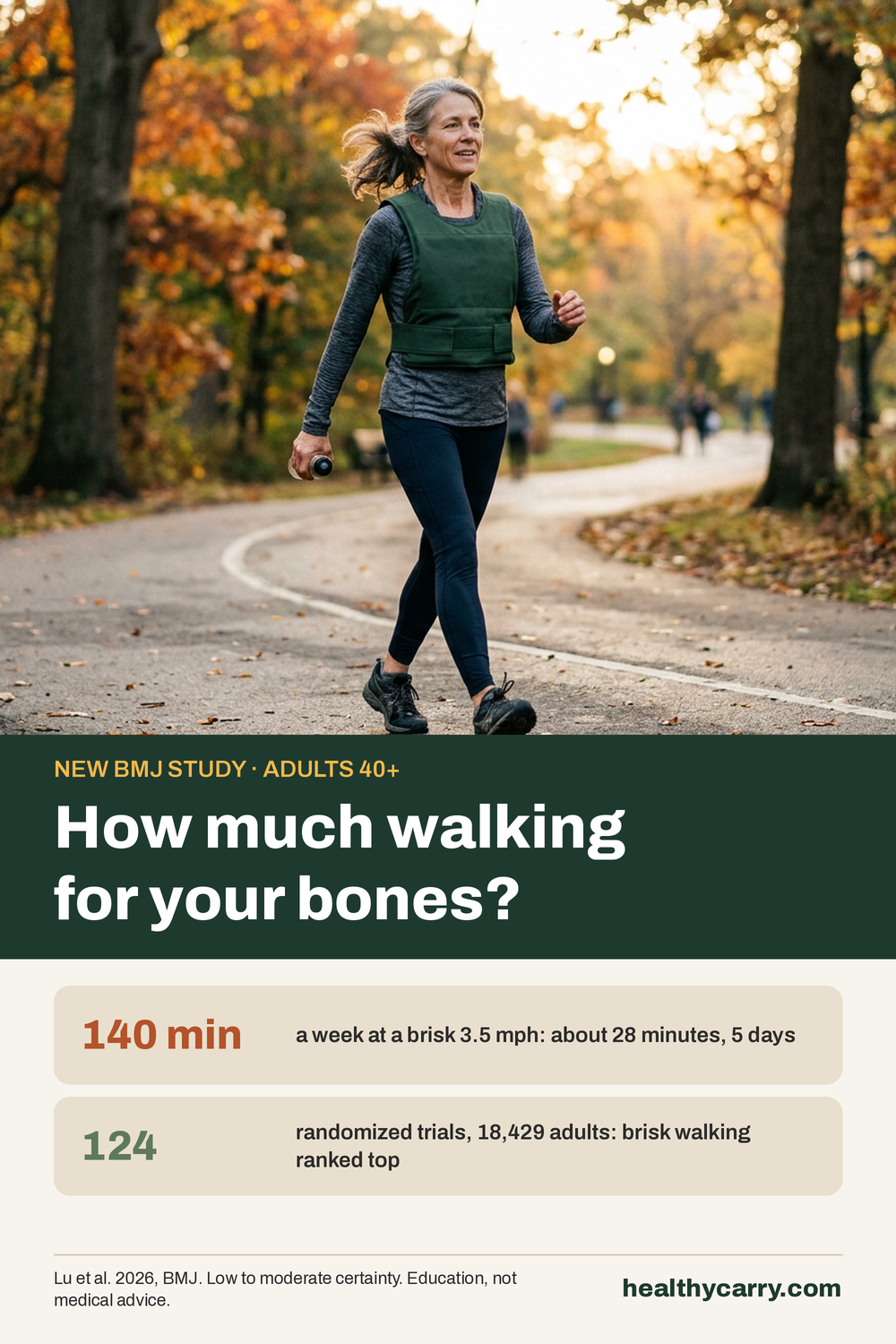
For years, the standard line on bones after 40 has been “lift heavy, walking isn’t enough.” Then a team pooled 124 randomized trials and 18,429 adults aged 40 and older, and brisk walking or jogging landed at or near the top for bone density at the spine, the femoral neck and the hip. The dose that started to matter was about 2 to 3 hours a week.
Quick answer: How much walking for bone density? A 2026 BMJ network meta-analysis of 124 trials found clinically meaningful bone-density benefits at about 600 MET-minutes a week, which the authors translate to roughly 2–3 hours of brisk walking or jogging. At a brisk 3.5 mph that’s about 140 minutes, or 28 minutes on five days. Evidence certainty was low to moderate.
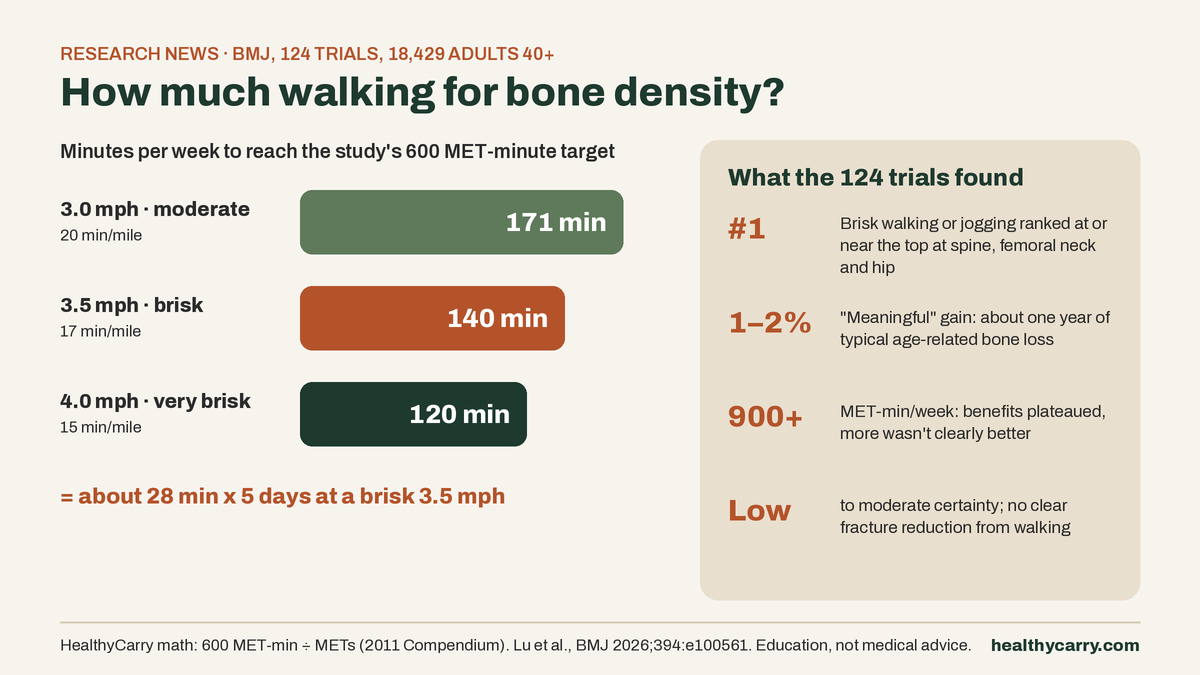
How much walking for bone density did the study find?
The paper, published in The BMJ on September 9, 2026 and highlighted by NEJM Journal Watch on October 7, asked two practical questions: which type of exercise best slows bone loss after 40, and how much of it you need.
The researchers grouped exercise into six types (brisk walking or jogging, resistance training, combined aerobic and resistance training, mixed aerobic exercise, mind-body exercise like tai chi and yoga, and whole-body vibration) and converted every program into one shared unit: MET-minutes per week. One MET is the energy you burn sitting still, so a brisk walk at 4.3 METs for 30 minutes is about 129 MET-minutes.
Their dose findings, in plain numbers:
- About 400 MET-min/week was enough for a meaningful change at the lumbar spine.
- About 600 MET-min/week was the threshold for the femoral neck and total hip, and the paper’s headline target.
- Benefits plateaued around 900–1,000 MET-min/week. More wasn’t clearly better.
- For brisk walking specifically, the modeled thresholds were 427 (spine), 753 (femoral neck) and 789 (total hip) MET-min/week.
“Meaningful” here means a gain of 1–2% of baseline bone density. That sounds tiny, but it’s roughly the 1–2% a year that adults in this age range typically lose, so it’s about cancelling a year of decline.
Your weekly walking minutes, by pace
The paper gives MET-minutes, not minutes. So we did the math. The table uses the 2011 Compendium of Physical Activities, the same reference the BMJ team used to score exercise intensity.
| Walking pace (level ground) | METs | Spine target (427) | Headline target (600) | Hip target (789) |
|---|---|---|---|---|
| 3.0 mph (20 min/mile), moderate | 3.5 | 122 min/week | 171 min/week | 225 min/week |
| 3.5 mph (17 min/mile), brisk | 4.3 | 99 min/week | 140 min/week | 183 min/week |
| 4.0 mph (15 min/mile), very brisk | 5.0 | 85 min/week | 120 min/week | 158 min/week |
| 3.5 mph + pack at 10% of body weight* | ~4.6 | ~92 min/week | ~130 min/week | ~171 min/week |
HealthyCarry calculation: minutes = MET-minute target ÷ METs. Spine and hip targets are the BMJ’s brisk-walking thresholds; 600 is its overall threshold. *Loaded row estimated with the Pandolf load-carriage equation (about 7% more energy than unloaded at 3.5 mph). The study didn’t test loaded walking.
Two things jump out. First, pace matters as much as time: speeding up from 3.0 to 3.5 mph cuts about 30 minutes off the weekly target. Second, the 2–3 hour figure isn’t a vague “be active” line. It’s 25 to 35 minutes on five days.
Why would brisk walking rank so high?
The authors’ explanation is mechanical. Every brisk step lands with a ground force of roughly 1.5 to 2 times your body weight, thousands of times per session. Bone cells respond to that repeated, dynamic strain.
They also point out a practical problem with lifting in older adults: programs are often kept light for safety, and light loads may not cross the threshold bone needs. Brisk walking delivers a moderate, repeatable impact that most people can actually stick with.
That doesn’t mean strength training lost. Combined aerobic and resistance programs matched brisk walking at the spine (both +0.013 g/cm²). Resistance training alone still helped the spine and femoral neck, just by less, and it builds the muscle and balance that walking doesn’t.
What the study can’t tell us
- Certainty is low to moderate. The authors say so themselves. About 30% of trials were rated high risk of bias.
- The walking data are thin. The brisk-walking spine estimate came from 10 trials and 245 people. The total-hip result, the only site where brisk walking clearly beat control, rested on just 3 trials and 68 people.
- Small trials may inflate the effect. The paper flags that several small brisk-walking trials reported “outsized” results.
- Bone density isn’t fractures. In 26 trials that counted fractures, brisk walking’s result (odds ratio 0.68) didn’t reach significance. Mixed aerobic and mind-body exercise did show possible fracture reductions, also with low certainty.
- Women and older adults got less out of the same dose. Men and 40-to-60-year-olds reached the thresholds more easily than women and adults over 60, and people with overweight needed more (all very low certainty). 73% of trials were women-only, so the women’s data are the strongest part.
- METs measure energy, not bone strain. The authors warn that MET-minutes don’t capture peak loading. Their minute targets are approximations, not exact cutoffs.
- Older reviews disagree. A 2013 meta-analysis in Menopause found walking alone didn’t change spine density in peri- and postmenopausal women, with hip benefits only after 6+ months.
What it means for you
If you’re over 40 and walking is the exercise you’ll actually do, this is good news with a number attached. Aim for brisk, not strolling: you should be able to talk in short sentences but not sing. Build toward about 140 minutes a week at 3.5 mph, and don’t drop your twice-weekly strength work. The combination ranked well for the spine, and muscle is what keeps you from falling in the first place.
Carrying a load, like a vest or a backpack, makes the same walk cost more energy, so you may reach the MET target slightly sooner. Whether load adds extra bone benefit on top of brisk walking hasn’t been tested in this kind of trial. Our recent weighted vest study breakdown found a strength boost but no short-term bone change.
Safety first: If you have osteoporosis, a past fragility fracture or balance problems, ask your clinician or a physical therapist how fast and how far to build. Exercise complements treatment; it doesn’t replace it. Stop and get checked for new bone or joint pain, dizziness or near-falls.
Your step for this week
Time one walk at your normal “brisk.” If a mile takes longer than 17 minutes, you’re under 3.5 mph. This week, do five 25-minute walks at the fastest pace you can hold while still talking. That’s 125 minutes, about 540 MET-minutes at 4.3 METs. Next week, add 3 minutes per walk. Use the rucking pace calculator to check your speed, and the calorie calculator if you add a pack.
New to carrying weight? Start with weighted vest walking basics or how to start rucking, and keep the pace brisk before you add a single pound.
FAQ
Does brisk walking increase bone density?
In the 2026 BMJ analysis, brisk walking or jogging was linked to small but meaningful gains at the spine, femoral neck and hip compared with no exercise, with low to moderate certainty. In practice it mostly slows age-related loss rather than building new bone.
How many minutes a day should I walk for bone health?
The study’s target of about 600 MET-minutes a week works out to roughly 140 minutes at 3.5 mph, or about 28 minutes on five days. At a slower 3.0 mph you’d need about 34 minutes on five days.
Is walking enough for osteoporosis?
Not on its own. Guidelines still pair weight-bearing activity with strength and balance training, plus medication when your clinician prescribes it. This analysis didn’t show that walking reduces fractures, and people with osteoporosis should get a tailored plan.
Does walking speed matter for bone density?
The study grouped brisk walking with jogging, which suggests intensity matters. A slow stroll at about 2.5 mph is roughly 3 METs, so it takes about two-thirds longer to reach the target than a 4.0 mph walk at 5 METs: about 200 minutes a week instead of 120.
Is a weighted vest better than plain walking for bones?
We don’t know yet. A vest raises the energy cost and the load on your skeleton, but no large trial has shown it adds bone benefit beyond brisk walking itself. Short trials show strength gains, not bone changes.
Get the free 4-week Start Carrying plan: a printable walking-and-carry plan with a weekly log, plus one evidence-checked tip each week in Load Notes.
Sources
- Lu C, Li L, Zhang L, et al. “Effect of exercise on bone health in middle aged and older adults: hierarchical network meta-analysis of randomised trials.” BMJ 2026;394:e100561, published September 9, 2026. bmj.com (PubMed 42716561)
- Post SE. “Exercise and Bone Density: Does Modality Matter?” NEJM Journal Watch / NEJM Clinician, October 7, 2026. clinician.nejm.org
- Ainsworth BE, et al. “2011 Compendium of Physical Activities: a second update of codes and MET values.” Medicine & Science in Sports & Exercise 2011;43:1575-81. MET table (PDF)
- Compendium of Physical Activities (2024 update): Walking codes. pacompendium.com
- Ma D, Wu L, He Z. “Effects of walking on the preservation of bone mineral density in perimenopausal and postmenopausal women: a systematic review and meta-analysis.” Menopause 2013;20(11):1216-26. PubMed 24149921
- Knapik J, Harman E, Reynolds K. “Load carriage using packs: a review of physiological, biomechanical and medical aspects.” Applied Ergonomics 1996;27(3):207-16. PubMed 15677062
- National Institute of Arthritis and Musculoskeletal and Skin Diseases. “Exercise for Your Bone Health.” niams.nih.gov