Those “farmer’s carry by age” charts all over Pinterest and fitness blogs? We tried to trace them to a study and came up short. One 2025 lab paper that used body-weight percentages for its carry loads cited a coach’s blog for them. The good news: you don’t need a magic number. You need a starting weight you can walk tall with for 30 seconds, and a simple way to add more.
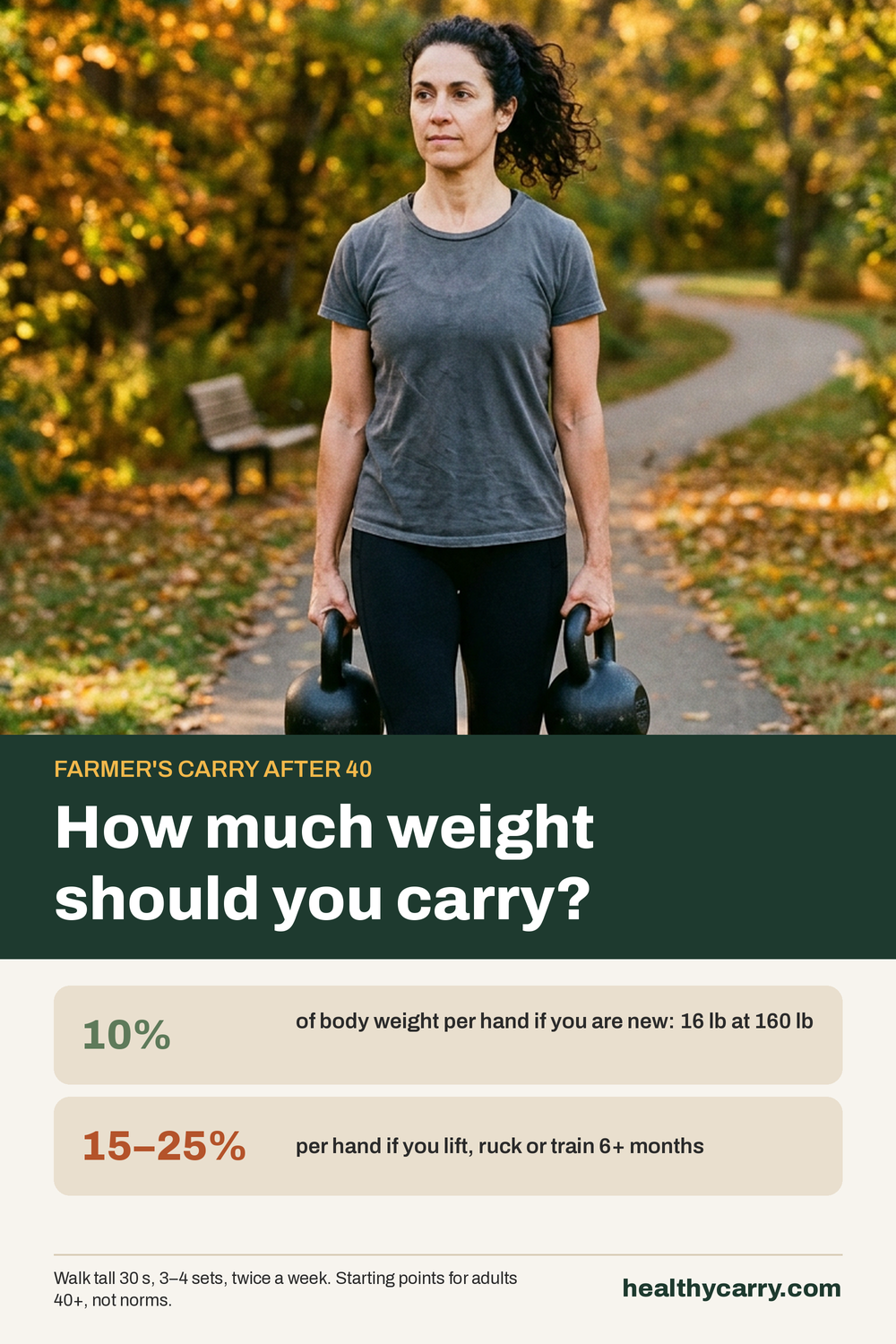
Quick answer: New to carries and 40+? Start with about 10% of your body weight in each hand (16 lb at 160 lb). Use 15% if you lift or ruck, 25% after 6+ months of steady training. Walk tall for 30 seconds, 3–4 sets, twice a week. Add 2.5–5 lb per hand only when every set feels easy.
What is a farmer’s carry, exactly?
You pick up a weight in each hand, stand tall, and walk. That’s it. Dumbbells and kettlebells are the usual tools, but two shopping bags or two full water jugs work too. A gallon of water weighs about 8.3 lb (3.8 kg), so two jugs per hand is roughly 17 lb.
It’s one of the few strength exercises that looks exactly like daily life: carrying groceries from the car, hauling a laundry basket up the stairs, lifting a suitcase into an overhead bin. That’s why physical therapists and strength coaches like it for adults over 40. If you’ve read our rucking guide, think of the farmer’s carry as rucking with the load in your hands instead of on your back. It’s shorter, heavier and much tougher on your grip.
How much weight should you use for a farmer’s carry?
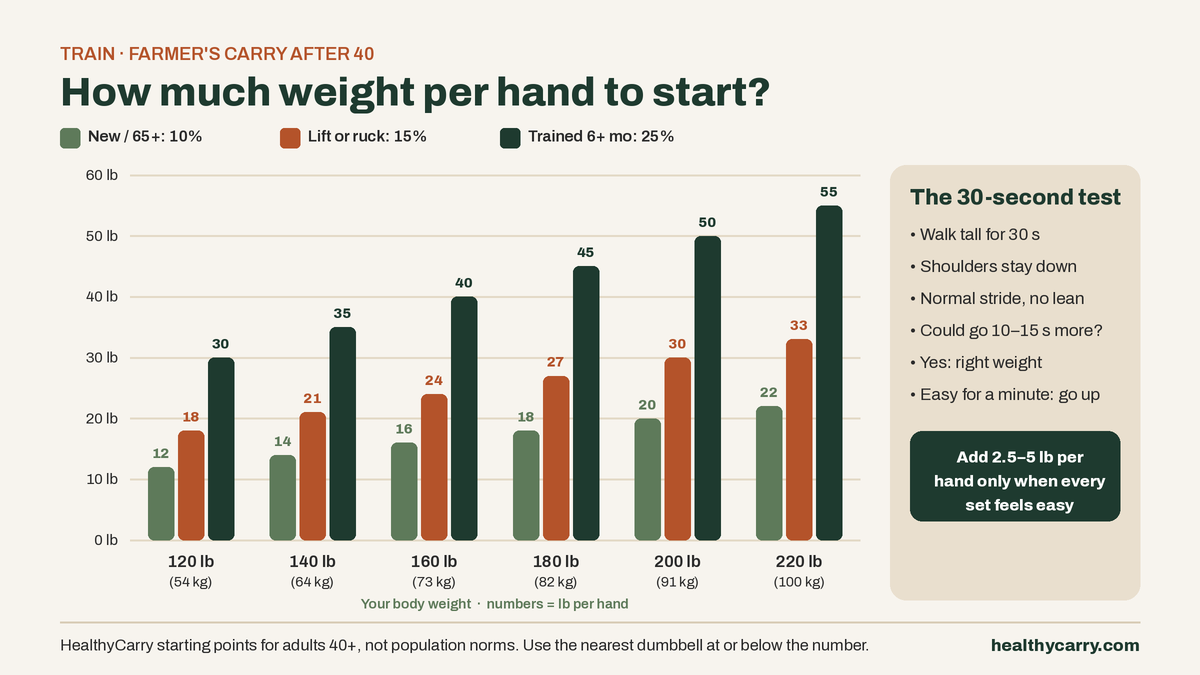
Use the table to find a starting weight per hand. These are HealthyCarry’s conservative starting points for adults 40+, not population norms. Start in the column that matches your training history, then let the 30-second test below have the final say.
| Your body weight | New to strength training or 65+ (10% per hand) | Lift or ruck sometimes (15% per hand) | Lift 2x/week for 6+ months (25% per hand) |
|---|---|---|---|
| 120 lb (54 kg) | 12 lb | 18 lb | 30 lb |
| 140 lb (64 kg) | 14 lb | 21 lb | 35 lb |
| 160 lb (73 kg) | 16 lb | 24 lb | 40 lb |
| 180 lb (82 kg) | 18 lb | 27 lb | 45 lb |
| 200 lb (91 kg) | 20 lb | 30 lb | 50 lb |
| 220 lb (100 kg) | 22 lb | 33 lb | 55 lb |
Per hand, rounded. Use the closest dumbbell or kettlebell at or below the number. 1 kg ≈ 2.2 lb.
The 30-second test
Pick up your starting weight and walk for 30 seconds. Then ask yourself three questions:
- Did your shoulders stay down and back? If they crept up toward your ears or rolled forward, go lighter.
- Did you walk normally? Leaning, waddling or shuffling means the weight is too heavy.
- Could you have gone 10–15 seconds longer? If yes, it’s the right weight. If you could have gone a full minute more, go up one step.
Your grip will probably give out first. That’s normal and part of the point. Set the weights down with control (squat, don’t bend over), shake out your hands, and go again.
Is there a “good” farmer’s carry weight for your age?
You’ll see charts that list targets by age and sex, and the claim that women should eventually carry 37.5% of their body weight in each hand (75% total) for 60 seconds. These are usually credited to “a University of Pittsburgh study.” We searched and couldn’t locate that paper. The percentages appear to come from strength-coaching rules of thumb, and that’s fine as long as you treat them as long-range coaching targets, not science.
What research does show is that grip strength tracks with health as we age. In the PURE study, which followed nearly 140,000 adults in 17 countries, every 5 kg (11 lb) lower grip strength was linked with a 16% higher risk of death from any cause. That’s an association, not proof that carries extend life. But a carry is one of the most direct ways to train your grip, and it trains your legs, hips and trunk at the same time.
Our advice: compare yourself with yourself. Log your weight and time every session. A 40% jump in the weight you can carry for 30 seconds over a few months is a far more useful number than any age chart.
What muscles does a farmer’s carry work?
Almost everything that keeps you upright: forearms and grip, upper back and traps, glutes and legs, and the deep muscles along your spine. A 2024 study from Slippery Rock University measured trunk muscle activity in 18 young adults during carries, holds and planks, all with matched loads.
| Exercise | Low-back stabilizers (longissimus, right side) | Front abs (rectus abdominis, right side) | Best for |
|---|---|---|---|
| Farmer’s carry (walking) | 16.4% | 10.7% | Back and hip stability while you move |
| Farmer’s hold (standing still) | 5.6% | 4.6% | Learning posture and grip |
| Plank | 5.5% | 48.8% | Front abs |
| Suitcase carry (one hand) | 6.8% same side, 29.1% opposite side | 7.5% | Obliques and side-to-side control |
Average muscle activity as % of maximal effort. Data from Ellestad et al., International Journal of Exercise Science, 2024 (Table 2), simplified by HealthyCarry.
Two takeaways. First, walking with the weights worked the low-back stabilizers about three times harder than standing still or planking. Second, the plank still wins for the front abs. They’re partners, not rivals. The suitcase carry is especially handy if getting down to the floor for a plank is hard: on the side opposite the weight, it worked the outer abdominal wall about as much as a plank did.
One caution: these were 20-year-olds, so the exact numbers may differ for you. The pattern (moving under load asks more of your trunk than holding still) is what transfers.
How do you do a farmer’s carry with good form?
- Set up. Place the weights just outside your feet. Squat or hinge down with a flat back and grab them by the center of the handle.
- Stand up tall. Drive through your feet, then gently pull your shoulders down and back. Eyes forward, ribs stacked over your hips.
- Brace and breathe. Tighten your midsection as if someone’s about to poke your stomach, but keep breathing. Short, steady breaths. Don’t hold your breath.
- Walk normally. Smooth, heel-to-toe steps at your usual stride. The weights shouldn’t swing or bang your legs.
- Put it down like you picked it up. Stop, squat, and set the weights down. Most carry tweaks happen at the end, when you’re tired.
Safety first: Carries briefly raise blood pressure. In one 2025 study of healthy young adults, a 30-second farmer’s carry raised systolic pressure by about 9 mmHg in women and 15 mmHg in men. If you have high blood pressure, heart disease, a hernia, osteoporosis with a past spine fracture, or recent back, shoulder or hand surgery, check with your clinician or a physical therapist first. Keep breathing, keep sets short, and stop if you feel dizzy, chest pain, or sharp pain anywhere.
A 6-week farmer’s carry plan for beginners over 40
Do this twice a week, after a 5-minute warm-up (an easy walk is fine). Rest 60–90 seconds between sets, longer if your grip needs it. It pairs well with two weekly rucks or vest walks: on carry days, keep your walk easy.
| Week | What you do | Weight |
|---|---|---|
| 1 | 3 × 20-second farmer’s holds, then 3 × 20-second carries | Starting weight |
| 2 | 3 × 30-second carries | Starting weight |
| 3 | 4 × 30-second carries | Starting weight |
| 4 | 3 × 30-second carries | +2.5 to 5 lb per hand |
| 5 | 3 × 40-second carries + 2 × 20-second suitcase carries per side | Week 4 weight |
| 6 | 4 × 40-second carries + 2 × 30-second suitcase carries per side | Week 4 weight |
The rule is the same one we use for rucking: change one thing at a time. Add time or add weight, never both in the same week. If a week leaves your hands, shoulders or back sore for more than a day, repeat it.
What if you don’t have dumbbells?
Fill two sturdy grocery bags or two water jugs, or use a loaded backpack held by the top handle. Hardware stores sell sandbags you can bag into two equal halves. Uneven grips make the carry harder, so start lighter than the table suggests.
Farmer’s carry vs. suitcase carry: which should you do?
Do both. The farmer’s carry (a weight in each hand) lets you use more total weight and trains grip, upper back and spine stabilizers evenly. The suitcase carry (one weight, one hand) forces your trunk to fight leaning to the side, which trains your obliques and helps you carry real-life lopsided loads like a bag or a toddler. Start with the farmer’s carry in weeks 1 to 4, then add suitcase carries once your posture is solid. Use about half the farmer’s carry weight in one hand to start.
How do carries fit with rucking and walking?
Rucking and vest walking build endurance under load. Carries build strength under load. A simple week for most adults over 40 looks like this: two rucks or vest walks, two short strength sessions that include carries, and easy walking on the other days. That covers the CDC’s baseline of 150 minutes of moderate activity plus muscle-strengthening work on at least two days a week. Not sure how heavy your ruck should be? Use our ruck weight calculator, and browse more plans in Train.
FAQ
How much weight should a beginner use for a farmer’s carry?
About 10% of your body weight in each hand if you’re new to strength training or over 65, and about 15% if you already lift or ruck. A 160-lb person would start with 16–24 lb per hand. Keep it if you can walk 30 seconds with tall posture and feel you could go a bit longer.
How long should I carry for?
Start with 20–30 seconds per set, 3–4 sets. Build toward 40–60 seconds before chasing heavier weights. Long, light carries train endurance and posture; short, heavy carries train grip and strength.
Are farmer’s carries good for women over 50?
For most women, yes. They’re low-impact, use everyday movement, and train grip, legs and the muscles that support your spine. If you have osteoporosis, a past fracture, or pelvic floor symptoms, ask a physical therapist to help you choose a starting weight.
Can farmer’s carries help bone density?
They add load through your skeleton, which bone needs in order to adapt, but no trial has tested carries alone for bone density. The best bone evidence comes from months of progressive strength training plus impact work. Think of carries as one useful part of that program.
How often should I do farmer’s carries?
Two or three times a week is plenty, with at least a day in between. Your grip and forearms need recovery too, especially if you also ruck or lift.
Is it OK to do farmer’s carries every day?
Light carries, like groceries or a short walk with jugs, are fine most days. Hard sets that tire your grip are better kept to 2–3 days a week so your hands, shoulders and back can recover.
Get the free 4-week Start Carrying plan: a printable plan with a weekly log, plus one evidence-checked carrying tip each week in Load Notes.
Sources
- Ellestad SH, Holcomb TP, Swiergol AM, Holmstrup ME, Dicus JR. “The Quantification of Muscle Activation During the Loaded Carry Movement Pattern.” International Journal of Exercise Science 2024;17(1):480–490. PMC11042841
- Leong DP, et al. “Prognostic value of grip strength: findings from the Prospective Urban Rural Epidemiology (PURE) study.” The Lancet 2015. PubMed 25982160
- Wheelock B, Grzywaczewski M, Flannery M, Feairheller DL. “The Location of a Weighted Carry in Relation to the Body May Have Clinical Implications for Health and Exercise Programming.” Journal of Vascular Diseases 2025;4(3):32. mdpi.com
- McGill SM, McDermott A, Fenwick CM. “Comparison of different strongman events: trunk muscle activation and lumbar spine motion, load, and stiffness.” Journal of Strength and Conditioning Research 2009. PubMed 19528856
- Holmstrup ME, et al. “Fat-Free Mass and the Balance Error Scoring System Predict an Appropriate Maximal Load in the Unilateral Farmer’s Walk.” Sports 2018. PMC6315369
- National Strength and Conditioning Association. “Increase Hip and Trunk Stability with Loaded Carries for Injury Prevention, Rehabilitation, and Performance.” nsca.com
- Centers for Disease Control and Prevention. “Adult Activity: An Overview.” cdc.gov