
In a small 2026 lab study, nine people walked briskly on a treadmill at about 3.3 mph (5.2 km/h), with and without a 10-lb (4.5 kg) weighted vest. The vest raised their energy use by roughly 15 calories an hour. That doesn’t make vests useless. It means the number on the vest matters less than how you use it, and that’s what this guide is about.
Quick answer: Start with a vest that weighs about 5% of your body weight (7–8 lb / 3.5 kg if you weigh 150 lb / 68 kg). Wear it for 15–20 minutes, or less than half your usual walk, 2–3 times a week. Add about 1–2 lb (0.5–1 kg) every week or two only while your posture and stride stay normal. Most medical sources cap walking vests at about 10% of body weight. Skip the vest, or ask your clinician first, if you have back or neck problems, spinal stenosis, hip or knee arthritis that flares, or are pregnant.
Why weighted vests took off, especially with women 40+
Weighted vests have become one of the most talked-about walking upgrades, and much of the conversation comes from women in perimenopause and menopause who already walk and want more from it. Mass General Brigham notes the popular claim that vests help maintain bone density in this group; we’ll look at how well that holds up below. The appeal is simple. A vest turns a walk you already take into something that asks more of your legs, trunk, and heart, and it does so without a gym, a class, or a new skill.
The claims around vests have run ahead of the research, though, especially on bones. So we’ll keep two lists in this guide: what the studies show, and what is still a hopeful guess.
How heavy should your vest be?
Here’s what major medical centers recommend for starting weight. Notice how tightly they cluster:
| Source | Starting weight | Upper guidance |
|---|---|---|
| UCLA Health | About 5% of body weight | Build up gradually, in small increments |
| Mass General Brigham | 5% of body weight (8 lb at 160 lb) | “Start low and go slow” |
| Henry Ford Health | No more than 3% | Work up to 5% over time |
| Harvard Health | About 10% “at least for starters” | Should not exceed 10% |
| 2026 review, adults 60+ | 1–5% (1–3% if frail or new) | 5–10% during structured exercise |
Our reading: start at 5% if you already walk regularly, 3% if you’re newer to exercise or over 65, and treat 10% as a ceiling for walking, not a goal. Harvard’s 10% is the outlier for a first vest. We’d only start there if you already strength train and walk briskly most days.
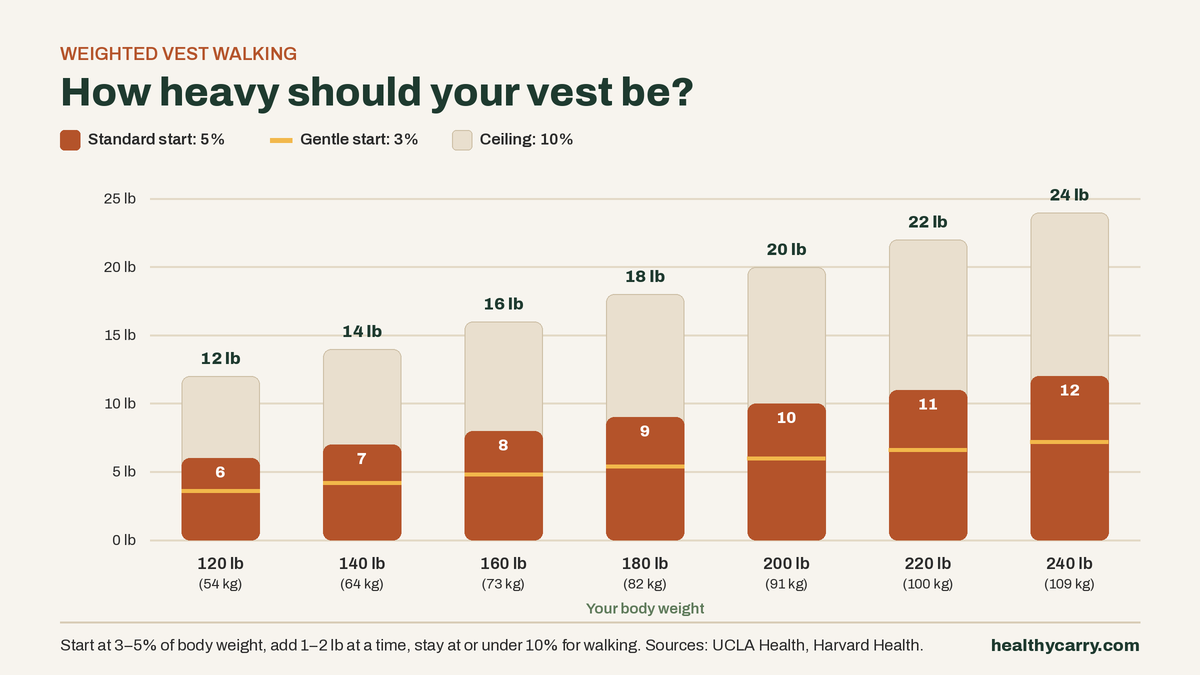
Vest weight by body weight
| Your weight | Gentle start (3%) | Standard start (5%) | Walking ceiling (10%) |
|---|---|---|---|
| 120 lb (54 kg) | 4 lb (1.5 kg) | 6 lb (2.5 kg) | 12 lb (5.5 kg) |
| 140 lb (64 kg) | 4 lb (2 kg) | 7 lb (3 kg) | 14 lb (6.5 kg) |
| 160 lb (73 kg) | 5 lb (2 kg) | 8 lb (3.5 kg) | 16 lb (7 kg) |
| 180 lb (82 kg) | 5 lb (2.5 kg) | 9 lb (4 kg) | 18 lb (8 kg) |
| 200 lb (91 kg) | 6 lb (2.5 kg) | 10 lb (4.5 kg) | 20 lb (9 kg) |
| 220 lb (100 kg) | 7 lb (3 kg) | 11 lb (5 kg) | 22 lb (10 kg) |
A practical note: many vests are sold in fixed weights (10, 12, 20 lb). If you weigh 140 lb, a fixed 20-lb vest is 14% of your body weight from day one. An adjustable vest with removable 1–2 lb inserts lets you start at 5% and grow into it. Dr. Sharon Hame at UCLA prefers adjustable vests for exactly this reason. For backpack loads instead of a vest, our ruck weight calculator gives you a number and a 6-week progression.
How long and how often to walk with a vest
Duration guidance is just as consistent: shorter than you think.
- UCLA Health: if you’re new to exercise, build several weeks of unweighted walking first, then wear the vest for a walk less than half as long as your typical unweighted one. Start with a small loop, even once around the block, rather than an out-and-back route you can’t cut short.
- Henry Ford Health: about 15 minutes per session, once or twice a week, then slowly extend the time.
- Northwestern Medicine: if you usually walk a mile, start with the vest for a quarter mile.
- Atlantic Health: limit vest workouts to no more than three times a week.
Put together, a sensible first month looks like this:
| Week | Vest load | Vest time | Sessions | Rest of your walk |
|---|---|---|---|---|
| 1 | 3–5% BW | 10–15 min | 2 | Vest off, keep walking if you like |
| 2 | 3–5% BW | 20 min | 2 | Vest off |
| 3 | +1–2 lb (0.5–1 kg) | 20 min | 2–3 | Vest off |
| 4 | Same as week 3 | 25–30 min | 2–3 | Vest off |
Change one thing per week: weight or time, never both. That rule echoes Cleveland Clinic’s advice for loaded walking, which is to raise one component by about 10% a week.
Wear-it-all-day vs. wear-it-to-train
Some people wear a light vest around the house for hours. The research favors the opposite approach. A 2026 review of 15 studies in adults 60 and older found that benefits showed up mainly in “task-based,” progressively loaded programs: walking, step-ups, sit-to-stands, or squats done in 20–40 minute sessions, 2–4 times a week. Low-load “wear-only” protocols, such as 3–5% of body weight for 2 hours a day, generally didn’t improve strength, function, or bone markers. Wear the vest to do something.
What a weighted vest actually does (and doesn’t)
What the evidence supports
- It makes walking harder in a measurable way. In a classic treadmill study, vests at 10%, 15%, and 20% of body mass raised oxygen use and increased ground reaction forces compared with no vest (Puthoff et al., 2006). The subjects were 10 young adults, so treat the exact numbers as a guide, not a promise for a 55-year-old.
- The effect at light loads is small. In the 2026 study from our opening, a 10-lb vest at 3.0–3.6 mph added about 0.25 kcal per minute, or 15 kcal an hour. The authors suggested pace, incline, or duration may be better levers. That’s a 9-person conference abstract, not a definitive trial, but it’s a useful reality check.
- Vests can help strength and function inside a training program. In older adults, home functional training with a vest at 10% of body mass improved sit-to-stand, chair-stand, and step-test results, according to the 2026 review.
What is still unproven: bones
This is where marketing outruns science. Two studies frame it:
- The hopeful one: nine postmenopausal women who did weighted-vest jumping exercise three times a week for 5 years kept their hip bone density, while nine active controls lost about 3.8% at the total hip (Snow et al., 2000). That’s a tiny group, and the stimulus was jumping, not walking.
- The sobering one: in the 12-month INVEST in Bone Health randomized trial, 150 older adults with obesity (75% women) lost about 10% of their body weight. Wearing a weighted vest about 7 hours a day did not prevent hip bone loss compared with weight loss alone. Neither did supervised resistance training.
UCLA’s Dr. Hame sums it up well: walking is good for bones, and it seems intuitive that a vest would add to that, “but to what extent the extra weight improves bone density isn’t really known at this time.” So a weighted vest won’t rebuild your bones on its own. Carrying load does give them a reason to adapt, so start light, progress slowly, and keep lifting too. Our Carry for Life section goes deeper on bones and menopause.
Is walking with a weighted vest safe?
For most healthy adults who start light, yes. Serious injuries are rarely reported in the research. But the risks are real enough that every source we read lists people who should skip the vest or check with a clinician first.
Check with your clinician before using a vest if you: have back or neck pain, spinal stenosis, or disc degeneration (Harvard Health warns a vest “puts pressure on your spine”); have hip, knee, or ankle arthritis that flares with load; are pregnant (Harvard advises against vests in pregnancy); have osteoporosis or a past fragility fracture; or have heart, lung, or balance problems. Stop and drop weight if you change how you walk, lean or shift to manage the load, or feel joint pain, dizziness, or tingling. Falls deserve attention too: one trial recorded 14 falls in the vest group versus 10 with diet alone. It wasn’t designed to test falls, so treat that as a safety signal, not proof. This article is general education, not medical advice.
Atlantic Health offers a simple self-test: “If you find that you have to change how you walk or you shift your weight around when wearing a vest, it’s probably too heavy.”
Vest fit for women: what to check
A vest that fits badly turns 8 lb into a bouncing, chafing 8 lb. In the store or at home, check:
- Bust: the front panels or weight pockets shouldn’t press across your chest. Many women find vests with weight carried at the sides, lower ribs, or back more comfortable.
- Torso length: on shorter torsos, long vests ride onto the hips or dig in when you bend. Look for adjustable shoulder and waist straps.
- Bounce: walk briskly for one minute, or try stairs. If the vest lifts and lands with every step, tighten it or choose another design.
- Heat: a vest traps heat. In summer, walk early and shorten the session.
We haven’t tested vests yet, so we’re not ranking any here. Our fit-and-bounce test protocol is published at How We Test, and reviews will appear in Gear Lab once each vest has logged real miles.
Weighted vest or rucking backpack?
| Weighted vest | Rucking backpack | |
|---|---|---|
| Load placement | Around the torso, close to your center of gravity | On your back; pulls your center of gravity backward |
| Balance | Often feels steadier (UCLA suggests it for stability or back concerns) | Can tip less-steady walkers off balance |
| Good for | Short walks, treadmill, step-ups, chores | Longer outdoor walks; carrying water and layers |
| Typical starting load | 3–5% of body weight | About 5% or 5–10 lb |
| Fit issues | Bust, short torso, heat | Shoulder pressure, low-riding load |
Neither is “better.” If you already own a sturdy backpack, you can try loaded walking for $0; our beginner’s guide to rucking has a 4-week plan. For strength moves to pair with either, see Train. If you’re walking more to support weight loss, the protein side is covered in Fuel.
Five habits that make vest walking work
- Warm up unweighted for 5 minutes, then put the vest on.
- Stand tall and brace your trunk lightly, as if someone might bump you.
- Use the vest for a task: a hill, a set of stairs, 10 step-ups at the end of the walk.
- Log it: vest weight, minutes, and how you felt the next morning.
- Progress by the smallest step available: one 1-lb insert, or 5 more minutes.
New research: In a 2026 trial, women aged 60 to 80 who danced in a 7% body-weight vest tripled their leg-strength gains in 8 weeks, while bone density stayed the same. Read our breakdown of the weighted vest study.
nn
FAQ
How heavy should a weighted vest be for walking?
Start at about 5% of your body weight, or 3% if you’re new to exercise or over 65. For a 150-lb (68 kg) person, that’s about 7–8 lb (3.5 kg). Most medical sources suggest staying at or below 10% of body weight for walking.
How long should I walk with a weighted vest?
Begin with 10–20 minutes, or less than half your usual walk, two or three times a week. Add 5 minutes at a time once you finish comfortably, and don’t raise time and weight in the same week.
Can I wear a weighted vest every day?
Physical therapy guidance suggests no more than three vest workouts a week when you’re starting. Research in older adults also found that wearing a light vest for hours during daily life did little; structured walking or exercise sessions worked better.
Does walking with a weighted vest build bone density?
It isn’t proven. A small study of vest-plus-jumping exercise helped postmenopausal women maintain hip bone density over 5 years. A larger 2025 randomized trial found daily vest wear didn’t prevent hip bone loss during weight loss. Walking with load may help as part of a broader strength program, but no vest is a treatment for osteoporosis.
Is a weighted vest bad for your back?
It can be if you already have back or neck problems, spinal stenosis, or disc degeneration, or if the vest is too heavy. Start light, keep your posture tall, and stop if you feel pain or change how you walk. Get clinical advice first if you have a spine condition.
Do weighted vests burn more calories?
A little. At light loads and normal walking speeds the increase can be small: about 15 extra calories an hour with a 10-lb vest in one 2026 lab study. Heavier loads, hills, and faster pace raise it more. Treat the calorie bump as a bonus, not the reason to wear one.
Get the free 4-week Start Carrying plan: a printable vest-and-walking schedule with a weekly log.
Sources
- UCLA Health. “Should you walk with a weighted vest?” (2025). uclahealth.org
- Harvard Health Publishing. “What are the benefits of walking with a weighted vest?” (2025). health.harvard.edu; and “Wearable weights: How they can help or hurt” (2018). health.harvard.edu
- Henry Ford Health. “Should You Wear A Weighted Vest While Working Out?” (2025). henryford.com
- Mass General Brigham. “Do Weighted Vests Work?” (2025). massgeneralbrigham.org
- Northwestern Medicine. “Should You Wear a Weighted Vest for Workouts?” nm.org
- Atlantic Health. “The Pros and Cons of Weighted Vests” (2025). atlantichealth.org
- Luo H, et al. “Weighted vest interventions in older adults: a mini-review of implementation, benefits, and limitations.” Frontiers in Public Health (2026). PMC13056602
- Puthoff ML, et al. “The effect of weighted vest walking on metabolic responses and ground reaction forces.” Medicine & Science in Sports & Exercise (2006). PubMed 16679992
- Brown AR, Joubert DP. “A Comparison of the Energetic Cost of Walking With and Without a 10-Pound Weighted Vest.” International Journal of Exercise Science: Conference Proceedings (2026). digitalcommons.wku.edu
- Snow CM, et al. “Long-term exercise using weighted vests prevents hip bone loss in postmenopausal women.” Journals of Gerontology (2000). PubMed 10995045
- Beavers KM, et al. “Weighted Vest Use or Resistance Exercise to Offset Weight Loss–Associated Bone Loss in Older Adults: A Randomized Clinical Trial.” JAMA Network Open (2025). PubMed 40540267
- Cleveland Clinic. “Should You Add Rucking to Your Workout?” (2024). health.clevelandclinic.org
