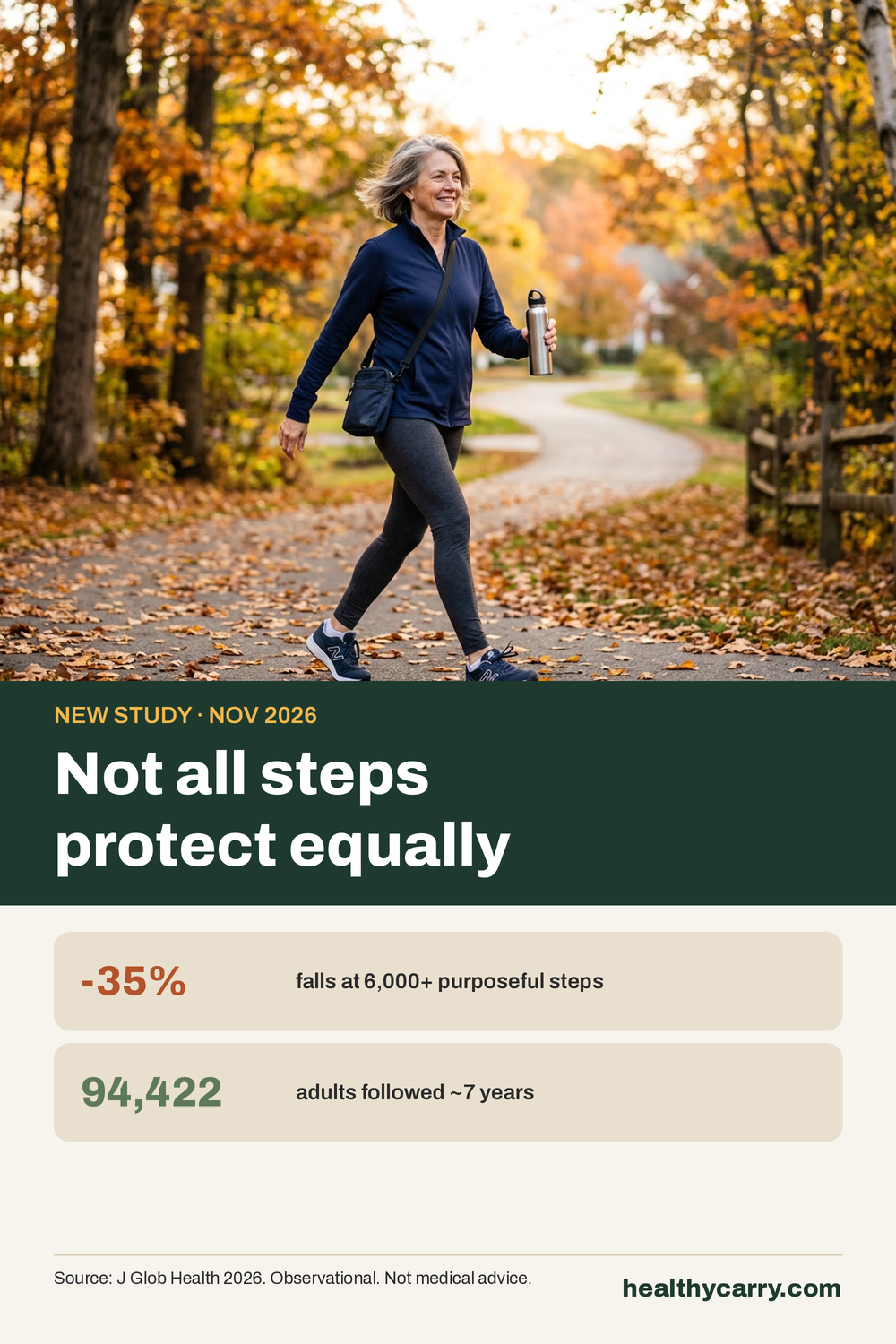
Two people can both log 8,000 steps. One gets there by wandering from the couch to the fridge and around the house. The other walks briskly for half an hour. A new study of 94,422 adults suggests those 8,000 steps may not protect you from a fall equally, and the difference showed up most clearly for hip fractures.
Quick answer: In a UK Biobank study published November 13, 2026, adults who took 6,000 or more “purposeful” steps a day (walked at 40+ steps a minute) had about 32-35% lower risk of a fall hospital admission than those under 4,000. Slow, incidental steps didn’t show a clear independent link. It’s observational, so it can’t prove cause.
What did the walking and falls study find?
Researchers at Central South University in China used accelerometer data from 94,422 UK Biobank participants aged 42 to 78. Each wore a wrist device for seven days. The team split every person’s steps into two buckets: purposeful steps (cadence of 40 steps a minute or more) and incidental steps (slower than that, like pottering around the house). Then they followed hospital records for about seven years, counting falls and hip fractures.
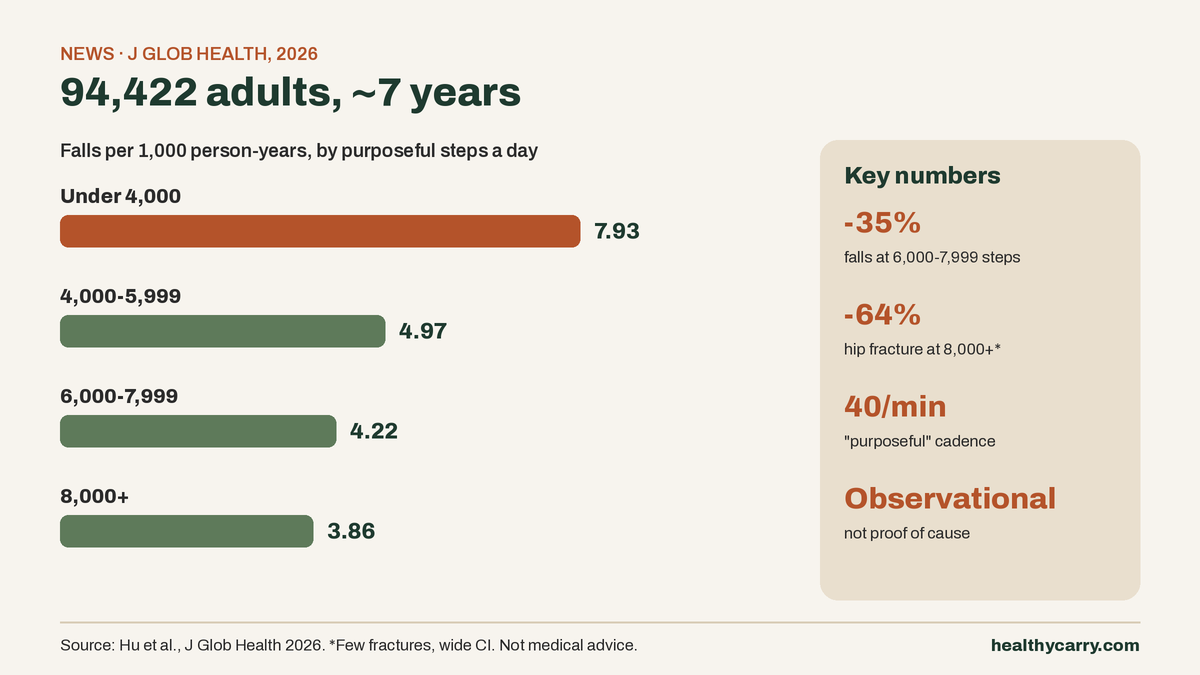
People who took more purposeful steps had fewer falls. The table shows incident falls, compared with the group taking 3,999 or fewer purposeful steps a day:
| Purposeful steps a day | Falls per 1,000 person-years | Risk vs lowest group (adjusted) |
|---|---|---|
| 3,999 or fewer | 7.93 | Reference |
| 4,000 to 5,999 | 4.97 | 25% lower (HR 0.75) |
| 6,000 to 7,999 | 4.22 | 35% lower (HR 0.65) |
| 8,000 or more | 3.86 | 32% lower (HR 0.68) |
Notice the shape. Most of the gap appeared by 6,000 purposeful steps, and 8,000 didn’t do noticeably better. The authors describe a curve that flattens at higher volumes.
Does walking more lower hip fracture risk?
The secondary result is the eye-catcher, with a caveat. Hip fractures were rare in this group, so the estimates are less precise:
- 4,000 to 5,999 purposeful steps: HR 0.63 (95% CI 0.39 to 1.02), not statistically clear
- 6,000 to 7,999: HR 0.49 (0.29 to 0.83)
- 8,000 or more: HR 0.36 (0.21 to 0.62)
Incidental steps showed no significant link with hip fracture. Since nearly all hip fractures follow a fall, preventing falls is the likely route, though this study can’t confirm the mechanism.
What is a purposeful step, and how do I count mine?
The cut-off was 40 steps a minute. That is slow: a stroll is usually 70 to 100. So “purposeful” here means any walking with a clear rhythm, like a walk to the shop, a dog walk or a lap around the block, not a power walk. A phone or watch usually can’t split your steps this way, but you can approximate it: count steps that happen in continuous walks of a few minutes, not scattered steps indoors.
What it means for you
- Bank continuous walks. Aim for two or three walks of 10 to 20 minutes a day instead of relying on steps scattered through the house.
- Don’t chase a magic number. The benefit looked largest between roughly 4,000 and 6,000 purposeful steps. More didn’t clearly add much.
- Add load slowly, if at all. This study didn’t test weighted vests or packs. If you want to try one, start light, as in how to start rucking and weighted vest walking.
- Pair walking with strength. Falls are about balance and leg strength too. See our training guides and the 4-minute workout for seniors.
What the study can’t tell us
- It can’t prove cause. Healthier, stronger people walk more and fall less. The authors adjusted for age, BMI, frailty, bone density, vision and more, but hidden health differences may remain. After excluding frail and poor-health participants the links held but got a bit weaker (HR 0.71 and 0.74 in the top two groups).
- One week of data. Walking was measured once, for seven days.
- Falls came from hospital records. Falls that didn’t lead to hospital care weren’t counted.
- Mostly white UK volunteers. Results may not apply the same way to everyone.
Safety: If you’ve fallen recently, feel unsteady or have osteoporosis, talk to your doctor or a physical therapist before changing your walking or adding weight. This is general information, not medical advice.
FAQ
Does walking prevent falls?
This study found that more purposeful walking was linked to fewer fall hospital admissions. Because it’s observational, it shows an association, not proof that walking prevents falls. Exercise programs that train balance and leg strength have stronger evidence for fall prevention.
How many steps a day lowers fall risk?
The clearest drop appeared around 6,000 purposeful steps a day compared with fewer than 4,000. Going to 8,000 or more did not clearly lower the risk further for falls.
Does slow walking count?
Slow, scattered steps (under 40 a minute) did not show a clear independent link with falls after accounting for purposeful steps. That doesn’t mean slow walking is useless. It means rhythmic, continuous walking looked more informative.
Can walking reduce hip fracture risk?
People with 8,000 or more purposeful steps had about 64% lower hip fracture risk in this study, but hip fractures were uncommon, so the estimate is uncertain.
Is a weighted vest good for preventing falls?
This study did not test vests. Evidence for vests and fall prevention is limited, so build walking and leg strength first.
Want the easy version?
Get the free 4-week Start Carrying plan – one short email a week, no hype.
Sources
- Hu Y, et al. Association of intensity-based walking steps and incident falls: a population-based cohort study. Journal of Global Health 2026;16:04382. jogh.org
- Tudor-Locke C, et al. How fast is fast enough? Walking cadence as a practical estimate of intensity. Br J Sports Med 2018. doi.org
- Sherrington C, et al. Evidence on physical activity and falls prevention for people aged 65+. Int J Behav Nutr Phys Act 2020. doi.org
- Moreland B, et al. Trends in nonfatal falls and fall-related injuries among adults 65+, United States. MMWR 2020. doi.org