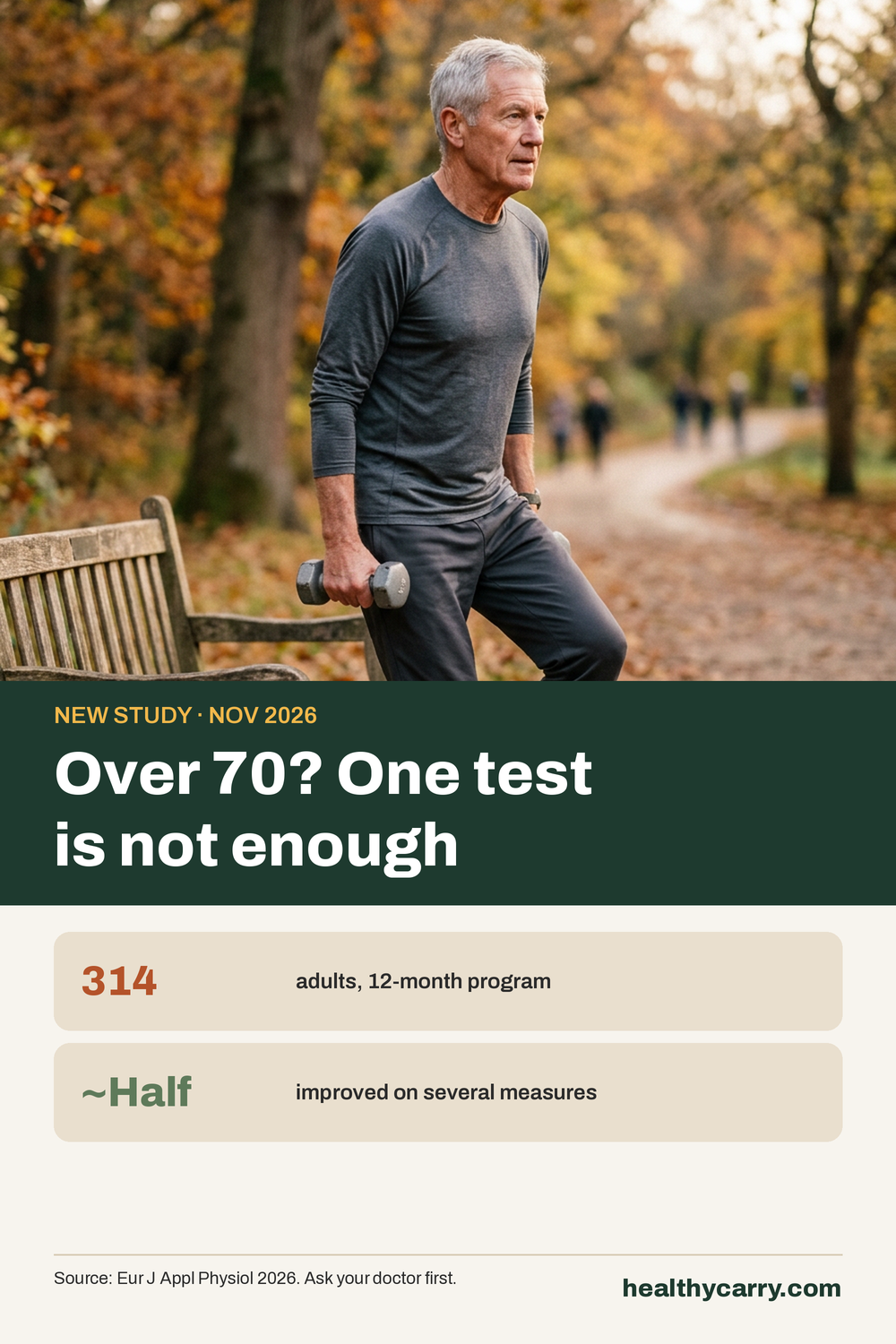
You lift, you walk, and the scale or the mirror barely moves. Is it working? A new Finnish study of 314 adults over 70 says that is the wrong question: the same program helped people in different ways, and muscle size was often the one thing that stayed put.
Quick answer: University of Jyvaskyla researchers followed 314 adults aged over 70 through a 12-month exercise program. On average, strength, walking speed and walking endurance improved, muscle mass did not change, and nearly half of participants made meaningful gains on several measures. Closer adherence to strength training was a key predictor of success.
What did the older adults exercise response study find?
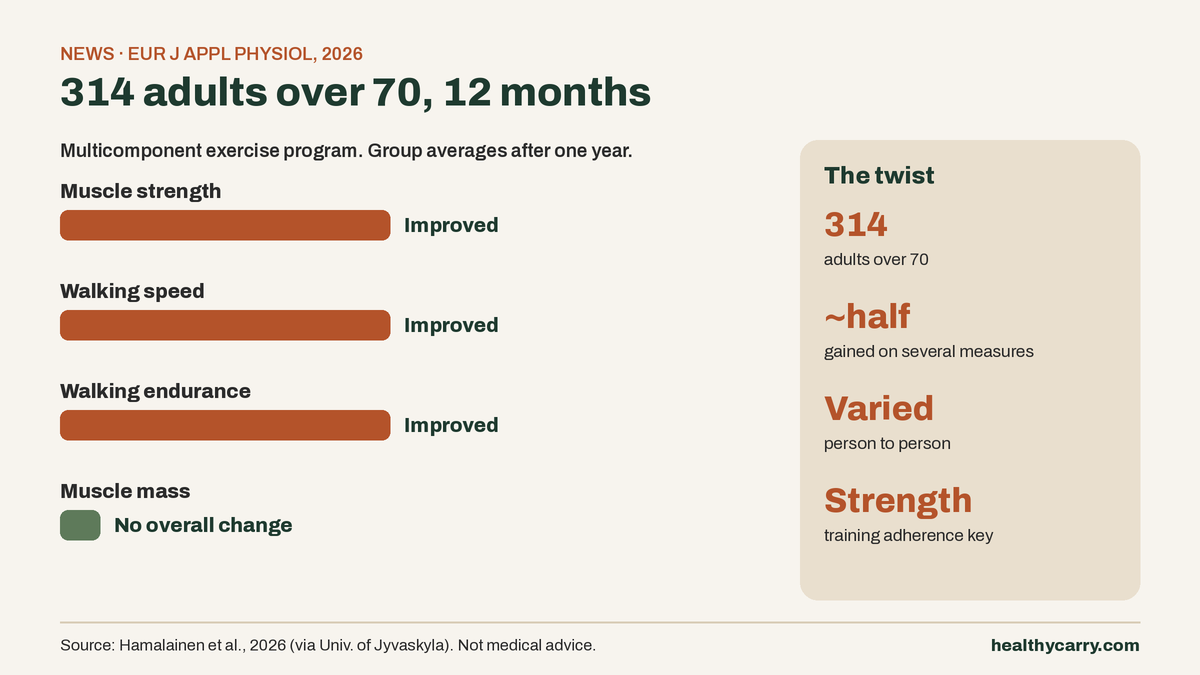
The paper, published in the European Journal of Applied Physiology, looked at individual variability after multicomponent physical training. Participants were over 70 and all completed 12 months. At the group level the program improved muscle strength, walking speed and walking endurance. Muscle mass showed no overall change.
| Measure | Group average after 12 months |
|---|---|
| Muscle strength | Improved |
| Walking speed | Improved |
| Walking endurance | Improved |
| Muscle mass | No overall change |
The twist is under the averages. Some people gained a lot, others changed little, and some slipped on certain measures. When the team looked at several outcomes together, nearly half of participants had meaningful improvements in several indicators of physical function.
Who responded best to training?
Participants were more likely to improve across multiple measures if they were younger, had a lower BMI, followed strength training more closely, or had multiple chronic conditions. The last point is the encouraging one: the authors conclude that chronic disease and multimorbidity did not stop older adults benefiting.
What does it mean for you?
- Judge progress on more than one number. Walking faster or standing up more easily counts even if body measurements do not change.
- Do not quit if one measure stalls. The study found gains show up in different places for different people.
- Protect the strength sessions. Adherence to strength training stood out as a key factor. Walking or rucking alone is not the same thing.
A simple 3-test check you can repeat
| Test | How | Retest |
|---|---|---|
| Chair stands | Count sit-to-stands in 30 seconds, arms crossed | Every 4-6 weeks |
| Timed walk | Walk the same 400 m route at your usual pace and time it | Every 4-6 weeks |
| Carry check | Note the heaviest bag or dumbbell you can carry 30 m with good posture | Every 4-6 weeks |
These tests are our own practical suggestions, not the protocol used in the study. For a gentle way in, see our 4-minute workout for seniors, the farmer’s carry guide and how to start rucking.
What the study can’t tell us
- We read the university’s news release, not the full paper, so we cannot report exact training schedules or effect sizes.
- Participants completed 12 months, so people who dropped out are not represented in these results.
- It describes who improved, not a guarantee that you will. It is not a fracture, fall or longevity trial.
Safety: If you are over 70 or have heart, bone, joint or balance concerns, talk to your doctor before adding loads or new exercises, and progress slowly. Stop for chest pain, dizziness or sharp pain. This is general information, not medical advice.
One step for this week
Do the three tests above, write the numbers down, and book two short strength sessions into your calendar. Boring and consistent wins here.
FAQ
What did the study find?
In 314 adults over 70 who finished a 12-month multicomponent exercise program, group averages improved for muscle strength, walking speed and walking endurance, while muscle mass did not change overall.
Does it mean exercise does not work for some people?
No. It means one measure rarely tells the whole story. Some people improved a lot in one area and little in another, so tracking several measures gives a fairer picture.
Which factors predicted a better response?
Being younger, having a lower BMI, sticking more closely to strength training and having several chronic conditions were linked to improving on more measures.
Can people with chronic conditions still benefit?
The researchers say chronic disease and multimorbidity did not prevent benefit in this group. Check with your own doctor about what is safe for you.
What should I track at home?
Pick two or three: a sit-to-stand count, a timed walk over the same route and how heavy a carry feels. Retest every 4 to 6 weeks.
Want the easy version?
Get the free 4-week Start Carrying plan – one short email a week, no hype.
Sources
- University of Jyvaskyla. Nearly half of adults over 70 benefited from physical training across multiple physical outcomes, 16 Nov 2026. jyu.fi
- Hamalainen O, Sipila S, Tirkkonen A, Savikangas T, Alen M, Hautala A. Individual variability and predictors of responsiveness in physical outcomes following multicomponent physical training in older adults. Eur J Appl Physiol 2026. doi.org