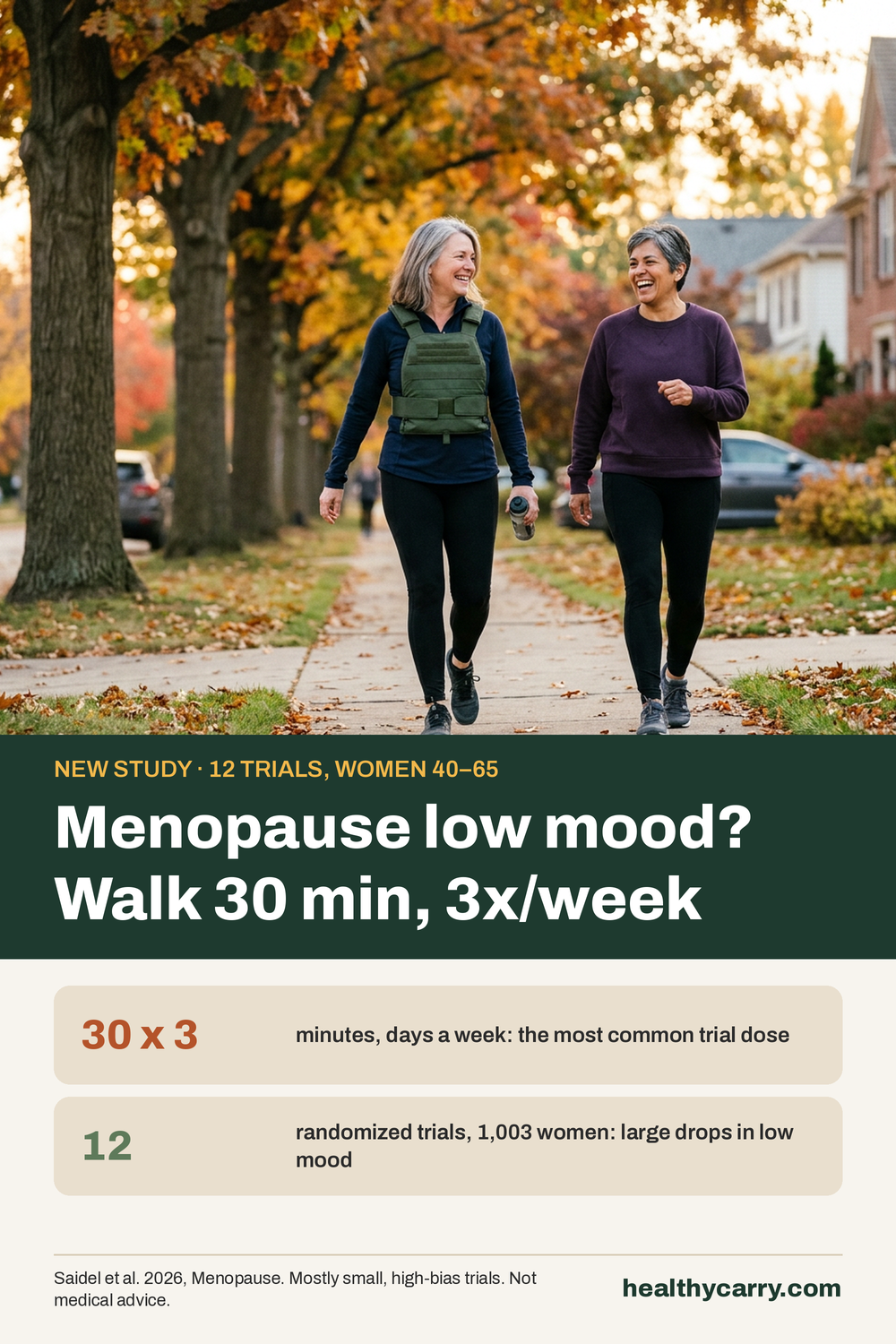
Low mood that shows up out of nowhere at 48. A short fuse you don’t recognize. Sleep that won’t stick. If that sounds familiar, a new review published October 13, 2026 has a surprisingly ordinary lead: in 12 randomized trials of women in perimenopause and early postmenopause, regular physical activity was linked to large drops in depressive symptoms. The most common prescription? About 30 minutes, three times a week.
Quick answer: Does exercise help menopause mood? A 2026 meta-analysis in Menopause pooled 12 randomized trials (1,003 women aged 40–65) and found physical activity improved depression, mood and quality of life. Aerobic activity like walking, dance and Zumba showed the clearest effect on depression. Most trials were small and at high risk of bias, so treat it as promising, not proven.
What did the new menopause exercise study find?
The review, led by researchers at University College London’s Menopause Mind Lab, is the first to limit itself to women clearly in the menopause transition: perimenopause or within five years of the final period. That matters, because older reviews mixed in women in their 70s, whose symptoms and life stage look very different.
The team searched five databases through April 2025 and kept only randomized controlled trials. Twelve made the cut, from Brazil, China, Tunisia, India, Iran, Korea and the USA. Activities fell into two groups:
- Aerobic-based: walking, Zumba, dance, aerobic exercise, Taekwondo.
- Mind-body: yoga, tai chi, Pilates, stretching.
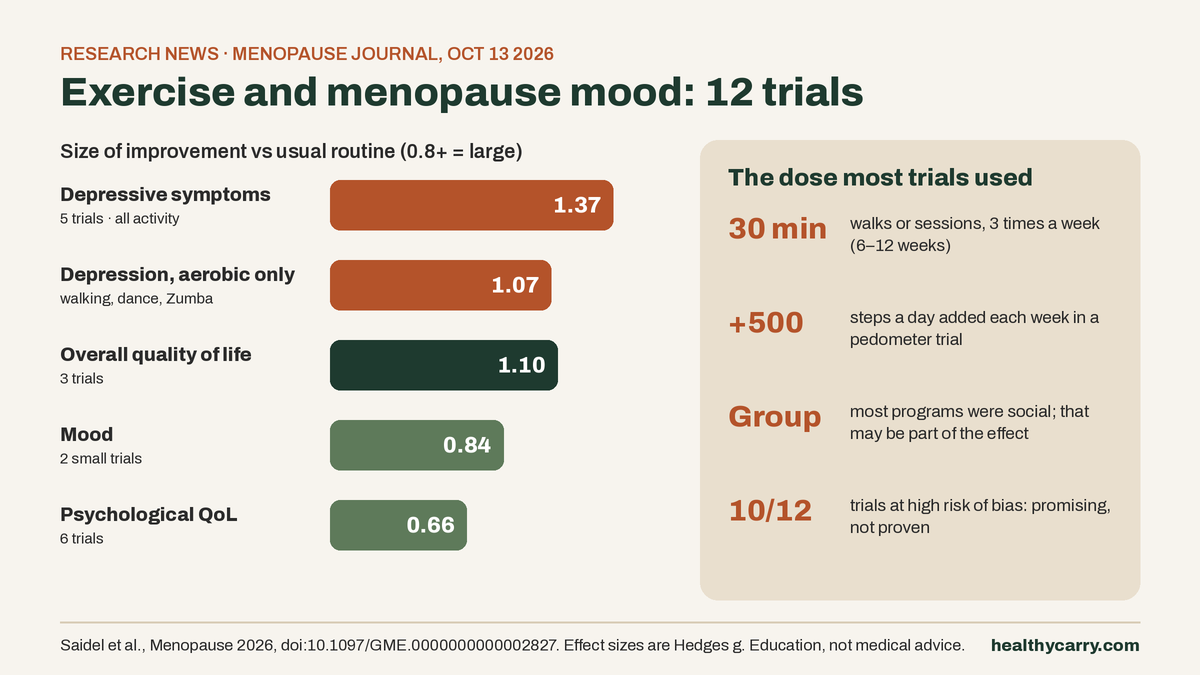
Compared with women who kept their usual routine, women who exercised scored better on four outcomes. The numbers below are “effect sizes,” a standard way to compare studies that used different questionnaires. Roughly, 0.2 is small, 0.5 is medium and 0.8 or more is large.
| Outcome | Trials pooled | Effect size (g) | In plain English |
|---|---|---|---|
| Depressive symptoms (all activity) | 5 (374 women) | −1.37 | Large drop |
| Depressive symptoms (aerobic only) | aerobic subgroup | −1.07 | Large drop, and the most consistent result (low heterogeneity) |
| Overall mood | 2 (86 women) | 0.84 | Large improvement, but only two small trials |
| Psychological quality of life | 6 (617 women) | 0.66 | Medium improvement; mind-body work did best here (0.80) |
| Overall quality of life | 3 (110 women) | 1.10 | Large, but fragile in sensitivity checks |
Source: Saidel S, et al., Menopause, published ahead of print October 13, 2026. Labels “small/medium/large” use the usual 0.2/0.5/0.8 rule of thumb. Anxiety, stress and memory had too few trials to pool.
Benefits for depression showed up in both perimenopause and early postmenopause. Most of the mood and quality-of-life data came from early postmenopausal women.
How much exercise did the trials actually use?
This is the part most headlines skip. The “dose” wasn’t heroic. Here’s what the aerobic arms looked like:
| Trial (country) | Activity | Dose | Length |
|---|---|---|---|
| Zhang 2014 (China) | Stride walking, alone + weekly group walk | 30 min, 3x/week | 12 weeks |
| Abedi 2014 (Iran) | Pedometer walking | +500 steps/day each week | 12 weeks |
| Sharma 2024 (India) | Treadmill walking at 50–60% of max heart rate | 30 min, 3x/week | 6 weeks |
| Lahiani 2024 (Tunisia) | Zumba | 50 min, 3x/week | 12 weeks |
| Taylor 2018 (USA) | Gym sessions or 5,000→10,000 steps/day | ~150 min/week | 6 months |
Three 30-minute walks a week is 90 minutes. That’s below the 150 minutes US guidelines recommend for general health, which suggests mood benefits may start before you hit the full target. It’s an inference from the trial designs, not something the review tested directly.
What it means for you
- Pick something you’ll repeat. Walking, dancing and yoga all helped. The best activity is the one you’ll still be doing in week 10.
- Make it social when you can. Most of the programs were group-based. The authors think the company may be part of the effect.
- Aerobic for low mood, mind-body for stress. Aerobic work moved depression scores most; yoga-type sessions moved psychological quality of life most. Many women will do best with both.
- Load is optional. No trial here used a weighted vest or backpack. Carrying light load is a good way to add strength work to a walk you already enjoy, but it isn’t what improved mood in these studies. If you add it, start light: see weighted vest walking: how heavy and how long.
What the study can’t tell us
- Bias is high. 10 of the 12 trials were rated at high risk of bias, mostly because women knew they were exercising and rated their own mood.
- Possible publication bias. Funnel-plot tests hinted that small positive studies may be over-represented for depression and quality of life.
- The biggest trial disagreed. The largest and longest study (213 US women, 6 months) found no significant improvement in psychological quality of life.
- Short follow-up. Programs ran 6 weeks to 6 months. We don’t know if the benefit lasts after people stop.
- Not a treatment swap. Exercise was compared with usual care, not with hormone therapy, antidepressants or CBT. It’s an add-on option, not a replacement.
Please don’t white-knuckle it. If low mood lasts more than two weeks, gets in the way of work or relationships, or comes with thoughts of self-harm, talk to your doctor or call or text 988 (the US Suicide & Crisis Lifeline). Exercise can help alongside care; it shouldn’t delay it.
One thing to try this week
Book three 30-minute walks in your calendar, like appointments. Make one of them with a friend. Walk at a pace where you can talk but not sing. That matches the most common dose in these trials. If 30 minutes feels like a lot, start with 15 and add 5 minutes each week. Our beginner’s guide to rucking shows how to build from there, and the walking and bone density study explains why the same habit pays off for your skeleton too.
FAQ
What is the best exercise for menopause mood swings?
In this review, aerobic activities such as brisk walking, dance and Zumba showed the strongest and most consistent effect on depressive symptoms. Yoga, tai chi and Pilates improved psychological quality of life. There isn’t enough data to name one winner, so choose what you enjoy.
How long does it take for exercise to improve menopause mood?
The trials lasted 6 weeks to 6 months, and the shortest (6 weeks of 30-minute treadmill walks, three times a week) still reported benefits. Plan on at least 6 to 12 weeks of regular sessions before judging.
Does walking help perimenopause anxiety?
We don’t know yet. Only one trial in this review measured anxiety, and it found no clear difference, likely because baseline anxiety was low. Earlier reviews suggest some benefit, but the evidence is thinner than for depression.
Can exercise replace HRT for menopause mood?
No study here compared them. Exercise was tested against usual care, so it’s best seen as an add-on. Decisions about hormone therapy or antidepressants belong with your clinician.
Should I wear a weighted vest for menopause mood?
Not for mood specifically; no trial in this review used one. A light vest can add strength and bone loading to walks, which matters after menopause. Start around 5% of your body weight and keep the pace conversational.
Get the free 4-week Start Carrying plan: a printable walking-and-carry plan with a weekly log, plus one evidence-checked tip each week in Load Notes.
Sources
- Saidel S, Hardy R, He L, Desai R, Robinson K, Spector A. “The effectiveness of physical activity interventions on non-physiological symptoms of menopause: a systematic review and meta-analysis.” Menopause, published ahead of print October 13, 2026. doi:10.1097/GME.0000000000002827. ovid.com
- UCL News. “Physical activity may improve mood and quality of life during menopause.” October 13, 2026. ucl.ac.uk
- Yue H, et al. “Effects of physical activity on depressive and anxiety symptoms of women in the menopausal transition and menopause.” Int J Behav Nutr Phys Act 2025;22:1. link.springer.com
- Han B, et al. “Effects of exercise on depression and anxiety in postmenopausal women: a pairwise and network meta-analysis.” BMC Public Health 2024;24:1816. link.springer.com
- Zhang J, et al. “Effects of physical exercise on health-related quality of life and blood lipids in perimenopausal women.” Menopause 2014;21:1269-76. PubMed 24937024
- US Department of Health and Human Services. Physical Activity Guidelines for Americans, 2nd edition. health.gov
- 988 Suicide & Crisis Lifeline. 988lifeline.org