Turn over a bottle of magnesium L-threonate and read the Supplement Facts. One popular brand’s serving is three capsules holding 2 grams of the compound, and it delivers 145 mg of actual magnesium. A two-capsule serving of magnesium glycinate from another brand delivers 200 mg. The word on the front of the bottle is marketing. The number on the back is the part your body can use, and it’s the first thing to check before you pick a form for sleep, cramps, or recovery.
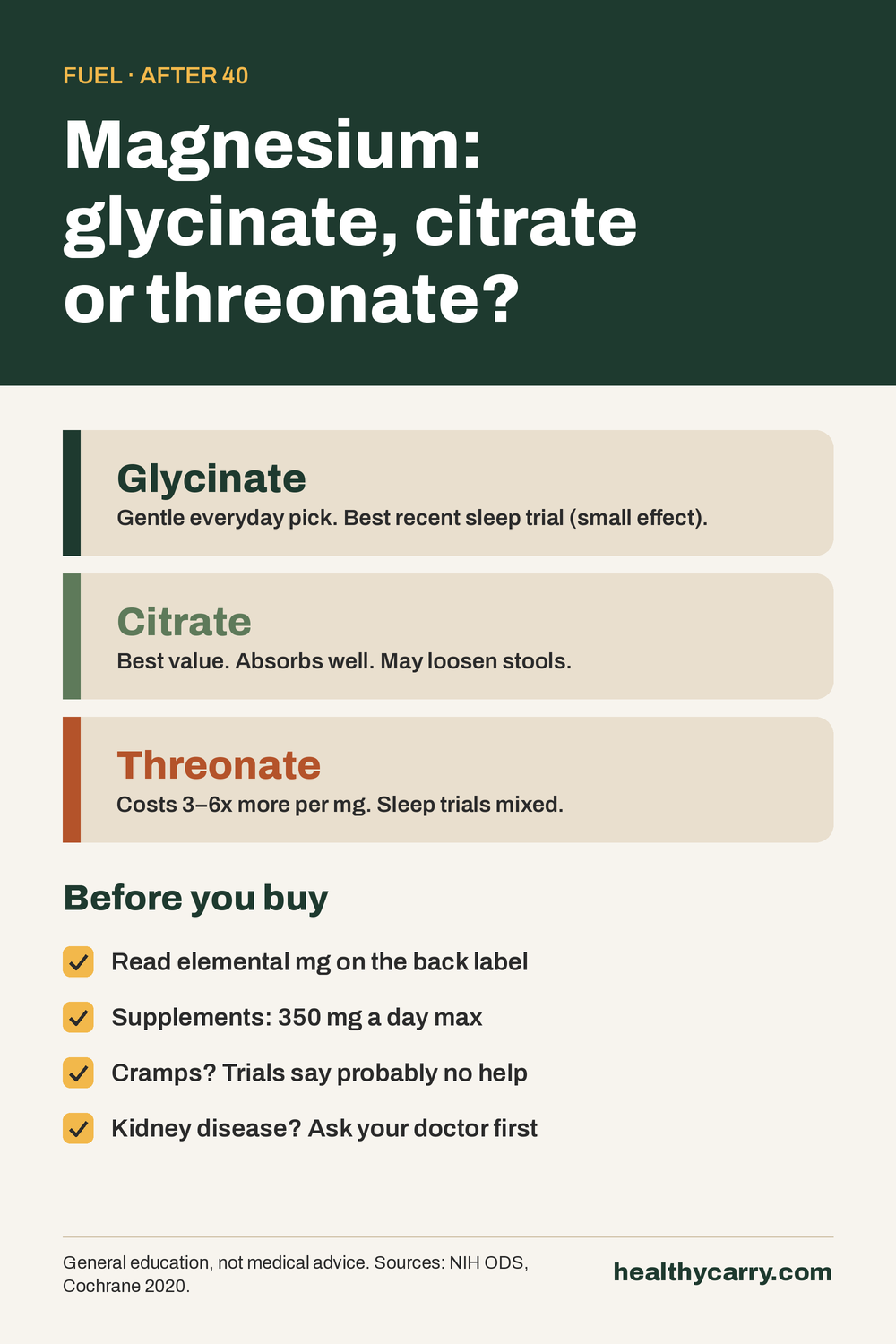
Quick answer: Magnesium glycinate is the best default for most adults over 40: it’s well tolerated and the form with the most recent (modest) sleep trial behind it. Magnesium citrate absorbs well and costs less, but it can loosen stools, which makes it a good pick if you’re prone to constipation. Magnesium threonate is marketed for the brain and sleep, costs several times more, and its sleep trials are small and mixed. Keep supplemental magnesium at or under 350 mg a day (the adult Upper Limit), choose a third-party-certified product, and get the rest from food. Magnesium probably won’t fix leg cramps, and the evidence for sleep is modest at best.
Why active adults over 40 think about magnesium
Magnesium is involved in more than 300 enzyme systems, including muscle contraction, nerve signaling, energy production, and bone structure; about 50–60% of your body’s magnesium sits in bone. Many people fall short: national survey data show 48% of Americans get less magnesium from food than they need, and men 71 and older are among the most likely to be low. With age, the gut absorbs less and the kidneys excrete more. Type 2 diabetes, gut conditions, heavy drinking, and some medicines also drain magnesium.
Daily needs, from the NIH Office of Dietary Supplements (ODS):
| Adults | RDA (food + supplements) | Upper Limit (supplements and medicines only) |
|---|---|---|
| Women 31–50 | 320 mg | 350 mg |
| Women 51+ | 320 mg | 350 mg |
| Men 31–50 | 420 mg | 350 mg |
| Men 51+ | 420 mg | 350 mg |
The Upper Limit looks lower than the RDA because it applies only to magnesium from supplements and medicines. Magnesium from food doesn’t count toward it, because healthy kidneys clear the excess.
Food first: an easy 300 mg
Before buying anything, see how close food gets you. Per NIH ODS, 1 oz of pumpkin seeds has 156 mg, 1 oz of chia seeds 111 mg, 1 oz of almonds 80 mg, ½ cup of cooked spinach 78 mg, and ½ cup of black beans 60 mg. A handful of pumpkin seeds on your post-ruck yogurt, plus beans or greens at dinner, covers most of a day’s need. A supplement fills the gap; it shouldn’t replace the food.
Magnesium glycinate vs citrate vs threonate at a glance
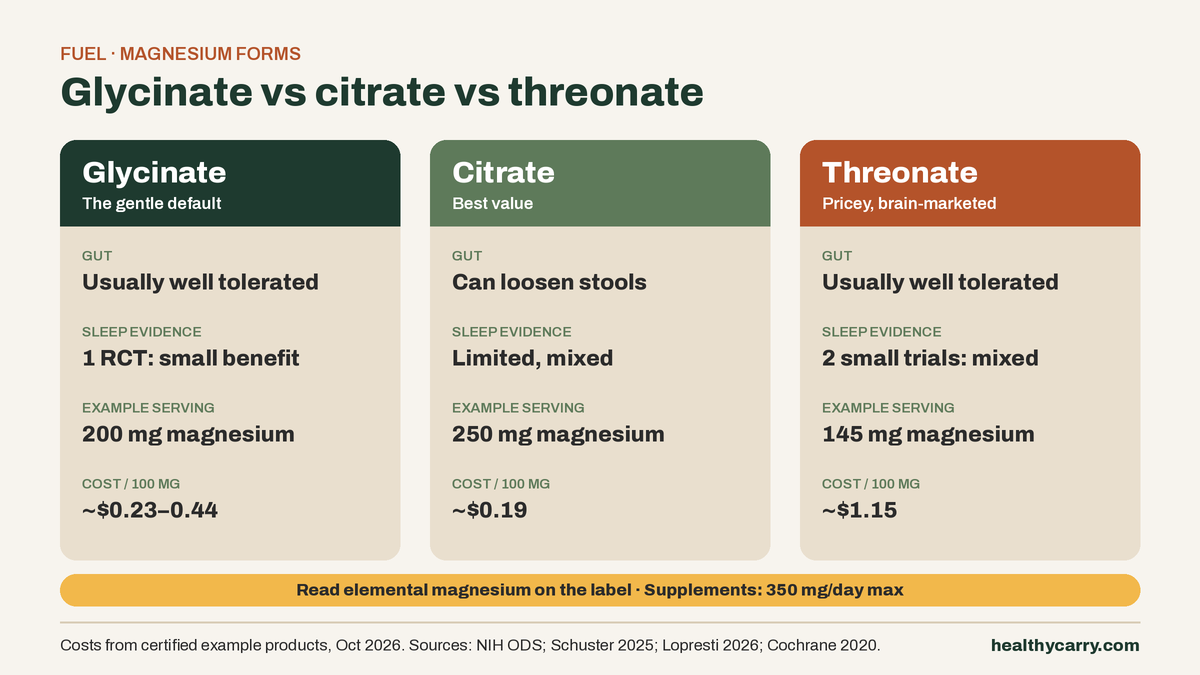
Every supplement label lists elemental magnesium, the amount of magnesium itself, not the weight of the whole compound. That’s the number to compare. Prices are from the example products later in this guide.
| Form | Best known for | Gut effects | Evidence for sleep | Typical cost per 100 mg |
|---|---|---|---|---|
| Glycinate (bisglycinate) | Gentle daily magnesium; sleep and calm | Usually well tolerated | One 2025 RCT: small benefit | ~$0.23–0.44 |
| Citrate | Good absorption at a low price; regularity | Can loosen stools | Limited, mixed | ~$0.19 |
| L-threonate | Marketed for brain and sleep | Usually well tolerated | Two small trials: mixed | ~$1.15 |
| Oxide (for comparison) | Cheap, high dose per pill | Most likely to cause diarrhea | One small older-adult trial | Lowest |
Magnesium glycinate
Magnesium bound to the amino acid glycine. Brands often call it “chelated” and “gentle on the stomach,” and that matches how people tend to experience it, though we couldn’t find head-to-head trials proving it’s better tolerated than citrate. It’s the form in the best recent sleep trial (below). It’s also more expensive than citrate, and capsules tend to hold only 100–120 mg each, so a serving is often two capsules.
Magnesium citrate
Magnesium bound to citric acid. Small studies cited by NIH ODS found citrate, along with aspartate, lactate, and chloride, absorbed more completely than magnesium oxide. A randomized study found citrate more bioavailable than other magnesium preparations (Walker et al., 2003). The tradeoff: citrate pulls water into the gut, which is why it’s also sold as a laxative. If your digestion runs slow, that’s a feature; if you’re heading out on a long ruck, it’s a bug.
Magnesium L-threonate
Magnesium bound to threonic acid, sold mainly under the trademark Magtein. Brands promote it as the form that best raises magnesium in the brain, based largely on animal research. In people, the sleep evidence is thin: a 21-day trial of 80 adults aged 35–55 with sleep complaints reported better sleep quality and some wearable-measured sleep scores with 1 g/day of threonate (Hausenblas et al., 2024), while a later trial at 75 mg/day of elemental magnesium found no improvement in insomnia severity, according to a 2026 systematic review. Threonate also delivers relatively little magnesium per dollar.
Magnesium for sleep: what the trials actually show
- Older adults with insomnia. A meta-analysis of three small trials (151 people) found people fell asleep about 17 minutes faster on magnesium than placebo. Total sleep time didn’t improve significantly, and the evidence was rated low to very low quality.
- Glycinate in poor sleepers. In a 2025 double-blind trial, 155 adults aged 18–65 took 250 mg of elemental magnesium as bisglycinate or a placebo. After four weeks, insomnia scores fell by 3.9 points versus 2.3 with placebo, a statistically significant but small effect (Cohen’s d = 0.2).
- The big picture. A 2026 systematic review of 12 randomized trials concluded that the evidence is inconsistent and of low to very low certainty. It found that no form can be called superior for sleep, because no trial has compared forms directly, and that routine use for insomnia isn’t supported.
Our read: if you sleep badly and your diet is low in magnesium, a glycinate trial of 4 weeks at a dose within the Upper Limit is reasonable and low-risk. Expect a nudge, not a knockout. Morning light, a consistent bedtime, less late caffeine and alcohol, and tiring your legs with a daytime ruck have better evidence for sleep than any capsule.
Magnesium for leg cramps: probably not
This is where marketing and evidence part ways most clearly. The 2020 Cochrane review found, with moderate certainty, that magnesium is unlikely to reduce the frequency or severity of muscle cramps in older adults. The trials mostly studied night-time leg cramps in people with an average age in the 60s. For pregnancy-related cramps the results conflict. And the review found no randomized trials of magnesium for exercise-associated cramps, so claims that it prevents cramps on long rucks or hikes have no trial evidence behind them.
If you get frequent cramps, mention them to your clinician. Cramps can have other causes worth checking, such as a medicine side effect, dehydration, a nerve problem, or low electrolytes that a blood test can find. For exercise cramps, the practical levers are pacing, building distance gradually, and fluids and sodium on hot or long efforts.
Magnesium for recovery and rucking
We found no good trials showing that magnesium supplements speed recovery from walking, rucking, or strength training in people who already get enough. Magnesium matters for muscle function, and a true shortfall can cause weakness and cramps (NIH ODS). So the honest goal for an active adult is adequacy: reach the RDA through food, use a supplement to fill a gap, and let progressive load do the training work. Our 4-week rucking plan and weighted vest walking guide are where the recovery you actually feel gets built.
How to choose a magnesium supplement
- Read the elemental dose. Compare milligrams of magnesium per serving, not milligrams of “magnesium glycinate complex.”
- Stay at or under 350 mg a day from supplements, counting multivitamins, sleep blends, electrolyte mixes, and antacids or laxatives that contain magnesium. Many people do well on 100–200 mg.
- Pick the form for your goal and your gut. Glycinate for a gentle default; citrate for value or if you tend toward constipation; threonate only if you accept paying more for weak evidence. Skip oxide if your stomach is sensitive.
- Look for third-party certification: USP Verified (checks ingredients, potency, and manufacturing), NSF Certified for Sport (label accuracy, contaminants, and banned-substance screening), or Informed Choice (banned-substance testing and retail monitoring). In the U.S., the FDA doesn’t verify supplement potency before sale.
- Compare price per 100 mg of magnesium, not price per bottle.
- Start low. Begin with one capsule or half a serving with dinner and increase after a week if your gut is happy.
Examples that meet our criteria (not yet tested by us)
We haven’t tested these products, and this isn’t a ranking. Each is widely available and meets the checklist above. We confirmed certifications on the certifier’s directory or the brand’s own page in October 2026; prices are the brands’ listed prices that month and will change. Certification can apply to specific products or lots, so check the label on the bottle you buy.
| Product | Form | Magnesium per serving | Certification | Approx. cost per serving |
|---|---|---|---|---|
| Nature Made High Absorption Magnesium Glycinate | Glycinate, 2 capsules | 200 mg | USP Verified | ~$0.73 (60 ct, $21.99) |
| Klean Athlete Klean Magnesium | Glycinate, 1 capsule | 120 mg | NSF Certified for Sport | ~$0.28 (90 ct, $25.40) |
| Thorne Magnesium Bisglycinate | Bisglycinate powder, 1 scoop | 200 mg | NSF Certified for Sport | ~$0.87 (60 scoops, $52) |
| Nature Made High Absorption Magnesium Citrate | Citrate, 2 softgels | 250 mg | USP Verified | ~$0.47 (60 ct, $14.19) |
| Momentous Magnesium L-Threonate | L-threonate (Magtein), 3 capsules | 145 mg | NSF Certified for Sport | ~$1.67 (90 ct, $49.99) |
Safety first. Keep magnesium from supplements and medicines at or under 350 mg a day unless a clinician advises otherwise. Higher doses often cause diarrhea, nausea, and cramping; very large doses, usually from laxatives or antacids, can cause dangerously high blood magnesium, with low blood pressure, weakness, and heart rhythm problems. If you have kidney disease, don’t take magnesium supplements without your doctor’s approval, because your kidneys may not clear the excess. Magnesium can reduce absorption of osteoporosis drugs (bisphosphonates such as alendronate; separate by at least 2 hours) and tetracycline or quinolone antibiotics (take the antibiotic at least 2 hours before or 4–6 hours after). Long-term proton pump inhibitors and loop or thiazide diuretics can lower magnesium, while potassium-sparing diuretics can raise it (NIH ODS). This guide is general education, not medical advice.
The bottom line
Pick a form you’ll tolerate, keep the dose sensible, and pay for certification, not adjectives. For most active adults over 40, that means a certified magnesium glycinate at 100–200 mg with dinner, or citrate if you’d like it cheaper and your gut agrees, plus pumpkin seeds, beans, and greens. If you’re also looking at bone health, read our guide to vitamin D3 (+K2) for active adults over 40. More on protein, creatine, and hydration lives in Fuel, and midlife bone and joint questions are in Carry for Life.
FAQ
Is magnesium glycinate or citrate better?
For most people, glycinate is the better default because it’s usually gentle on the gut and has the most recent sleep trial behind it. Citrate absorbs well, costs less, and is the better pick if you tend toward constipation, since it can loosen stools. Compare them by the elemental magnesium on the label.
Which magnesium is best for sleep?
No form has been proven best, because no trial has compared forms head to head. The strongest single trial used 250 mg of magnesium as bisglycinate and found a small improvement in insomnia scores after four weeks. Threonate’s sleep trials are small and mixed. Expect a modest effect at most.
Does magnesium help leg cramps?
Probably not for most adults. A 2020 Cochrane review found, with moderate certainty, that magnesium is unlikely to reduce the frequency or severity of muscle cramps in older adults. There are no randomized trials for exercise-associated cramps. Frequent cramps are worth raising with your clinician.
Is magnesium threonate worth the price?
For most people, no. It delivers relatively little magnesium per serving (about 145 mg per 2 g of Magtein in one product), costs several times more per milligram, and its sleep results in people are mixed. Its brain-health claims rest largely on animal research.
How much magnesium should I take a day?
The RDA is 310–320 mg for adult women and 400–420 mg for adult men, from food and supplements combined. Supplemental magnesium should stay at or under 350 mg a day, the Upper Limit. Many active adults need only 100–200 mg from a supplement once they count their diet.
When should I take magnesium?
With a meal, at a time you’ll remember. If you’re trying it for sleep, take it with dinner or 30–60 minutes before bed. Separate it from bisphosphonates and certain antibiotics, as described in the safety box.
Get Load Notes, our weekly newsletter: one evidence-checked tip on carrying, recovery, and fuel each week, plus the free 4-week Start Carrying plan.
Sources
- NIH Office of Dietary Supplements. “Magnesium: Fact Sheet for Health Professionals” (updated January 6, 2026). ods.od.nih.gov
- Garrison SR, et al. “Magnesium for skeletal muscle cramps.” Cochrane Database of Systematic Reviews (2020). cochrane.org
- Mah J, Pitre T. “Oral magnesium supplementation for insomnia in older adults: a systematic review & meta-analysis.” BMC Complementary Medicine and Therapies (2021). PubMed 33865376
- Schuster J, et al. “Magnesium Bisglycinate Supplementation in Healthy Adults Reporting Poor Sleep: A Randomized, Placebo-Controlled Trial.” Nature and Science of Sleep (2025). PubMed 40918053
- Hausenblas HA, et al. “Magnesium-L-threonate improves sleep quality and daytime functioning in adults with self-reported sleep problems: a randomized controlled trial.” Sleep Medicine: X (2024). PubMed 39252819
- Lopresti AL, Smith SJ, Drummond PD. “Magnesium Supplementation for Sleep in Adults: A Systematic Review of Randomized Controlled Trials.” Journal of Dietary Supplements (2026). tandfonline.com
- Walker AF, et al. “Mg citrate found more bioavailable than other Mg preparations in a randomised, double-blind study.” Magnesium Research (2003). PubMed 14596323
- U.S. Pharmacopeia. “USP Verified Products” directory. quality-supplements.org
- NSF. “Certified for Sport Product Search” (Thorne Magnesium Bisglycinate, Klean Magnesium, Momentous Magnesium Threonate listings). nsfsport.com
- LGC. “Informed Choice” certification program. choice.wetestyoutrust.com