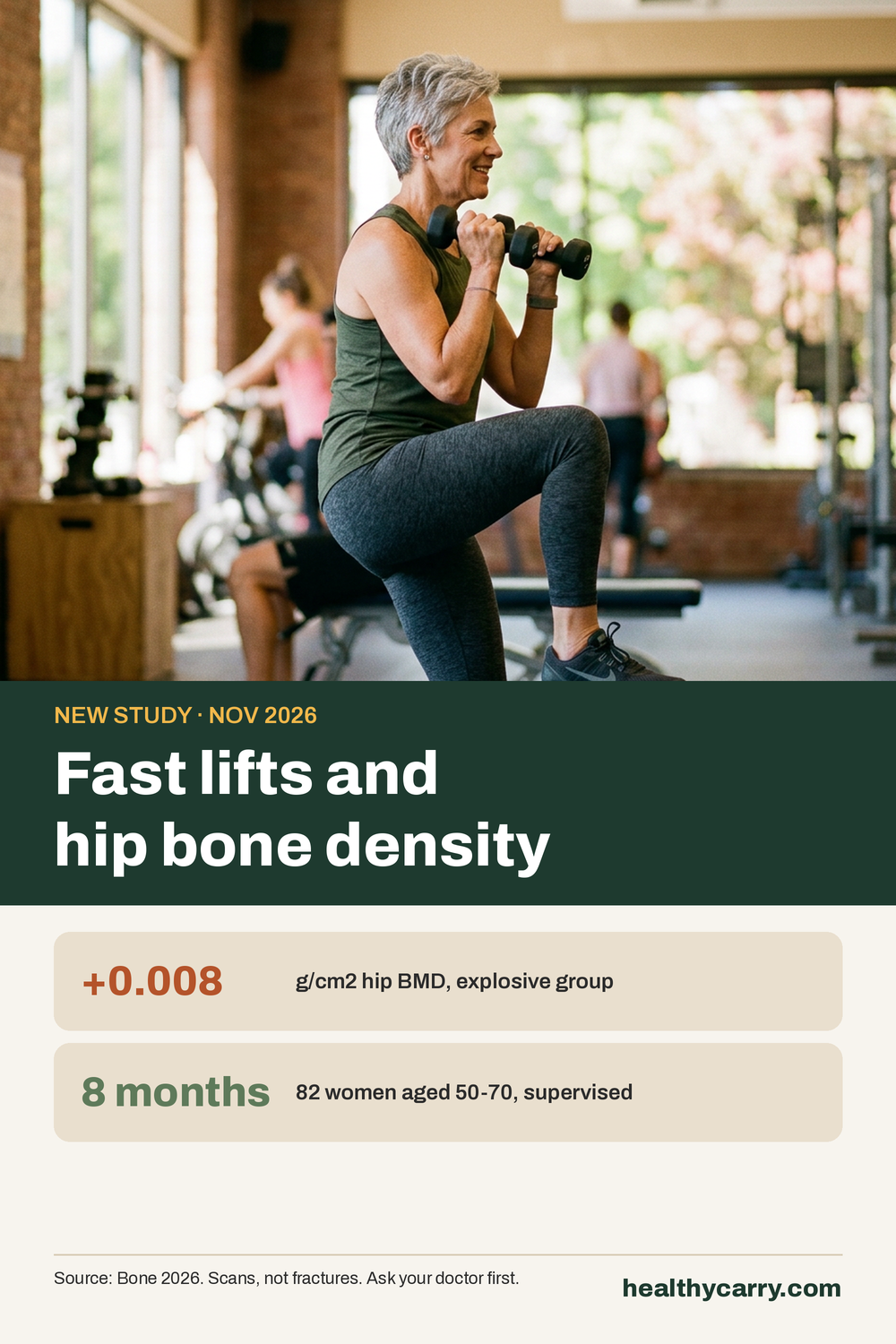
Heavy, slow lifts get all the bone-health attention. A new eight-month trial in women aged 50-70 asked a different question: what if you lift light-to-moderate weights as fast as you can? Only that group saw total hip bone density rise. Here is what it found, and what it can’t tell you.
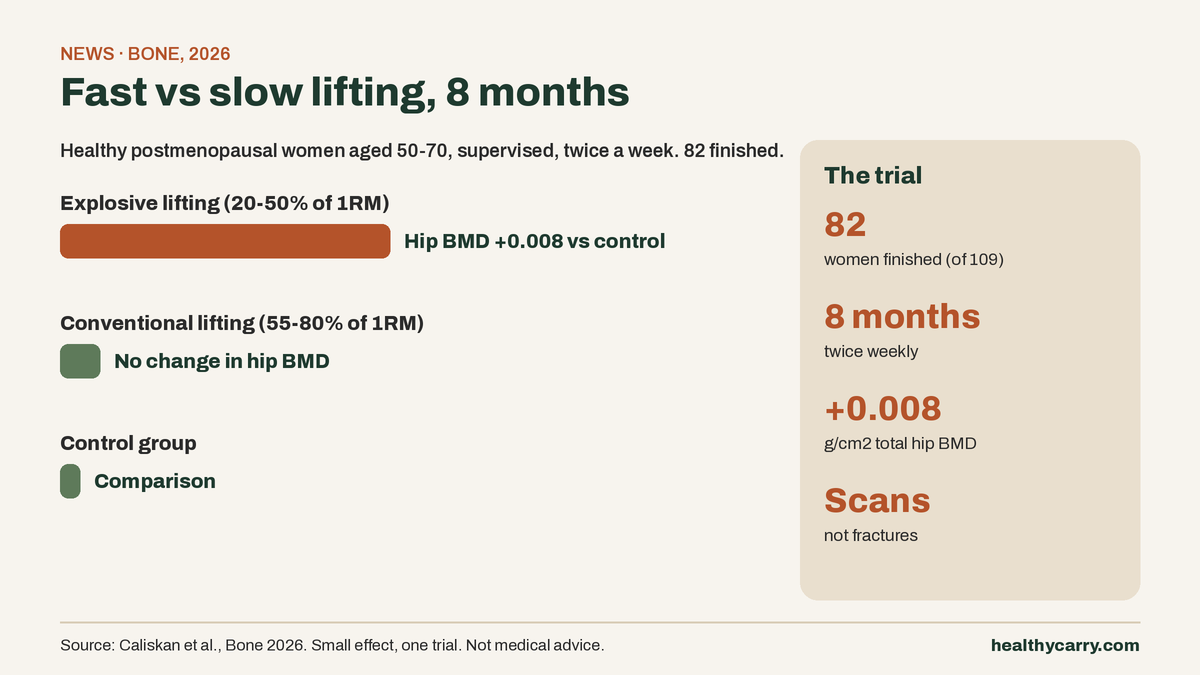
Quick answer: In a randomized trial (Bone, 2026) of 82 healthy postmenopausal women who finished, twice-weekly supervised explosive lifting (maximum speed at 20-50% of one-rep max) raised total hip bone mineral density by 0.008 g/cm2 versus controls over eight months. Conventional lifting at 55-80% did not change hip density. Bone scans, not fractures, were measured, and sessions were supervised.
What did the explosive training bone study find?
A UK-led team (Caliskan, Brooke-Wavell and colleagues) randomized postmenopausal women aged 50-70 to three groups: explosive (ballistic) resistance training, conventional resistance training, or a control group. Of 109 women randomized, 82 finished the eight months. Both lifting groups trained under supervision twice a week.
| Group | How they lifted | Reported bone result |
|---|---|---|
| Explosive | Maximum-speed lifting at 20-50% of one-rep max | Total hip BMD +0.008 g/cm2 vs control (also in women with low bone density) |
| Conventional | 55-80% of one-rep max, about 2 seconds up and 2 down | No change in hip BMD; denser outer layer of the shinbone, which also thinned as the bone widened |
| Control | No training program | Comparison group |
The size matters. 0.008 g/cm2 is small, roughly the scale seen in other exercise reviews of the hip. It is a signal, not a transformation.
Does “explosive” mean jumping or heavy lifting?
No. In this trial the weights were light to moderate (20-50% of the heaviest single lift). What was “explosive” was the intent: move the weight up as fast as possible, then lower it under control. It was done in a gym, with supervision, twice a week.
What the study can’t tell us
- No fracture data. Bone density scans don’t prove fewer broken bones.
- Dropouts. 27 of 109 women didn’t finish, which can bias results.
- Who was studied. Healthy women aged 50-70. It may not apply to men, younger women or people with osteoporosis who have restrictions.
- Supervision. Coaches checked form and load. Home results may differ.
- Source note. We read the published summary and key numbers from the journal record, not the full paper, so details like exact exercises are not covered here.
Safety first: If you have osteoporosis, a past fracture, joint problems or heart conditions, ask your doctor or a physical therapist before trying fast loaded movements. Fast does not mean sloppy; start light and learn the movement slowly.
What does this mean for rucking and walking?
Steady walking and rucking build fitness, muscle endurance and habits, and a recent BMJ review linked brisk walking to better hip and spine density. This trial hints that bones also respond to speed of loading. For ruckers, the practical translation is modest: add one or two short sessions of fast, controlled strength moves per week, such as sit-to-stand or step-ups done briskly with light weight, alongside your walks. Our own walking and bone density review and bone-formation markers explainer cover the other side of the evidence.
A simple step for this week
Pick one lower-body move you already do safely, like a sit-to-stand from a chair. Lower slowly for 2-3 seconds, stand up briskly, 2 sets of 6-8, with a light load or none. If you ruck, do it before your walk. Stop if anything hurts, and talk to a clinician about proper loading for your bones. See more training guides and our beginner rucking guide.
FAQ
Can fast lifting really improve bone density after menopause?
In this trial, explosive training raised total hip density by a small amount versus controls over eight months. One trial is a signal, not a guarantee.
Is explosive training safe for women over 50?
The women were healthy and supervised, with light to moderate loads. People with osteoporosis, fractures or joint issues should get medical advice first.
Is walking still worth it for bones?
Yes. Walking has many benefits, and a large BMJ review linked brisk walking to better hip and spine density. Lifting adds a different stimulus.
Do I need heavy weights to help my bones?
Not according to this trial: the explosive group used 20-50% of one-rep max. The conventional group used heavier loads and saw no hip change.
How often did the women train?
Twice a week for eight months, under supervision.
Want the easy version?
Get the free 4-week Start Carrying plan – one short email a week, no hype.
Sources
- Caliskan O, Marques EA, Breasail MO, et al. “Influence of ballistic and conventional resistance training on bone properties in postmenopausal women: A randomised controlled trial.” Bone, 2026. doi.org/10.1016/j.bone.2026.118172
- Summary of the trial, AgingResearch.News, Nov 15 2026: agingresearch.news
- PubMed record: PMID 43035177
- Walking and bone density in adults over 40 (BMJ review), covered in our explainer.