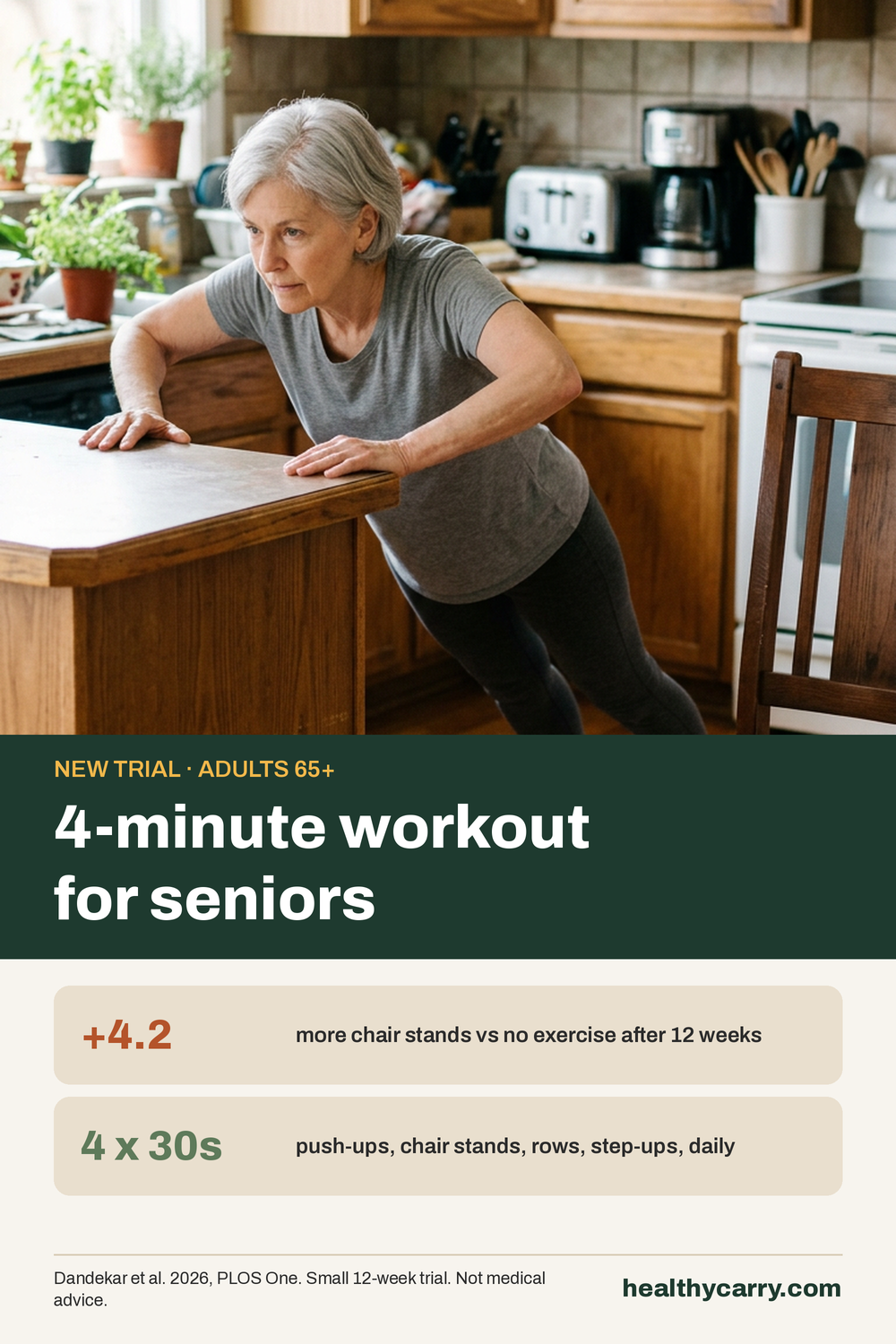
Sixty seconds. That’s how much leg training was in the daily routine of a Penn State trial that’s making the rounds again this week. Older adults who already had trouble walking a quarter mile did it at home, and after 12 weeks their 30-second chair-stand score had climbed from about 9.5 to 14.6. Most people assume getting stronger after 65 takes an hour at the gym. This study says the floor is a lot lower than that.
Quick answer: Does a 4-minute workout work for seniors? In a 2026 randomized trial in PLOS One, 97 inactive adults aged 65+ (average 74) did push-ups, chair stands, band rows and step-ups for 30 seconds each, daily. After 12 weeks they did 4.2 more chair stands in 30 seconds and balanced 3.6 seconds longer on one leg than a no-exercise group.
What did the 4-minute workout study test?
The trial is called FAST-2 (Functional Activity Strength Training). Penn State College of Medicine researchers recruited adults 65 and older who were inactive (under 60 minutes of activity a week, no strength training) and who reported difficulty walking. At the start they averaged just 18 minutes of activity per week. 68% were women.
Participants were randomly split: 44 did the routine for 12 weeks, 53 kept their usual habits and got the program afterward. Everyone was tested over video at the start, at week 6 and at week 12.
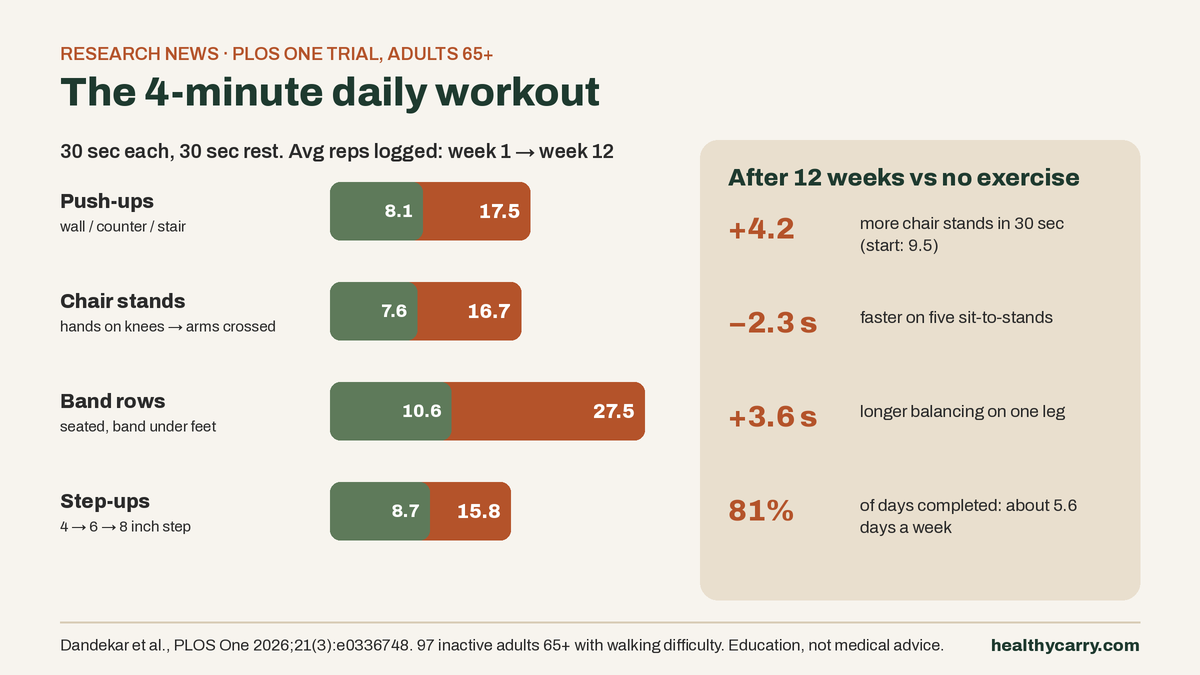
The routine itself is simple. Four moves, 30 seconds each, as many good reps as you can, with 30 seconds of rest between. Every day of the week. Here’s the exact version from the paper, including how people made each move easier or harder.
| Move (30 sec) | Easier version used | When to make it harder | Reps: week 1 → week 12 |
|---|---|---|---|
| Push-ups | Hands on the wall, a kitchen counter or a stair | At 15 reps, move hands lower (e.g., counter → stair) | 8.1 → 17.5 |
| Chair stands | Hands on knees for help | Work toward arms crossed over the chest | 7.6 → 16.7 |
| Seated band rows | Lighter band (set ran 10–40 lb) | Use the next band up | 10.6 → 27.5 |
| Step-ups | 4-inch step, hand on a wall | At 6 full step-ups in 30 sec, raise to 6, then 8 inches | 8.7 → 15.8 |
Source: Dandekar S, et al., PLOS One 2026. Rep counts are the averages participants logged during their daily workouts. Chair: sturdy, armed, no wheels, seat about 17 inches high, on carpet or against a wall.
How much did strength and balance improve?
The team used three standard tests that clinicians use to flag fall risk and future mobility problems. Compared with the control group, the exercisers improved on all three.
| Test | Exercise group, start | Change vs control at 12 weeks | Is that meaningful? |
|---|---|---|---|
| 30-second chair stand | 9.5 reps | +4.2 reps (95% CI 2.8–5.7) | Yes. About 2 reps is the commonly cited minimum important change |
| Five-times sit-to-stand | 12.2 sec | 2.3 sec faster (0.5–4.1) | Right at the 2.3-sec threshold the authors cite |
| One-leg stance | 7.3 sec | +3.6 sec (0.6–6.5) | Helpful, from a starting point that signals balance risk |
Two other numbers stand out. People did the workout on 81% of days, or about 5.6 days a week. And only 11% of the exercise group dropped out, versus 28% of the control group. Short, it turns out, is easy to repeat.
Effort stayed moderate. On a 0–10 scale, chair stands felt like a 3.2 at the start and a 4.6 by the end.
For context: in a different trial we covered, women 60–80 who added a weighted vest to dance classes gained 6.4 chair-stand reps in eight weeks. Different people, different program, but the same lesson. Older legs respond fast when you give them a reason.
What the study can’t tell us
- It was tested on a specific group. Adults 65+ with existing walking difficulty, internet access and a clean heart-risk screen. A fit 50-year-old would likely need more challenge to see similar gains.
- Nobody was blinded. Participants and the staff running the tests knew who exercised. A blinded second rater reviewed the videos, but some bias is possible.
- There was coaching. Four short Zoom check-ins, daily email reminders and a log. “Four minutes” also came with accountability. Doing it alone may stick less.
- Only 12 weeks, and only function tests. No data on falls, bone, heart health or body composition. The authors say plainly it doesn’t show four minutes is enough for those.
- Small and with a disclosed interest. 97 people. The lead author is part-owner of companies formed to commercialize findings from exercise studies.
- Some aches happened. Seven adverse events in 2,994 sessions (about 1 per 427), all joint- or muscle-related, shoulders most often. Most meant skipping a workout or two.
What it means for you
If you’re 65+ and mostly inactive, this is a real, evidence-backed place to start. If you’re 40–60 and already walking, think of it as a daily floor, not the whole house.
- It’s not a replacement for the guidelines. US guidelines still call for muscle-strengthening work at least 2 days a week plus about 150 minutes of moderate activity, and balance work for older adults. Four minutes is a door, not the destination.
- Pair it with walking. The study’s people struggled to walk. Getting stronger at chair stands is exactly what makes longer walks possible. Our beginner rucking guide picks up from there.
- Add load later, not first. Once 15+ chair stands feel easy, carrying something is a natural next step. A light farmer’s carry or a light vest walk trains the same “get up and go” strength in real life. That’s our suggestion; this trial didn’t test it.
Safety first: The trial screened out people with chest pain on a standard questionnaire. If you have heart symptoms, recent surgery, frequent falls or use a walker, check with your clinician first. Put the chair against a wall, the step in a corner, and stop if pain changes how you move.
Your step this week: test, then start
- Day 1, test. Sit in a sturdy chair, arms crossed. Count full stands in 30 seconds. Write it down. (In this trial, the exercisers started at 9.5.)
- Days 1–7, do the four moves. 30 seconds on, 30 seconds off. Pick the easier version of each that lets you move with good form.
- Log your reps. The participants’ counts roughly doubled in 12 weeks. Watching that number climb is the motivation.
- Retest at week 6 and week 12. A gain of 2+ chair stands is a meaningful change.
More plans like this live in Train.
FAQ
What are the 4 exercises in the 4-minute workout for seniors?
Push-ups (on a wall, counter or stair if needed), chair stands, seated two-arm rows with a resistance band looped under the feet, and step-ups on a 4- to 8-inch step. Each is done for 30 seconds with 30 seconds of rest, once a day.
Does the 4-minute workout really work?
In one 97-person randomized trial of inactive adults 65+ with walking difficulty, it improved chair-stand, sit-to-stand and one-leg balance scores in 12 weeks. That’s promising but limited: one small, unblinded, 12-week study with coaching support.
How many chair stands should a 70-year-old be able to do?
Norms vary by age and sex, but the study authors note scores below about 10–12 in 30 seconds often signal higher fall risk. The trial’s exercisers rose from about 9.5 to 14.6. Track your own number over time rather than chasing a single cutoff.
Is 4 minutes of exercise a day enough?
Enough to improve leg strength and balance in very inactive older adults, according to this trial. Not enough, on its own, to meet guidelines for heart health or to change body composition, which the researchers did not test. Use it as a start and build from there.
Can I do the 4-minute workout if I’m in my 40s or 50s?
Yes, but it was tested on people 65+ with walking difficulty. If you’re younger and active, use the harder versions (floor push-ups, arms-crossed chair stands, 8-inch step) or add a light carry or vest walk on other days.
Get the free 4-week Start Carrying plan: a printable walking-and-carry plan with a weekly log, plus one evidence-checked tip each week in Load Notes.
Sources
- Dandekar S, Kurth J, Shang Y, et al. “Brief daily functional strength training to improve functional performance in older adults with mobility disability: A randomized trial.” PLOS One 2026;21(3):e0336748. doi:10.1371/journal.pone.0336748. journals.plos.org
- Penn State. “Four-minute daily workout improves strength, balance in older adults.” June 9, 2026. psu.edu
- ScienceDaily. “Just 4 minutes a day can dramatically improve strength after 65.” October 21, 2026. sciencedaily.com
- ClinicalTrials.gov. NCT05697497, Functional Activity Strength Training. clinicaltrials.gov
- Sciamanna CN, et al. “Feasibility and impact of a 1-minute daily functional exercise regimen prescribed to older adults by their primary care physician.” Prev Med Rep 2021;21:101307. doi.org
- Jones CJ, Rikli RE, Beam WC. “A 30-s chair-stand test as a measure of lower body strength in community-residing older adults.” Res Q Exerc Sport 1999;70(2):113-9. doi.org
- CDC. “Adding physical activity as an older adult.” cdc.gov
- US Department of Health and Human Services. Physical Activity Guidelines for Americans, 2nd edition. health.gov