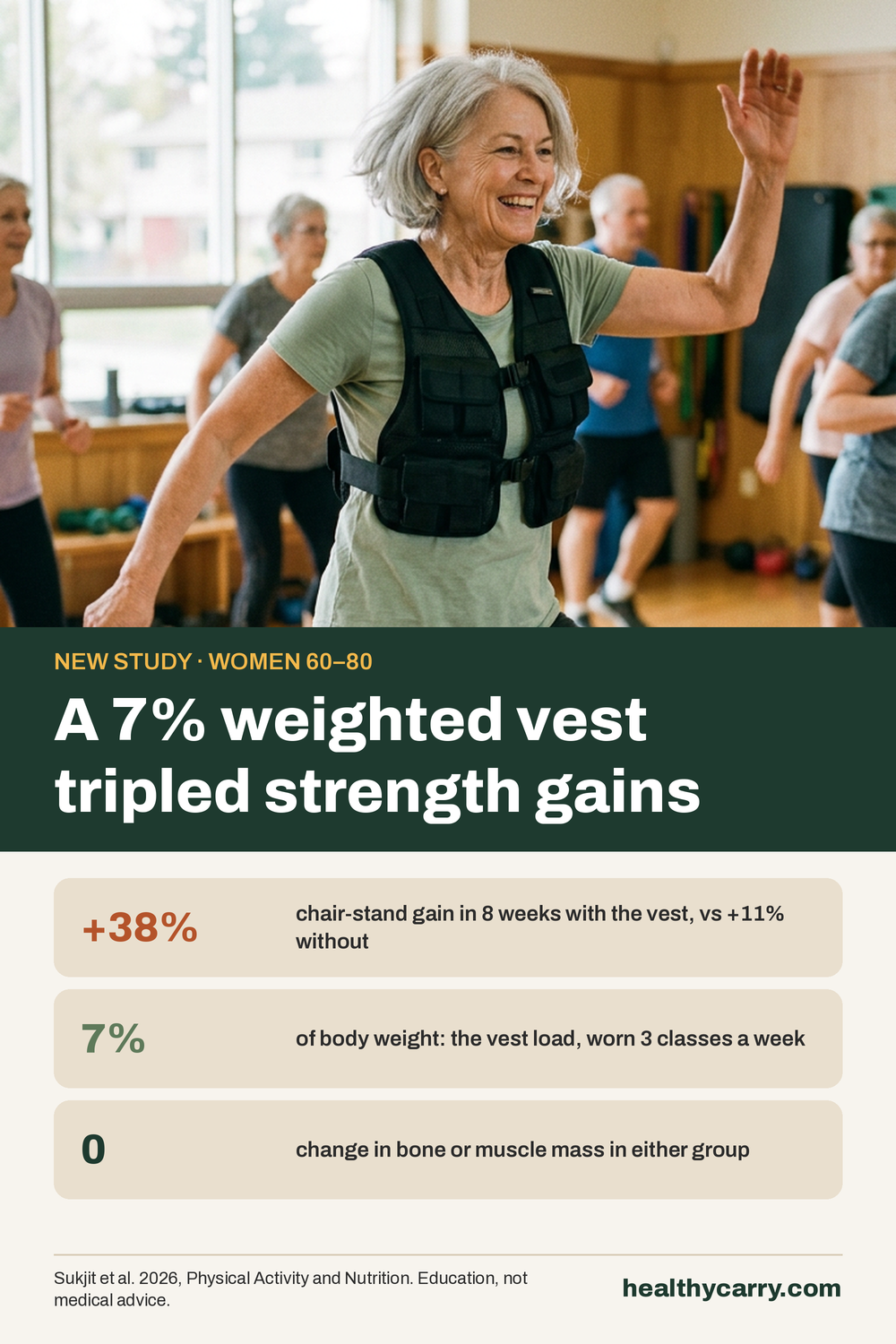
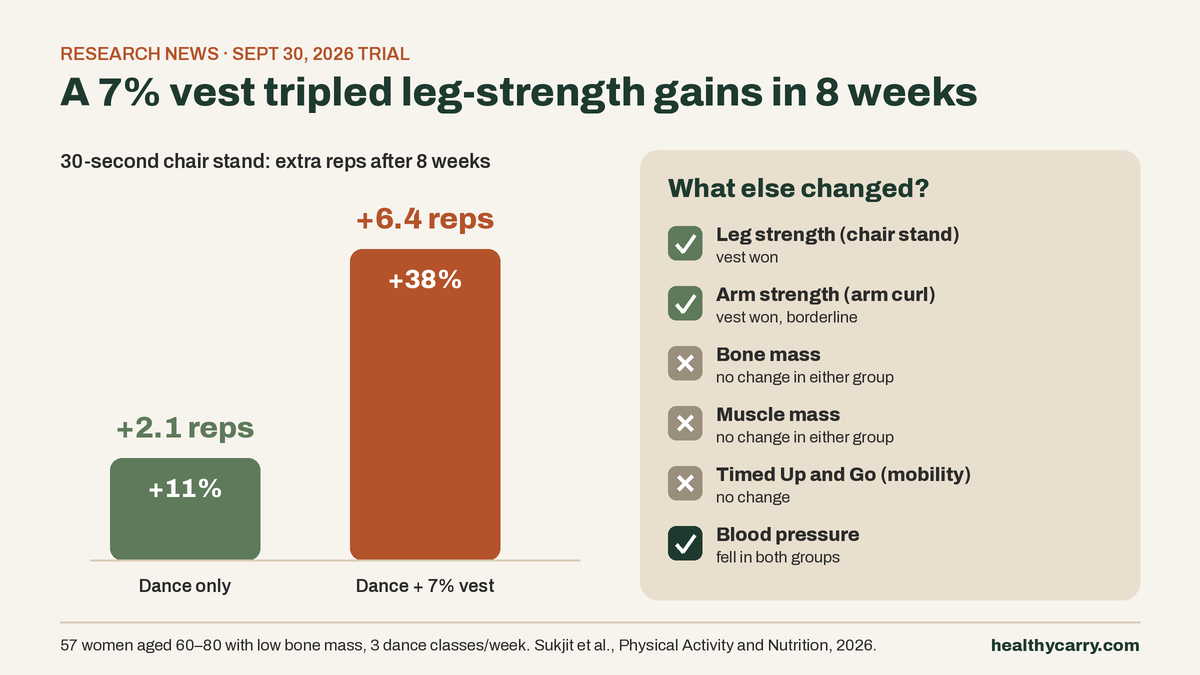
Fifty-seven women aged 60 to 80, all with low bone mass, did the same 50-minute dance class three times a week for eight weeks. Half of them wore a vest loaded to 7% of their body weight. The vest group’s chair-stand score jumped by 6.4 reps, three times the 2.1-rep gain in the no-vest group. Their bone readings didn’t move at all.
Quick answer: A randomized trial published September 30, 2026 found that adding a 7% body-weight vest to aerobic dance tripled leg-strength gains: +38% vs +11% on the 30-second chair-stand test. Bone mass and muscle mass didn’t change in either group. The vest looks like a strength tool in the short term, not a bone fix.
What did the new weighted vest study test?
The trial ran at Uttaradit Rajabhat University in northern Thailand and was published in the journal Physical Activity and Nutrition. Researchers recruited community-dwelling, postmenopausal women aged 60 to 80 with low bone mass and an elevated fracture-risk score. None had exercised regularly in the previous six months.
Everyone did the same program: 24 instructor-led aerobic dance sessions over eight weeks (Monday, Wednesday, Friday). Each class had a 10-minute warm-up, 30 minutes of dance and a 10-minute cool-down, at a “somewhat hard to hard” effort. In weeks 5 to 8 the choreography got more complex and the music faster.
The only difference: 29 women wore an adjustable vest set to exactly 7% of their starting body weight. For a 150-lb (68 kg) woman, that’s about 10.5 lb (4.8 kg). The other 28 danced without one. Attendance was excellent, with every analyzed participant making at least 22 of 24 sessions.
What changed, and what didn’t?
| Measure (8 weeks) | Dance only | Dance + 7% vest | Vest made a difference? |
|---|---|---|---|
| 30-second chair stand | +2.1 reps (+11%) | +6.4 reps (+38%) | Yes |
| Arm curl (30 s, 5-lb dumbbell) | +3.6 reps | +6.4 reps | Yes, borderline |
| 2-minute step test | +54.6 steps | +78.8 steps | No (both improved) |
| Timed Up and Go (balance and mobility) | No change | No change | No |
| Systolic blood pressure | −5.1 mmHg | −6.7 mmHg | No (both improved) |
| Bone mass (scale estimate) | No change | No change | No |
| Muscle mass | No change | No change | No |
HealthyCarry summary of Tables 2 and 3 in Sukjit et al., 2026. “Yes” means a statistically significant group-by-time interaction.
No injuries or cardiovascular events were reported in either group. For women already at higher fracture risk, that’s worth noting.
Why would strength rise if muscle and bone didn’t?
Eight weeks is short. In the first weeks of any strength program, most gains come from your nervous system: better coordination and more muscle fibers recruited per movement. Visible muscle growth and bone remodeling take months. The authors say this directly and point to earlier work showing bone changes in postmenopausal women typically need 24 weeks or more of high-impact training.
The chair-stand result still matters. Getting up from a chair is a real-life strength task, and leg strength is one of the main things that predicts falls. The study didn’t measure falls, though, so you can’t say the vest prevents them.
How does this fit with the bigger research picture?
It lines up with a 2026 meta-analysis in Osteoporosis International that pooled nine randomized trials (368 middle-aged and older adults). Vest-plus-exercise programs improved hip and spine bone density compared with usual activity, and cut body fat by about 2.7 kg. But compared with the same exercise done without a vest, the vest added a little extra fat loss (about 0.7 kg) and no confirmed bone benefit. That last point rested on a single study.
The largest vest trial so far, INVEST in Bone Health (JAMA Network Open, 2025), found that wearing a vest during a year of weight loss did not prevent hip bone loss in older adults. The pattern across studies is consistent: the exercise does the heavy lifting, and the vest makes that exercise harder.
What the study can’t tell us
- Bone was estimated, not scanned. The team used a bioimpedance scale, not a DXA scan, so small bone changes could have been missed.
- Effort wasn’t equal. Intensity was tracked by how hard it felt, not by heart rate. The vest group likely worked harder overall, which may explain part of the gain.
- It was short and supervised. Eight weeks, with an instructor. Heavier vests or unsupervised home sessions could look different.
- One group of women. Results apply to healthy, community-dwelling Thai women aged 60 to 80 with low bone mass, not to men or people with advanced osteoporosis.
- Many outcomes, no correction. The authors tested lots of measures without adjusting for multiple comparisons, so the borderline arm-curl result needs caution.
What it means for you
If you already do a class or a routine you enjoy, a light vest is a reasonable way to make it count for more strength. The dose here was modest: 7% of body weight, worn for a 50-minute session, three times a week. That’s in the same range we suggest in our weighted vest walking guide (start at 3–5%, stay at or under about 10%).
What a vest won’t do on its own is rebuild bone in two months. For bone, the strongest evidence still points to progressive strength training plus impact work over many months. Loaded carries are an easy place to start; see our guide to how much weight to use for a farmer’s carry.
Safety first: If you’ve been diagnosed with osteoporosis, have had a spine fracture, or have back, neck, hip or knee problems, check with your clinician or a physical therapist before adding a vest. Keep the vest snug and high on your torso, and stop if you feel pain rather than effort.
Your step for this week
Do a 30-second chair-stand test today: arms crossed, stand fully and sit back down as many times as you safely can in 30 seconds. Write the number down. Then wear a vest at 5–7% of your body weight for two of your usual workouts this week (or try your first ruck). Retest in four weeks. It’s the same test this study used, so you’ll know if it’s working for you.
FAQ
Does wearing a weighted vest increase bone density?
Not on its own in the short term. In this 8-week trial, bone mass didn’t change. Over longer periods, vest-plus-exercise programs beat doing nothing, but adding a vest to the same exercise hasn’t shown a confirmed extra bone benefit.
How heavy was the vest in the study?
Exactly 7% of each woman’s starting body weight, kept the same for all eight weeks. For someone who weighs 150 lb (68 kg), that’s about 10.5 lb (4.8 kg).
Is a weighted vest safe for women with low bone mass?
In this supervised trial, no injuries were reported with a 7% vest. That safety finding applies only to that load and setting. If you have osteoporosis or a past fracture, ask your clinician or a physical therapist first.
What is the 30-second chair stand test?
You sit in a standard chair with arms crossed over your chest and stand up fully, then sit back down, as many times as you can in 30 seconds. It’s part of the Senior Fitness Test and a simple measure of leg strength.
Can I get the same benefit from walking with a vest?
We don’t know yet. This trial used dance, which includes stepping, turning and direction changes. Flat walking is a gentler stimulus. Adding hills, stairs or strength moves while wearing the vest gives your legs more to adapt to.
Get the free 4-week Start Carrying plan: a printable plan with a weekly log, plus one evidence-checked carrying tip each week in Load Notes.
Sources
- Sukjit S, Choktaweepanich B, Thuwakum W. “Efficacy of a weighted-vest aerobic dance intervention for enhancing lower extremity strength and mobility in older adults: a randomized controlled trial.” Physical Activity and Nutrition 2026;30(3):73-80, published September 30, 2026. doi:10.20463/pan.2026.0042 (full text PDF)
- Wang X, et al. “Effects of weighted vest on bone health and body fat in middle-aged and older adults: a systematic review and meta-analysis.” Osteoporosis International (2026). doi:10.1007/s00198-026-08196-y
- Beavers KM, et al. “Weighted Vest Use or Resistance Exercise to Offset Weight Loss–Associated Bone Loss in Older Adults: A Randomized Clinical Trial.” JAMA Network Open (2025). PubMed 40540267
- Luo H, et al. “Weighted vest interventions in older adults: a mini-review of implementation, benefits, and limitations.” Frontiers in Public Health (2026). PMC13056602
- Snow CM, et al. “Long-term exercise using weighted vests prevents hip bone loss in postmenopausal women.” Journals of Gerontology (2000). PubMed 10995045
- Centers for Disease Control and Prevention. “Adult Activity: An Overview.” cdc.gov