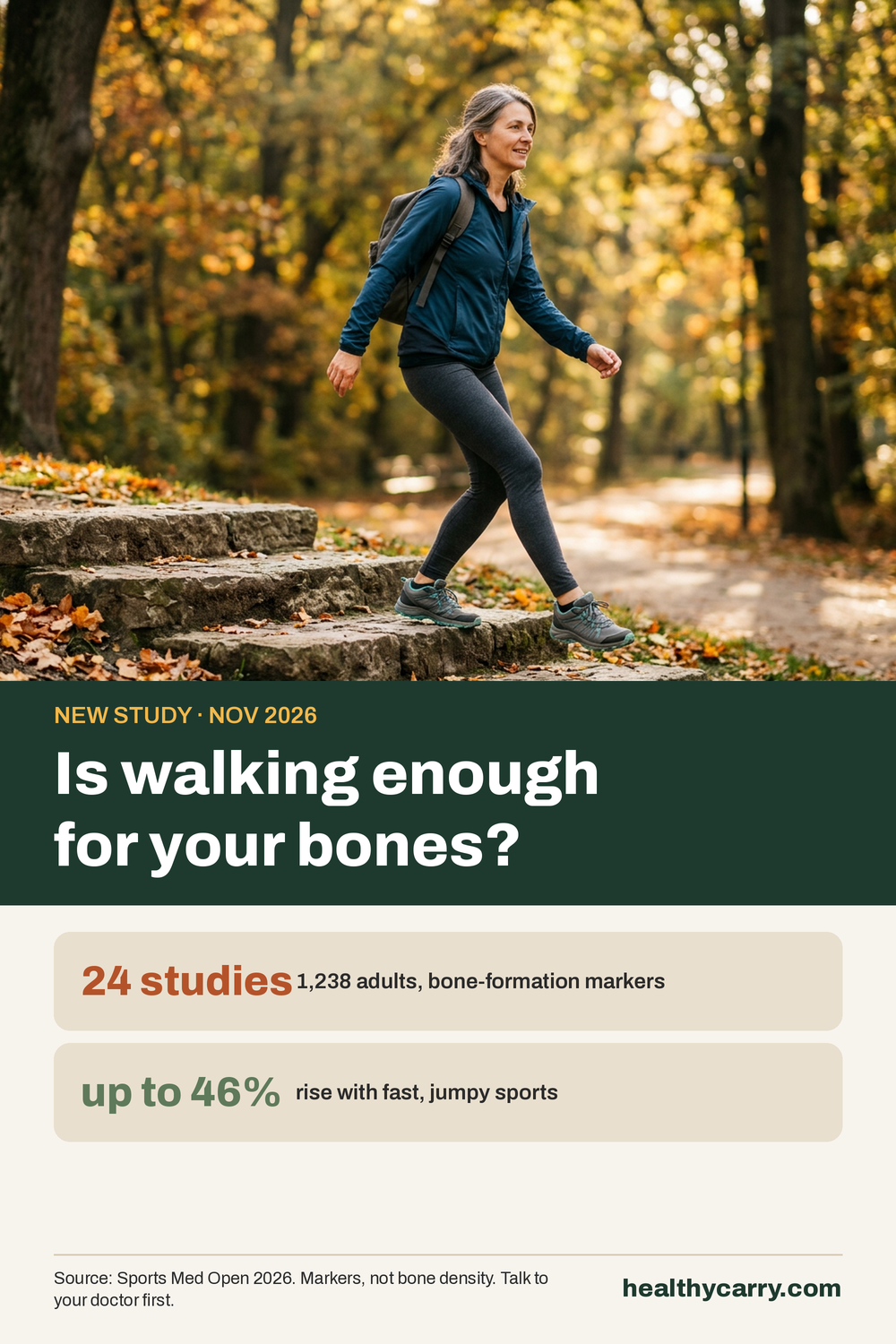
You walk, maybe you lift. Surely your bones are happy? A new meta-analysis says it may not be that simple: in 24 studies, walking and standard gym lifting barely moved blood markers of bone building, while fast, jumpy sports moved them by up to 46%. Here is what that does and doesn’t mean for you.
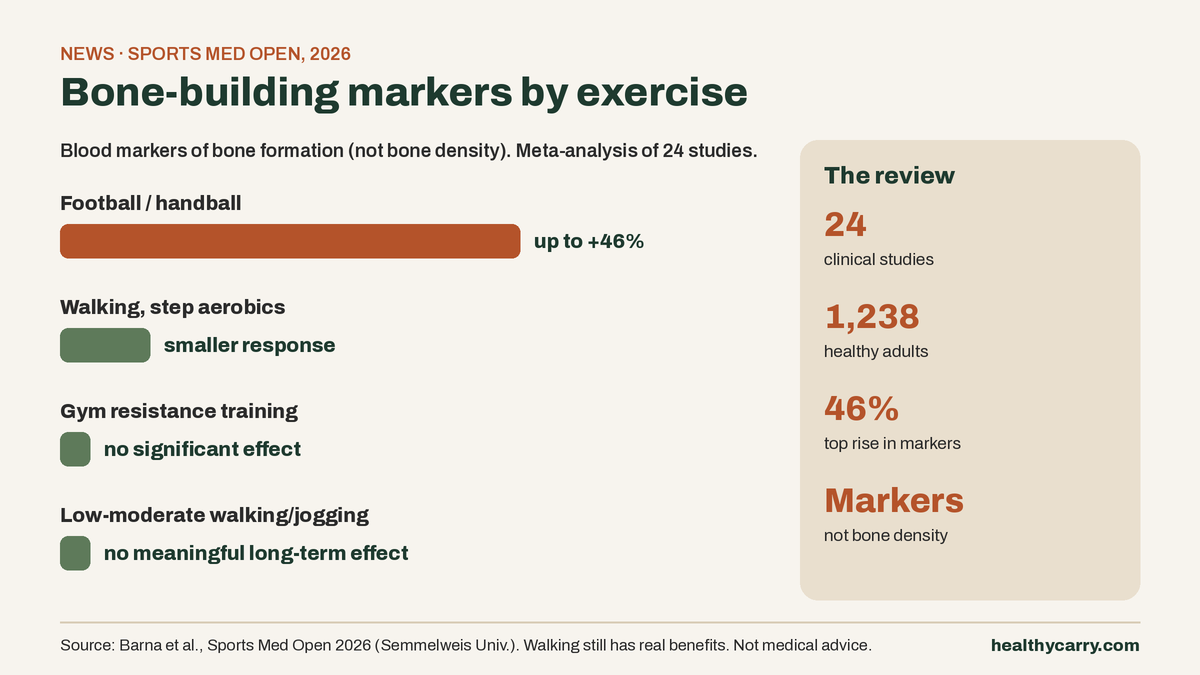
Quick answer: A meta-analysis from Semmelweis University (Sports Medicine – Open, 2026) pooled 24 clinical studies with 1,238 healthy adults and looked at blood markers of bone formation, not bone density. Sports with sudden acceleration and direction changes, like recreational football and handball, were linked to rises of up to 45-46%. Walking, jogging and standard resistance training showed no meaningful long-term effect on those markers. It does not mean walking is useless: it’s about bone-building signals only.
What did the new bone study find?
Researchers at Semmelweis University in Budapest reviewed “High-Intensity Training Increases Osteocalcin Levels: A Meta-Analysis of Effects of Exercise on Bone Remodeling biomarkers”. Instead of waiting for slow bone density scans, they compared blood markers of bone remodeling, which respond within weeks. They also split results by exercise type, intensity, frequency and duration.
| Measure | What was reported |
|---|---|
| Studies pooled | 24 clinical studies |
| People | 1,238 healthy adults |
| What was measured | Blood markers of bone formation (e.g., osteocalcin), not bone mineral density |
| Strongest response | Recreational football and handball: up to 45-46% higher bone-formation markers |
| Walking, step aerobics, gym resistance training | Smaller responses; resistance training showed no significant effect on the markers |
| Low/moderate endurance (walking, jogging) | No meaningful long-term effect on the markers |
The press summary describes the key feature of the winning sports: repeated bursts of acceleration, sharp turns and quick changes in direction. That kind of movement puts bigger, more varied forces through the skeleton than steady walking does.
Does this mean walking is bad for your bones?
No, and the authors say so. They stress that walking and other lower-intensity activity still carry real health benefits. The finding is narrower: steady, low-impact activity alone may not give bones the strongest building signal. Bone responds to force that is new and sudden, not just to time on your feet.
What this means if you walk or ruck
- Keep walking. It’s good for your heart, mood and mobility. Treat it as your base, not your whole bone plan.
- Add some variety, gently. Brisk intervals, 3-fast-3-slow walking, stair climbs and hills add more varied loading than a flat, steady stroll. That’s our reading of the idea, not something this study tested.
- Don’t count on weight alone. In a 2025 trial, wearing a weighted vest about 7 hours a day did not prevent hip bone loss during weight loss. See our summary of the weighted vest study on leg strength and bone density.
- Strength training still matters for muscle. The study measured bone markers, not muscle, balance or falls, so it says nothing against lifting.
What can’t this study tell us?
- Markers aren’t bone density. A blood marker going up soon after training doesn’t prove stronger bones years later. The authors say the results “suggest” a possible early benefit.
- Healthy adults only. Most people studied weren’t dealing with osteoporosis, so don’t assume the results apply to you if you are.
- A meta-analysis mixes designs. Pooled studies differ in people, timing and measures. We read the university’s summary and the abstract-level findings, not every table in the full paper.
- Sports carry injury risk. Sudden changes of direction are harder on joints than walking.
Safety first: If you have osteoporosis or osteopenia, heart or joint problems, or you haven’t been active lately, talk to your doctor or a sports medicine professional before adding fast, jumpy or high-impact work. Build up slowly. This article is general information, not medical advice.
A gentle way to add variety this week
- Keep your usual walks.
- Once or twice a week, add 4-6 short brisk pushes of 30-60 seconds, with easy walking between.
- Add a hill or a set of stairs if your knees feel fine. Skip jumping and sharp turns unless your clinician has cleared you.
Get the free 4-week Start Carrying plan: a printable plan with a weekly log, so your next few weeks are easy to track.
Sources
- Barna V, Makolli A, Pásztorné Benyó Z, et al. “High-Intensity Training Increases Osteocalcin Levels: A Meta-Analysis of Effects of Exercise on Bone Remodeling biomarkers.” Sports Medicine – Open 2026;12(1). doi.org/10.1186/s40798-026-00986-2
- Semmelweis University, “Walking and weight training may not be enough to keep your bones strong,” ScienceDaily, November 11, 2026. sciencedaily.com
- Beavers KM et al. INVEST in Bone Health trial, JAMA Netw Open, 2025 (weighted vest, 150 older adults, 12 months), as summarized in our weighted vest study article.